When the College Football Playoff bracket was unveiled, there were matchups that felt intriguing, some that felt predictable, and one that immediately carried extra weight. Oklahoma versus Alabama wasn’t just another pairing on the board — it felt like the reopening of a conversation that never really ended.
Most playoff games are about possibility. This one is about memory.
Just weeks ago, these two programs met under very different circumstances, and Oklahoma walked away with a 23–21 win that rattled assumptions across the sport. That result didn’t just affect rankings or résumés. It altered how both teams view themselves and each other. Now, with the postseason spotlight intensifying everything it touches, the rematch arrives not as a novelty, but as a reckoning.
This is not a game that needs hype. It already has history.
College Football Playoff games typically thrive on unfamiliarity. Fans tune in to see styles clash, conferences collide, and unknown dynamics reveal themselves in real time. Oklahoma and Alabama don’t have that luxury — or that insulation.
They’ve already been through the emotional furnace once.
This isn’t about learning who the opponent is. It’s about deciding what to do now that you already know.
Both coaching staffs enter this game with a detailed understanding of what worked, what failed, and what was left on the table. There are no clean slates here, only revisions. Every adjustment Alabama makes will be measured against November. Every Oklahoma decision will be scrutinized for whether it leans into confidence or invites risk.
That familiarity changes everything. It removes excuses. It magnifies pressure. And it transforms what could have been a routine first-round matchup into something far more personal.
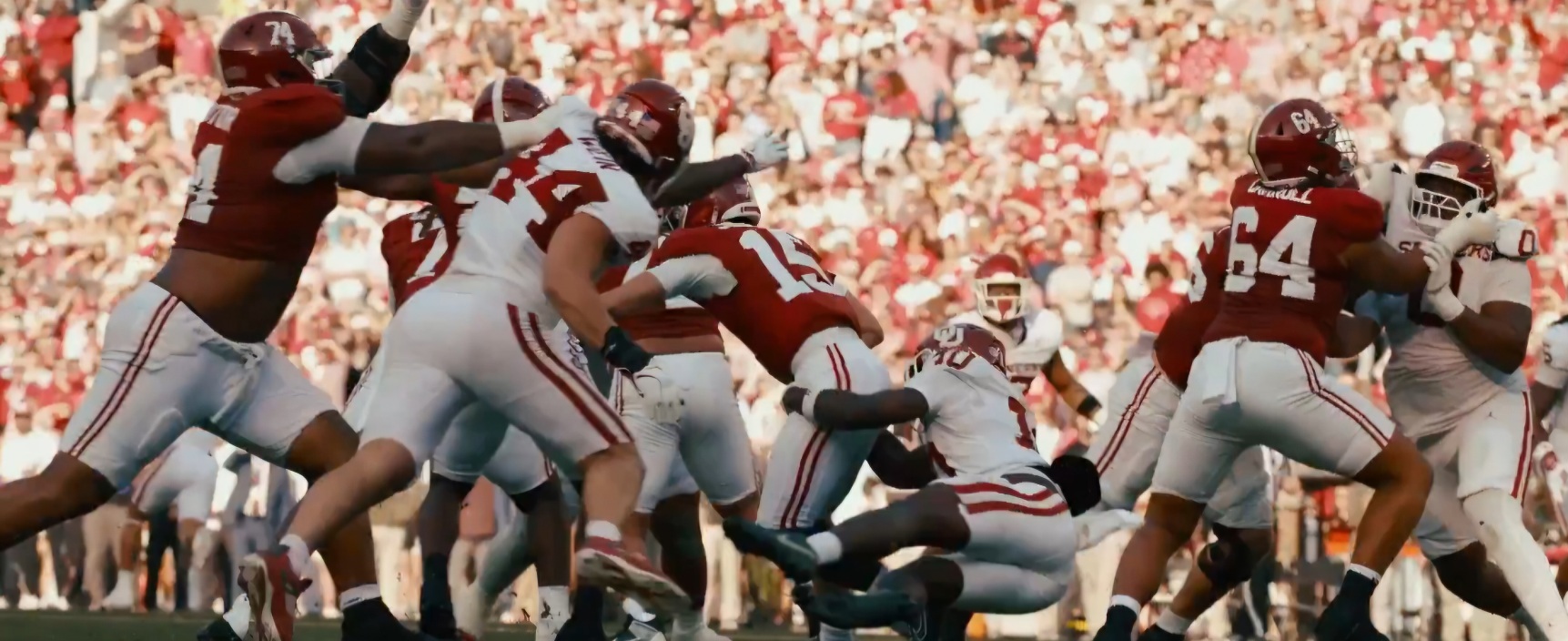
The first meeting between Oklahoma and Alabama didn’t unfold like a classic shootout or a perfectly executed masterpiece. It was messy, physical, and tense — the kind of game where momentum never fully settles and every mistake feels heavier than the last.
Alabama entered that contest expecting to assert control. Instead, it spent much of the night reacting.
Oklahoma didn’t overwhelm the Crimson Tide with gaudy numbers or explosive dominance. It did something arguably more impressive: it stayed composed. The Sooners capitalized on opportunities, protected their position when it mattered most, and forced Alabama to play outside of its preferred rhythm.
Turnovers played a pivotal role, but they weren’t flukes. They were moments created by discipline and anticipation. Oklahoma’s defense didn’t just wait for Alabama to stumble — it forced errors, then turned those moments into tangible advantages.
That 23–21 final score still lingers because of what it represented. It wasn’t a lucky escape. It was proof that Oklahoma could stand toe-to-toe with a program long considered the sport’s measuring stick and emerge unflinching.
That truth doesn’t disappear just because the calendar flips to December.
Rematches are uncommon in the playoff era for a reason. The sport is built to avoid repetition at its highest level, favoring fresh intrigue over immediate revisits. When rematches do happen, they bring with them a unique volatility.
Familiarity eliminates surprise, but it amplifies consequence.
Every tendency is known. Every weakness has been studied. Every strength has been targeted. Adjustments become necessary, but adjustments also invite vulnerability. Change too little, and you’re predictable. Change too much, and you risk unraveling what made you successful in the first place.
There’s also the emotional residue that statistics can’t capture. Players remember the hits, the missed chances, the moments where momentum slipped away. Coaches remember the calls they’d like back. Those memories influence decisions in ways that don’t always show up on a game plan.
There’s an old saying that beating the same team twice is harder than beating them once. Whether or not that’s universally true, it speaks to the reality that rematches are less about raw talent and more about mental clarity. The team that handles the weight of memory better often gains the edge.
That’s what makes this game dangerous — for both sides.
Oklahoma and Alabama arrive at this rematch from entirely different psychological places, and that contrast may matter as much as any schematic adjustment.
For Oklahoma, belief has replaced doubt. The Sooners don’t have to imagine what competing with Alabama feels like anymore — they’ve already done it, and they’ve already won. That knowledge frees a team in subtle but powerful ways. It reduces hesitation. It sharpens decision-making. It allows players to trust what they see rather than fear what might happen.
There’s a lightness that comes with having already crossed a line you weren’t sure you could cross.
Alabama, meanwhile, carries a different weight. The Crimson Tide enter this game not chasing validation, but restoration. The November loss challenged assumptions about inevitability and control. Now, the pressure isn’t just to advance — it’s to reassert identity.
That kind of pressure can be motivating, but it can also tighten margins. When expectations loom large, mistakes feel heavier, and patience can erode faster than usual. Alabama isn’t discovering who it is in this game; it’s trying to remind everyone else.
That difference matters.
One team is playing to confirm a reality it already experienced. The other is playing to undo one it didn’t expect.
The stakes of this matchup stretch beyond the immediate result.
For Oklahoma, another win would signal more than playoff progress. It would represent a defining moment in how the program is perceived in the modern CFP era — not as a participant hoping to hang around, but as a contender capable of shaping the postseason itself. Wins like these linger in memory. They become reference points for future seasons.
For Alabama, the game offers a chance to reassert order. A victory wouldn’t erase the November loss, but it would contextualize it — reframing that night as a temporary disruption rather than a lasting shift. For a program built on sustained dominance, controlling narrative is almost as important as controlling the scoreboard.
And for the playoff itself, this game carries the potential to define the tone of the entire bracket. It has the feel of a hinge point — the kind of contest that reminds everyone why expanded playoffs can elevate drama instead of diluting it.
December 19 will arrive with layers already baked in. This won’t be a game decided solely by matchups or metrics. It will be shaped by memory, confidence, restraint, and timing.
Over the coming days, the focus will narrow. Tactical wrinkles will be analyzed. Individual matchups will be dissected. But none of that exists in a vacuum. Every decision made on that field will echo with the knowledge of what happened before.
The first meeting between Oklahoma and Alabama asked a simple question: could the Sooners compete?
The rematch asks something far more unsettling — for both sides.
And that’s what makes this game feel different.
Follow us on Instagram & Facebook