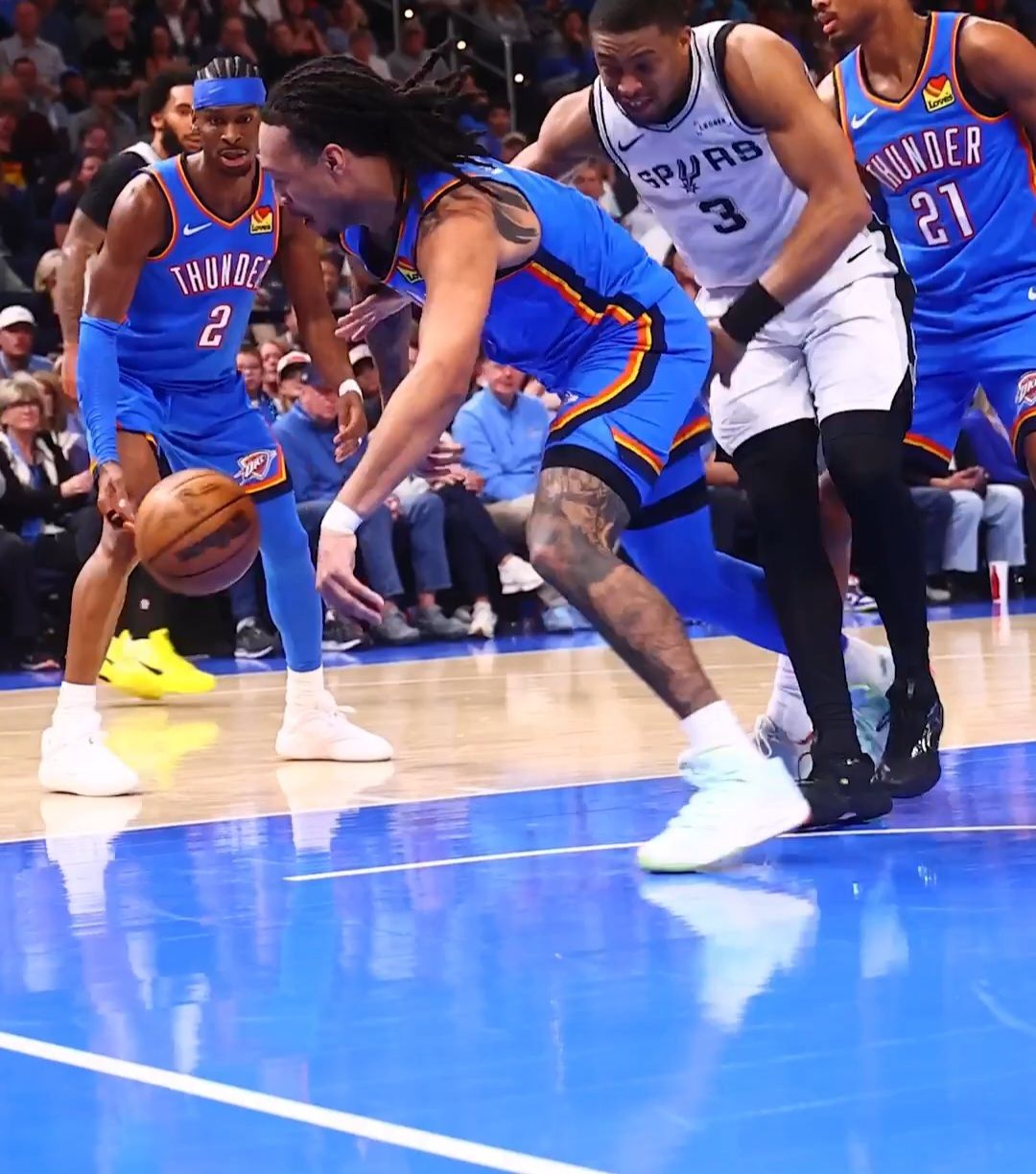
For two and a half quarters Tuesday night, the Oklahoma City Thunder were playing a familiar but uncomfortable role.
They were the defending champions. They were the best team in the Western Conference. They were at home. And yet, against the San Antonio Spurs, they were still searching for something they hadn’t yet claimed this season: control.
That’s what made the third quarter of Oklahoma City’s 119–98 win over San Antonio so important. Not because it was explosive. Not because it was dominant. But because it was corrective.
For the first time this season against their rising Western Conference rival, the Thunder didn’t just survive the Spurs—they imposed themselves on them.
And that matters.
The Spurs had already beaten Oklahoma City three times this year. One of those wins snapped a 16-game Thunder winning streak in December. Another came with a physical edge that clearly lingered. San Antonio hadn’t just matched OKC—they had gotten under their skin. You could feel it in the tone of this game: 48 fouls, three technicals, constant chirping, bodies on the floor.
This wasn’t just another January night. It was unfinished business.
That’s why the third quarter wasn’t merely a run. It was a response.
At halftime, the game was still undecided. No double-digit lead. No sense of separation. Just two teams circling each other, probing for weakness. San Antonio believed—rightfully so—that they could go toe-to-toe again. Oklahoma City knew something had to change.
Then the champions remembered who they were.
The Thunder opened the second half with an 11–0 run, a burst fueled by defensive pressure that immediately altered the rhythm of the game. San Antonio responded, as good teams do, with a quick 7–0 spurt of their own. Victor Wembanyama collided knee-to-knee with Shai Gilgeous-Alexander and briefly went to the bench. The moment felt precarious—like the kind of inflection point where a game can swing either way.
Oklahoma City made sure it only swung one direction.
What followed was the defining stretch of the night: a 14–1 Thunder run that effectively ended the contest before the fourth quarter even began. By the time the dust settled, OKC had turned a competitive game into a 19-point advantage, 95–76, and San Antonio never threatened again.
This wasn’t about shot-making variance or lucky bounces. It was about force.
The Thunder outscored the Spurs 40–24 in the third quarter by doing what championship teams do when they sense resistance—they tightened the screws. Passing lanes disappeared. Dribble penetration became claustrophobic. San Antonio’s offense, which had looked comfortable earlier, suddenly felt rushed and disjointed.
Over the final two quarters, the Spurs scored just 40 points total.
That’s not an accident. That’s an adjustment.
At the center of it all, once again, was Shai Gilgeous-Alexander.
SGA’s stat line—34 points, five rebounds, five assists, four blocks—was pristine, but the timing was what mattered. He scored 15 of those points in the third quarter alone, and every basket felt heavier than the last. Drives through traffic. Midrange pull-ups over late contests. Defensive plays that ignited transition opportunities.
This was not SGA as entertainer. This was SGA as enforcer.
And in the process, he quietly extended one of the most remarkable streaks in NBA history: his 111th consecutive game with at least 20 points. That number doesn’t scream for attention the way a triple-double does. But it tells you everything about his reliability, his consistency, and his understanding of when a game requires his fingerprints.
Against San Antonio, the Thunder didn’t need him to score 45. They needed him to take ownership of the moment. He did exactly that.
But the most important takeaway from this game wasn’t individual brilliance—it was collective clarity.
Oklahoma City’s defense held San Antonio to 40 percent shooting for the game. That’s a staggering number against a team with Wembanyama, Stephon Castle, and a roster built on pace and creativity. The Thunder didn’t neutralize the Spurs with gimmicks. They did it with discipline. Help arrived early. Closeouts were sharp. Physicality was embraced rather than avoided.
This was a message game.
For all the talk about rivalries being born in the playoffs, some of them start in January, when one team decides it’s tired of being tested by the same opponent. Oklahoma City didn’t need to beat San Antonio to validate its season—but it did need to beat this version of the Spurs, in this way, to validate its authority.
That authority showed up in the margins.
Jalen Williams chipped in 20 points without forcing the issue, continuing his evolution as a steady secondary threat who thrives in big moments. The Thunder didn’t overreact to Wembanyama’s presence—they respected it, then limited it. Seventeen points and seven rebounds is a solid night for most players. For Wembanyama, it felt contained.
And perhaps most telling of all: when the third quarter avalanche hit, the Thunder didn’t let up. They didn’t play not to lose. They kept defending. They kept attacking. They treated the final 24 minutes like a referendum.
The Spurs walked into Paycom Center believing they had Oklahoma City figured out. They walked out knowing the equation had changed.
This win wasn’t about standings. Oklahoma City already leads the West. It wasn’t about revenge, either—though it certainly carried that undertone. It was about reestablishing terms.
The Thunder are no longer the young team proving it belongs. They are the champions reminding everyone else where the line is drawn.
On Tuesday night, that line was drawn in the third quarter.
And once Oklahoma City crossed it, San Antonio couldn’t follow.
Follow us on Instagram & Facebook