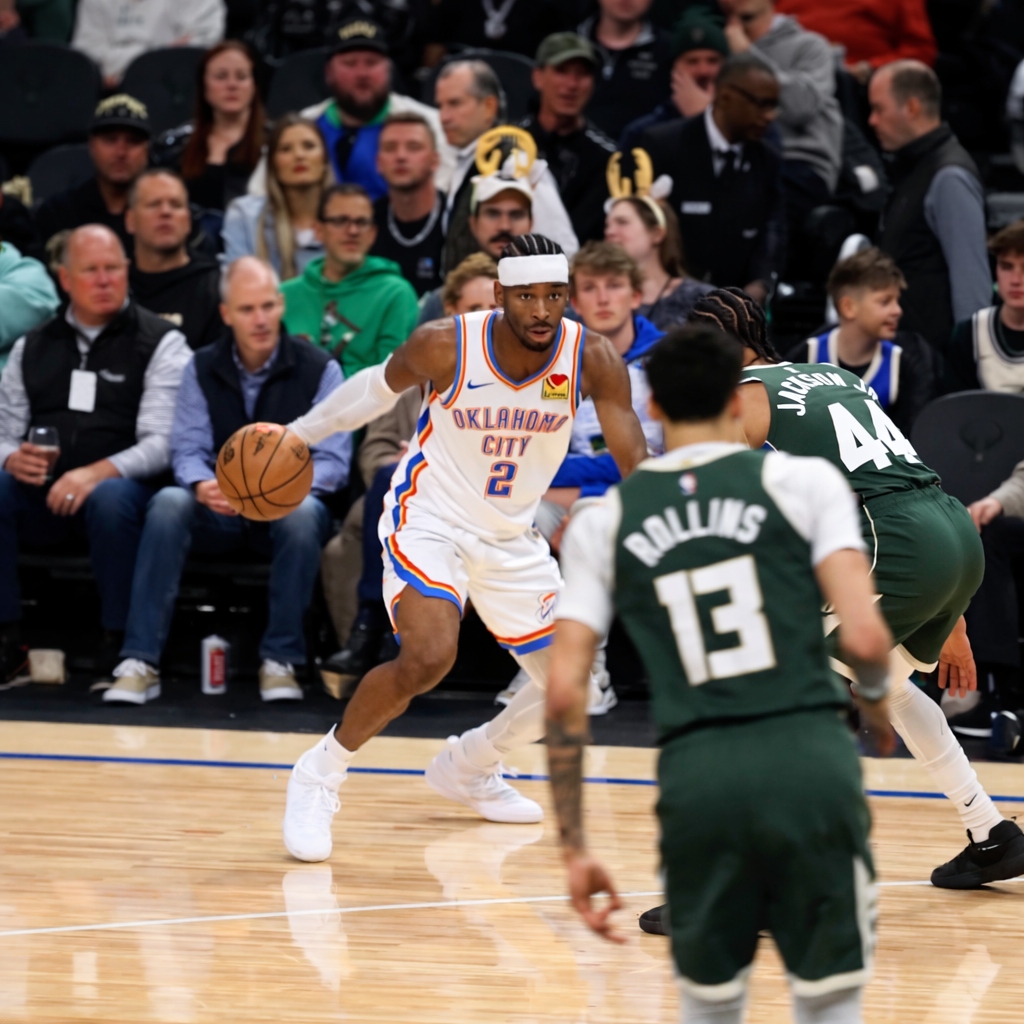
There are performances that quietly rewrite how a team is understood, and that’s exactly what we got to witness Wednesday night in Milwaukee.
The Oklahoma City Thunder didn’t just beat the Bucks 122–102 on the road. They authored a game that felt pre-determined after about six minutes, built around a version of Shai Gilgeous-Alexander that no longer fits neatly into the category of “superstar scorer.”
This was Shai as infrastructure.
Forty points. Eleven assists. Seven rebounds. Sixteen made shots on nineteen attempts. And a first quarter so controlled, so surgical, that the Bucks never once led the game.
But the most important number from that night wasn’t 40.
It was 38–18.
That’s the hole Milwaukee was placed in before it could even take a breath. And it happened not because the Thunder caught fire, but because Shai turned the opening minutes into a live demonstration of how elite players now dominate games without ever forcing them.
The Thunder opened with a 7–0 run and forced three turnovers in the first four minutes. By the time Doc Rivers called his first meaningful timeout, Milwaukee looked less like a home team and more like a group still waiting for the scouting report.
Oklahoma City shot nearly 70 percent in the opening quarter. But the shot quality told the real story. Nothing was rushed. Nothing was improvised. The ball moved side-to-side, downhill, and outward again — the kind of offensive rhythm that only exists when the defense has already lost the argument.
Shai didn’t take over.
He organized.
That distinction matters. Because takeover implies chaos. This was the opposite. This was calm control, with Gilgeous-Alexander reading the Bucks like a live whiteboard: where help came from, who hesitated on switches, which defender was overplaying passing lanes.
Every possession felt pre-solved.
By the end of the first quarter, the game’s emotional outcome was already decided. Milwaukee would spend the rest of the night chasing a version of the Thunder that had already moved on.
What made this performance historically rare wasn’t the scoring volume. We’ve seen 40-point nights before. We’ve seen efficiency before.
We haven’t seen this level of efficiency combined with this level of orchestration.
Shai became just the second player since 1980 to post 40 points and 10 assists while shooting over 80 percent from the field. But even that undersells what happened.
He didn’t dominate touches. He dominated decisions.
Every time Milwaukee shaded a defender toward him, Ajay Mitchell appeared in space. Every time the Bucks tried to send help early, Kenrich Williams found himself cutting into open lanes. Every time Giannis switched onto him, Shai calmly backed out and reset the geometry of the floor.
This wasn’t scoring.
This was quarterbacking.
And that’s the shift that makes Oklahoma City genuinely dangerous in a way box scores don’t capture. Shai is no longer just the Thunder’s best option. He’s their operating system.
However, the part of this game that should terrify the rest of the league isn’t that Shai was perfect.
It’s that Oklahoma City was missing multiple core pieces and looked untouched by it.
No Jalen Williams. No Alex Caruso. A rotation held together with role players and situational lineups.
It didn’t matter.
Because the Thunder didn’t rely on individual brilliance to build their lead. They relied on spacing, reads, and defensive discipline. When you remove key players and the structure doesn’t collapse, you’re not watching a hot team.
You’re watching a stable one.
Ajay Mitchell and Kenrich Williams both scored 18. But those numbers were byproducts, not sources. They came from being in the right places at the right times inside a system that already knew where the pressure points would be.
This is what happens when a team’s identity doesn’t depend on who’s available — only on how they think.
It would be easy to frame this as a Bucks failure. Milwaukee committed eight turnovers in the first quarter. Doc Rivers publicly criticized his team’s “single pass, shot” offense. Giannis finished with 19 points and 14 rebounds, but the game never bent around him.
All true.
But the more uncomfortable truth is that Milwaukee didn’t play badly.
They played slowly.
And in today’s NBA, slow is fatal.
The Thunder didn’t overwhelm the Bucks with size or athleticism. They overwhelmed them with speed of decision-making. Every Thunder possession felt one move ahead. Every Bucks possession felt reactive.
That’s not a matchup issue. That’s a philosophical one.
Milwaukee still plays basketball like a team trying to find the best shot.
Oklahoma City plays basketball like a team that already knows where the best shot will be.
Wire-to-Wire Is the New Dominance
The most telling detail from this game is also the simplest:
The Bucks never led.
Not once.
No momentum swing. No early punch. No crowd surge. No emotional shift.
From the opening tip to the final horn, Oklahoma City controlled the environment. And control is the rarest form of dominance in professional sports.
Anyone can win a game.
Very few teams can prevent one from ever forming.
The Thunder have quietly become one of those teams.
Not because they’re explosive — though they are.
Not because they’re deep — though they are.
But because they dictate tempo, geometry, and emotional flow in ways that don’t show up in highlight packages.
They remove your options.
Every great team goes through phases.
First, you’re talented.
Then, you’re competitive.
Then, you’re dangerous.
Finally, you’re inevitable.
Oklahoma City is entering the final stage.
This version of Shai doesn’t need to prove anything. He doesn’t need signature moments or takeover sequences. He can win games in the first quarter, on the road, without drama, without noise, without needing to remind anyone who he is.
That’s the difference between a star and a framework.
And frameworks scale.
They survive injuries.
They survive bad shooting nights.
They survive hostile arenas.
They survive playoff pressure.
Milwaukee didn’t lose because Shai had 40.
They lost because Oklahoma City no longer needs him to have 40 to feel in control.
That’s the part the rest of the league should be paying attention to.
Not the points.
Not the record.
Not the standings.
The fact that the Thunder now walk into buildings and decide how the game will feel before anyone else gets a say.
That’s not dominance.
That’s authority.
Follow us on Instagram & Facebook