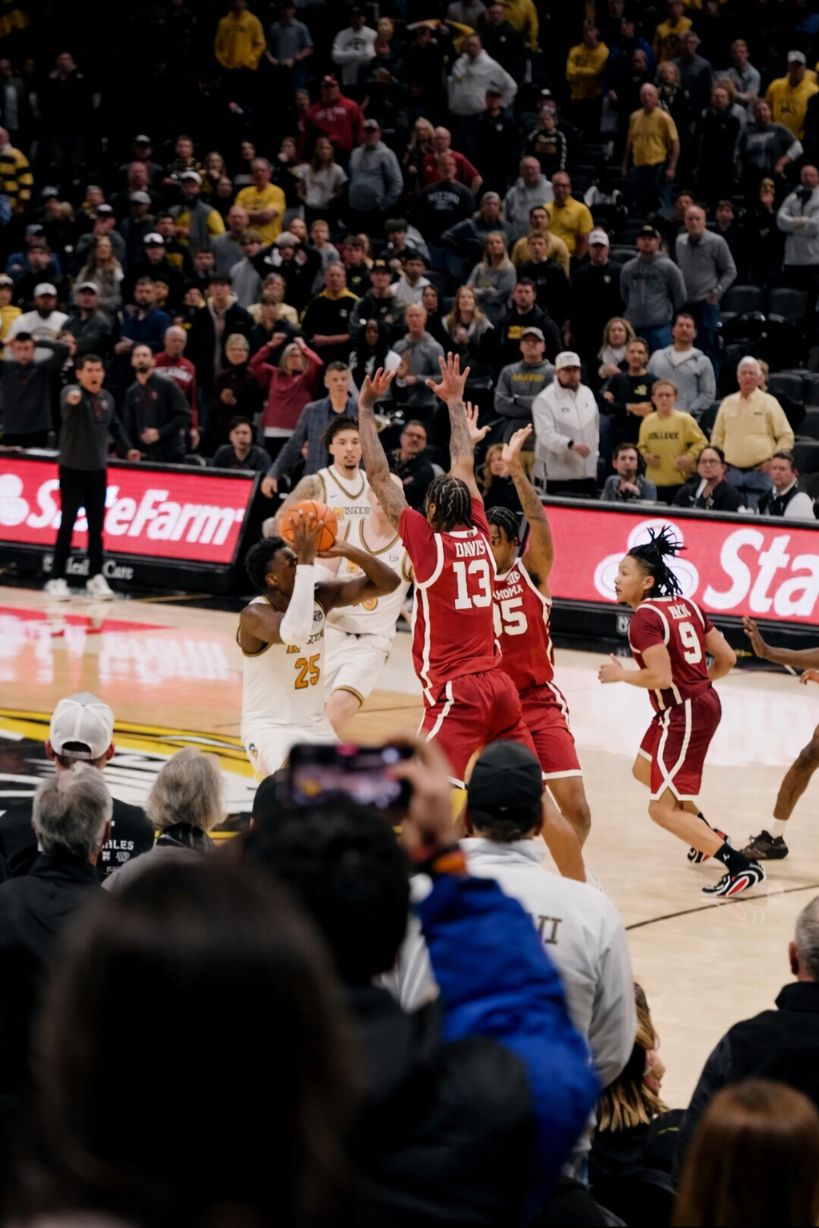
The shots will live forever.
Trent Pierce banking in a 37-footer from the logo to force overtime.
Mark Mitchell sprinting the length of the floor and burying a contested three at the horn.
Two buzzer-beaters. One night. One loss that will be replayed on highlight shows for the rest of the season.
But if you think Oklahoma lost to Missouri because of miracle shots, you’re missing the real story.
Oklahoma didn’t lose this game on the perimeter.
It lost it on the block.
The Sooners didn’t lose because Missouri hit impossible threes. They lost because Missouri got whatever it wanted inside for 45 minutes — and Oklahoma never found a way to stop it.
That’s the uncomfortable truth behind the most dramatic loss of Porter Moser’s tenure.
The scoreboard says Missouri 88, Oklahoma 87 in overtime. The tape says something far more troubling: Missouri dominated the most basic, foundational part of basketball.
Rebounding. Physicality. Interior presence.
The numbers are brutal.
Missouri: 40 points in the paint.
Oklahoma: 12.
Missouri: 41 rebounds.
Oklahoma: 29.
Missouri: 17 offensive rebounds.
Oklahoma: 5.
Second-chance points: Missouri 19, Oklahoma 3.
That’s not a statistical quirk. That’s a structural collapse.
You don’t lose a game by one point when the other team outscores you by 28 in the paint. You lose it by 28, then survive just long enough for the basketball gods to make it dramatic.
Which is exactly what happened.
Oklahoma actually played winning basketball on the perimeter. Nijel Pack finally broke out of his slump with 25 points and five threes. Xzayvier Brown was composed, efficient, and nearly the hero. Tae Davis hit clutch free throws late. The Sooners shot 48% from the field and doubled Missouri in made threes.
That should be enough.
In modern college basketball, that’s usually more than enough.
But Oklahoma’s entire offensive profile was built on jump shots because they had no alternative. No interior scoring. No post presence. No second-chance safety net.
Every possession had to be perfect because there was no margin.
And in overtime — when legs are tired, shots flatten, and chaos creeps in — that kind of basketball collapses.
The moment that told the real story of the night wasn’t either buzzer-beater.
It was Mohamed Wague’s box score: 0 points, 0 rebounds, 14 minutes.
Your starting center cannot play 14 minutes in a road SEC game and leave with zero rebounds. That’s not a bad night. That’s a system failure.
Wague’s early foul trouble forced Oklahoma into small lineups that Missouri immediately punished. Mark Mitchell, Shawn Phillips Jr., and T.O. Barrett turned the lane into a layup line. Missed shots didn’t matter — Missouri just grabbed them again.
Miss. Rebound. Kick out. Reset. Attack again.
It wasn’t flashy. It was relentless.
Missouri didn’t need to shoot well from three. They shot 29% from deep and still won because they controlled the geometry of the floor. Everything happened where Oklahoma was weakest.
This wasn’t about shot-making. It was about shot volume.
Missouri took more shots because Missouri earned more possessions.
That’s the kind of loss coaches hate most — the ones where the opponent doesn’t outplay you, they out-muscle you.
And that’s why this loss feels heavier than the others in Oklahoma’s six-game SEC skid.
Against Alabama, Oklahoma lost momentum.
Against South Carolina, Oklahoma lost the opening stretch.
Against Missouri, Oklahoma lost the identity of the game itself.
This wasn’t about execution. It was about construction.
Oklahoma is now 1–6 in SEC play, riding its longest losing streak under Porter Moser. But more concerning than the streak is the way this roster is built for a league that doesn’t care about finesse.
The SEC is not a perimeter-first conference. It’s a rebounding conference. A contact conference. A “get two feet in the paint or don’t get anything” conference.
And Oklahoma simply does not have the personnel to survive that style for 40 minutes, let alone 45.
The paradox of this Missouri loss is that Oklahoma actually played better basketball than in several previous defeats. They executed offensively. They hit shots. They didn’t turn the ball over excessively. They even led late.
But they were fundamentally incapable of closing because every miss was a death sentence.
Missed jumper? Missouri rebound.
Missed floater? Missouri rebound.
Defensive stop? Doesn’t matter if you can’t finish it.
That’s how you end up with 17 offensive rebounds allowed. That’s how you give up 19 second-chance points in a one-point loss. That’s how a team can shoot worse, defend worse, and still win.
The buzzer-beaters are the headline.
The rebounding is the autopsy.
And it leads to a much bigger question about where this program is right now.
Porter Moser has built competitive teams. Organized teams. Disciplined teams. But in the SEC, discipline doesn’t beat size. And Oklahoma is small where it matters most.
This roster is guard-driven, perimeter-oriented, and dependent on shot-making to survive. That’s a fragile way to live in January.
Because when the shots fall, you look dangerous.
And when they don’t, you have no fallback plan.
Missouri exposed that brutally.
They didn’t need hero ball. They didn’t need scheme. They just needed to be bigger, stronger, and more patient.
And they were.
The irony is that Oklahoma actually did everything you’re supposed to do to steal a road game. They won the shooting battle. They hit clutch free throws. They made plays late.
They just forgot the one rule that never changes in basketball, regardless of era, analytics, or style:
You still have to end possessions.
Until Oklahoma fixes the interior — through lineup changes, rotation adjustments, or roster reality — nights like this will keep happening.
Maybe not with two buzzer-beaters.
Maybe not in overtime.
But in different buildings, against different teams, in the same way.
Because you can’t build a season on jump shots alone.
And you definitely can’t survive the SEC without owning the paint.
Missouri didn’t steal this game.
They took it one rebound at a time.
Follow us on Instagram & Facebook