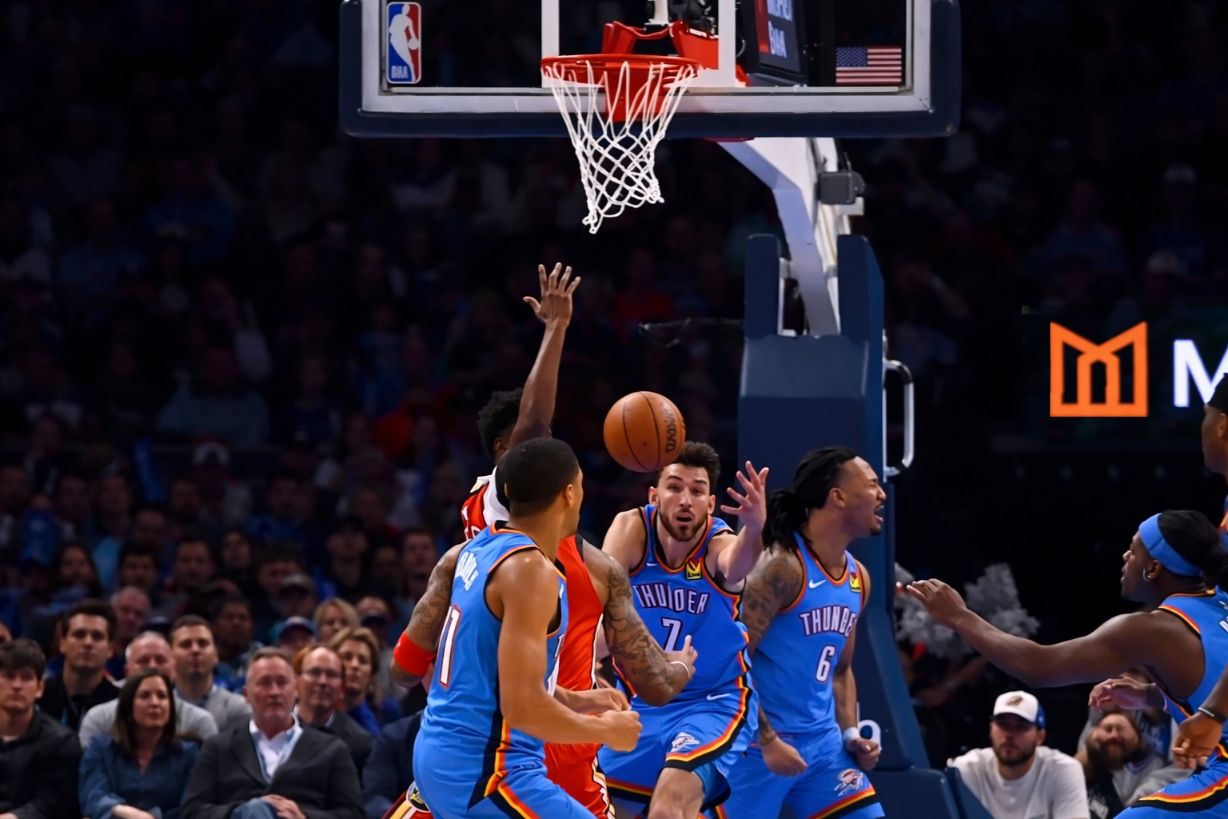
There are nights when basketball tells you exactly who you are. Not through fireworks, not through efficiency charts or social-media-ready highlights, but through resistance. Through possessions that feel heavier than they should. Through wins that don’t sparkle but linger.
Oklahoma City’s 104–95 victory over New Orleans on Wednesday night was one of those games.
It won’t live in season montages. It won’t change the Thunder’s place atop the standings. But it may matter more than plenty of cleaner wins that came before it—because it forced this team to confront the version of itself that doesn’t have margin, doesn’t have rhythm, and doesn’t have all its pieces.
And it still won anyway.
That’s the specific lesson worth unpacking here: not Shai Gilgeous-Alexander’s scoring streak, not Chet Holmgren’s five blocks, not even Lu Dort’s late three that finally quieted the building. It’s the way Oklahoma City leaned into discomfort and chose defense and composure over panic at a moment when recent history suggested that might be hard.
This game came after back-to-back home losses. That matters. Teams don’t usually admit it publicly, but consecutive losses in your own building linger. They challenge identity. For a Thunder group that has built its reputation on energy, cohesion, and control, losing twice at Paycom Center introduced a question they haven’t had to answer often this season:
What happens when things don’t flow?
Against New Orleans, the answer wasn’t elegant. It was stubborn.
Shai Gilgeous-Alexander scored 29 points, but this was not one of his surgical nights. He missed more shots than he made. He didn’t glide. He grinded. Thirteen of his points came at the free-throw line, not because defenders couldn’t stay in front of him, but because he refused to stop pressuring them. There is a difference between inefficiency and persistence, and SGA lived in that distinction all night.
That’s leadership in a subtler form. When the jumper isn’t falling and the offense stalls, stars either drift or demand contact. Gilgeous-Alexander demanded it. His streak of 20-point games—now at 118—will be cited in history, but the more important takeaway is how he got there on a night like this. It wasn’t skill bailing Oklahoma City out. It was force of will.
The same could be said for Chet Holmgren, whose fingerprints were everywhere the box score doesn’t fully capture. Yes, 20 points, 14 rebounds, and five blocks are gaudy. But this game wasn’t about totals. It was about deterrence. New Orleans shot 34 percent from the field not because it forgot how to score, but because Holmgren erased angles, erased confidence, erased second chances before they fully formed.
Every Thunder championship conversation eventually circles back to one central question: can this team survive when the offense goes cold? Against the Pelicans, the answer came from the paint. Holmgren didn’t just block shots; he dictated decisions. Zion Williamson finished with a double-double, but many of his touches came farther from the rim than New Orleans wanted. That’s not accidental. That’s defensive gravity.
And then there’s Isaiah Joe, who deserves more than a passing nod here. His 17 points off the bench weren’t just timely—they were necessary. Oklahoma City was missing key rotation pieces again, and Joe’s shooting provided oxygen during stretches when the Thunder looked dangerously close to suffocating themselves. Five made threes in a game this tight aren’t just contributions; they’re structural support.
But the defining stretch of this game came late, when New Orleans made its inevitable push.
The Pelicans cut a double-digit lead to five. Momentum shifted. The building tightened. Oklahoma City has seen this movie recently, and the endings haven’t always been satisfying. This is where habits show. And instead of rushing shots or forcing early-clock mistakes, the Thunder slowed the game down defensively.
Lu Dort’s three with 3:26 remaining didn’t just extend the lead—it restored belief. It told the Pelicans the window was closing. It told Oklahoma City it didn’t need to be perfect to finish. Dort’s value to this team has never been about aesthetics. It’s about moments. And this was one of them.
Even the postgame scuffle between Dort and rookie Jeremiah Fears felt revealing. Not because of the altercation itself—those happen—but because of the edge behind it. Oklahoma City did not play loose or carefree basketball on Wednesday night. It played territorial basketball. It played like a team protecting ground that had felt shakier than usual.
There’s a tendency to overreact to wins like this. To label them “ugly” and move on. But ugly wins are often the most honest ones. They strip away the illusion of inevitability. They force a team to confront how it responds when things stop going its way.
This Thunder group responded with defense, patience, and toughness.
That matters in January. It matters more in April.
Oklahoma City is not a finished product. The absences of Jalen Williams and Isaiah Hartenstein were felt. Offensive spacing suffered. Rebounding margins fluctuated. There were stretches where the Thunder looked thin, not deep. Those are real concerns, and they shouldn’t be ignored just because the final score landed in the win column.
But context matters. This wasn’t about style points. It was about stabilizing.
Championship teams aren’t defined by how often they dominate—they’re defined by how rarely they unravel. The Thunder flirted with unraveling against New Orleans and chose not to. That’s progress you don’t measure with shooting percentages.
If Oklahoma City does make a deep playoff run this spring, this game won’t be remembered statistically. No one will cite the 104 points. No one will replay the free throws. But internally, it will matter. It will stand as proof that this team can absorb pressure, accept limitations, and still close.
The Thunder didn’t find themselves Wednesday night.
They confirmed what they already suspected.
They can win without beauty. And that might be the most dangerous trait of all.
Follow us on Instagram & Facebook