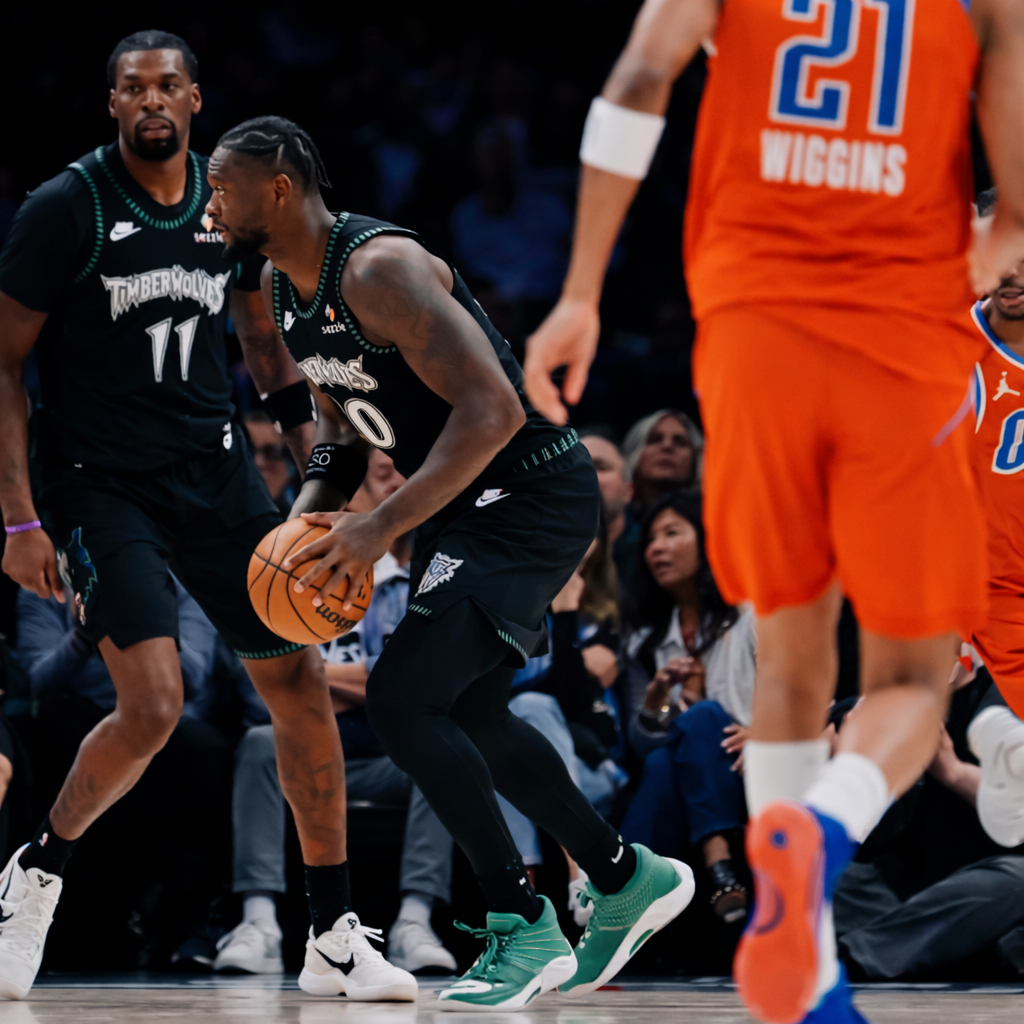
Some games aren’t decided by effort, execution, or even shot-making alone. They’re decided by environment — by the way the floor feels, stretches, and resists everything a team wants to be.
From the opening minutes in Minneapolis on Thursday night, the court tilted away from Oklahoma City. Space widened. Rotations lengthened. Decisions that normally come instinctively required just enough extra thought to arrive late. Minnesota didn’t need to sprint ahead or manufacture drama. It simply shaped the game into something the Thunder never fully escaped.
The result was a 123–111 loss that felt settled long before the final minutes, not because Oklahoma City stopped competing, but because the Timberwolves controlled the conditions.
Minnesota led wire-to-wire, opening the night with eight made three-pointers in the first quarter and never loosening its grip. By the time the Thunder tried to recalibrate, the Wolves had already established a geometry that rewarded patience and punished hesitation. Twenty-two made threes at a 47 percent clip don’t happen by accident, but they don’t require perfection either. They require comfort.
Minnesota was comfortable all night.
That comfort came from forcing Oklahoma City into a series of defensive choices it couldn’t consistently win. Protect the rim or protect the arc. Stay home or help early. Switch or recover. None of those decisions are inherently wrong, but without the personnel that usually allows the Thunder to blur those lines, each choice carried a cost.
The absence of Jalen Williams and Alex Caruso wasn’t just noticeable — it was structural. Those two are the connective tissue of Oklahoma City’s defense. Williams closes space without conceding angles. Caruso disrupts timing before actions fully develop. Together, they compress the floor in ways that allow the Thunder to defend aggressively without feeling exposed.
Without them, the floor stretched.
Minnesota saw it immediately. The Timberwolves didn’t force the issue or hunt mismatches recklessly. They spaced the corners, trusted their ball movement, and waited for Oklahoma City to reveal where the help would come from. When it did, the ball followed. Clean looks piled up. Jaden McDaniels’ perfect 5-for-5 night from beyond the arc wasn’t a heat-check anomaly — it was a reward for consistency.
This is where the game quietly slipped out of reach. Not in a single run, but in a pattern that never broke.
Even when Oklahoma City scored, the answers came back quickly. Even when the Thunder found stops, they struggled to end possessions. Minnesota’s 46–36 rebounding edge underscored the problem. Isaiah Hartenstein’s return after a 16-game absence helped stabilize the interior, but timing and chemistry take longer than one night to reassemble. Second chances extended Minnesota’s rhythm and kept Oklahoma City chasing.
Chet Holmgren felt the strain in ways the box score only hints at. His 15 points and six rebounds don’t reflect poor play — they reflect tension. Minnesota forced him to defend in space, to help earlier than ideal, to choose between rim protection and recovery. When Oklahoma City has its full complement of perimeter defenders, those choices are shared. On Thursday, they fell heavier on Holmgren alone.
Shai Gilgeous-Alexander did everything he could to keep the Thunder within range. His 30 points, eight assists, and constant pressure were the only reason the game never fully unraveled. But this wasn’t an SGA night defined by control. It was one defined by necessity. Minnesota was content to let him score as long as it meant Oklahoma City’s offense remained fragmented.
That distinction matters.
Scoring doesn’t always equal command. Against the Timberwolves, Gilgeous-Alexander produced, but the Thunder never dictated pace or flow. They reacted. Minnesota stayed ahead of the game without ever needing to accelerate it.
The turnovers told the same story. Sixteen giveaways leading to 30 Minnesota points weren’t the result of reckless ambition — they were the product of pressure applied patiently. Passing lanes closed a fraction earlier than expected. Reads took longer to process. Oklahoma City didn’t look frantic, but it didn’t look comfortable either.
That discomfort is the real takeaway.
Oklahoma City has built its season on cohesion. On a defense that bends without breaking. On depth that absorbs absences. On movement that smooths over cold stretches. Against Minnesota, those strengths were stressed simultaneously — and without enough margin to hide the strain.
This loss won’t alter the standings. The Thunder still own the best record in the league. It won’t dent confidence or invite overreaction. But it should sharpen the focus on what playoff basketball tends to look like.
Because postseason games are rarely generous environments.
Opponents won’t allow Oklahoma City to play in space. They’ll stretch the floor, force choices, and test whether the Thunder can defend multiple threats without their full defensive toolkit. Minnesota didn’t invent that challenge — it simply presented it clearly.
The encouraging part is that most of what went wrong Thursday night is situational, not foundational. Williams and Caruso will return. Hartenstein will regain timing. Rotations will tighten. The Thunder’s ceiling hasn’t changed.
But the floor was visible in Minneapolis.
Championship teams aren’t defined by how they perform when everything aligns. They’re defined by how well their identity holds when conditions turn against them. On Thursday night, Oklahoma City found itself playing on a floor shaped by someone else.
That doesn’t make the loss alarming.
It makes it instructive.
Because before the playoffs arrive — before possessions slow and space disappears — it’s better to understand how fragile comfort can be. Minnesota didn’t expose a fatal flaw. It exposed how quickly environment can become an opponent as well.
And for a Thunder team with legitimate title aspirations, that’s a lesson worth absorbing now, while there’s still time to adjust the shape of the floor.
Follow us on Instagram & Facebook