There are losses that sting because you were outplayed.
There are losses that sting because you gave one away.
And then there are losses like Wednesday night in Detroit — the kind that don’t just go in the standings column, but linger in the back of your mind.
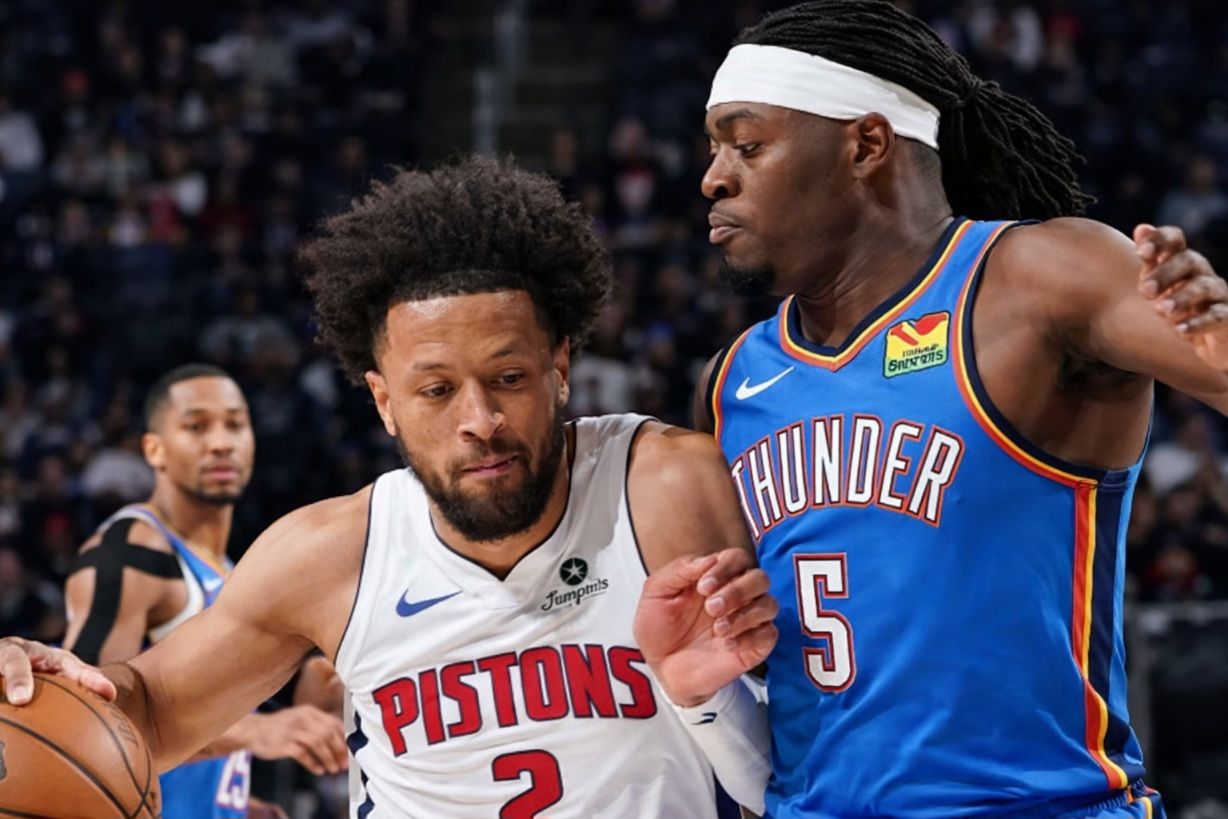
The Oklahoma City Thunder fell 124–116 to the Detroit Pistons at Little Caesars Arena, dropping its season record to 45–15. On paper, it’s a February loss against another contender. In context, it’s something more complicated — and potentially more revealing.
Because yes, the Thunder were severely shorthanded. But no, that doesn’t make what happened insignificant.
If anything, it makes it instructive.
The Illusion of Control
Oklahoma City opened the game like a team intent on embarrassing the injury report. A 15–2 run. A 34–22 first-quarter lead. Crisp ball movement. Active hands defensively. Energy that suggested defiance.
For 12 minutes, the Thunder looked deeper than their absences.
Then the middle of the game happened.
Detroit outscored Oklahoma City 72–46 across the second and third quarters. That’s not a subtle shift. That’s a structural collapse.
And it didn’t happen because of hot shooting variance. The Pistons shot 54 percent from the field for the game and controlled the glass 52–37. They grabbed 16 offensive rebounds. They dictated where the game was played — and it was played in the paint.
When you give up 70 points in the paint and lose the rebounding battle by 15, you’re not losing on the margins.
You’re losing at the foundation.
The Paint Vacuum
The Thunder were already without Shai Gilgeous-Alexander (abdomen), Jalen Williams (hamstring), Chet Holmgren (back), Isaiah Hartenstein (calf/knee) and Ajay Mitchell (abdomen/ankle) before tipoff. Then they lost Isaiah Joe (hip) and Branden Carlson (back) at halftime.
At some point, “next man up” becomes “who’s left?”
But here’s the uncomfortable truth: Detroit didn’t just beat a depleted Thunder roster. They targeted its softest remaining spot and pressed until it gave way.
Jalen Duren finished with 29 points and 15 rebounds. He shot over 70 percent from the field. He dunked through contact. He sealed deep. He feasted on switches. He played like a man who understood there was no elite rim protector waiting behind him.
This is where Holmgren and Hartenstein’s absence wasn’t just noticeable — it was defining.
Oklahoma City’s defensive identity depends on verticality, weak-side shot deterrence and rebounding discipline. Remove the backline, and suddenly every drive bends the defense a little further. Help comes a step earlier. Rotations get longer. Box-outs get softer because they’re coming from smaller bodies.
Detroit didn’t out-scheme Oklahoma City.
They out-sized them.
Cade Controlled the Game
While Duren punished the interior, Cade Cunningham orchestrated everything else.
Twenty-nine points. Thirteen assists. MVP chants cascading from the stands.
This wasn’t a volume scoring night. It was a tempo night.
Cunningham slowed the game when Oklahoma City tried to speed it up. He hunted mismatches without forcing shots. He fed Duren at angles that eliminated help. He turned broken possessions into calm resets.
When the Pistons went on their decisive run in the second quarter — holding the Thunder to 30.4 percent shooting — it wasn’t chaos that fueled it. It was control.
That’s what star guards do in February when they smell vulnerability.
They press it.
The Sequence That Told the Whole Story
With five minutes left, Oklahoma City had done the hard part.
Behind a furious fourth-quarter push — sparked largely by Jaylin Williams — the Thunder cut a 14-point deficit to 108–105. The arena tightened. Momentum tilted.
And then came the possession.
Detroit missed.
Offensive rebound.
Missed again.
Another offensive rebound.
Missed.
Another.
Four offensive boards on a single trip, ending in a dagger three from Javonte Green.
That wasn’t just a back-breaking sequence. It was a summary.
Effort wasn’t the issue. Oklahoma City fought. They scrambled. They contested.
But they couldn’t finish on the defensive end of the floor.
Championship defenses don’t just force misses. They secure the rebounds after.
Jaylin Williams’ Night — and What It Meant
Williams deserves more than a footnote.
Thirty points. Eleven rebounds. Fourteen points in the fourth quarter alone.
In a game where Oklahoma City’s offensive ecosystem was stripped to its wiring, Williams became a lifeline. He hit five threes. He attacked mismatches. He earned trips to the free-throw line. He gave the Thunder a pulse when the game threatened to flatline.
But here’s the larger point: Williams’ career night was a necessity, not a luxury.
When your top six scorers are either out or compromised, individual heroics are survival tactics.
And survival, while admirable, isn’t sustainable.
The Shooting Numbers Tell a Story
Oklahoma City shot 41 percent from the field.
Detroit shot 54 percent.
The Thunder actually hit 18 threes and shot 37 percent from deep — respectable numbers under the circumstances. But those perimeter makes masked what was happening inside the arc.
Detroit lived in the paint. Oklahoma City lived beyond it.
One is a playoff formula.
The other is a patch.
So What Does This Mean?
It would be easy to dismiss this as an injury loss and move on.
And in one sense, that’s fair. When you’re missing Gilgeous-Alexander — an MVP candidate — plus Holmgren, Williams and Hartenstein, you are not your full self. Few teams would survive that.
But depth is only as strong as the weaknesses it can protect.
Wednesday night exposed a truth about the Thunder’s roster construction: their margin for error inside shrinks dramatically without their two primary rim protectors.
That’s not a fatal flaw.
It’s a pressure point.
Contenders are defined not just by their strengths, but by how narrow their vulnerability windows are.
Detroit found Oklahoma City’s.
The Bigger Picture
At 45–15, the Thunder are still among the league’s elite. One loss in late February does not redefine a season.
But the Pistons, now 43–14, treated this game like a measuring stick — and passed.
The Thunder treated it like a resilience test — and fell short.
There’s a difference.
Oklahoma City’s identity is built on connectivity, rim deterrence and rebounding discipline. Remove enough pieces, and even the best systems wobble.
The concern isn’t that they lost.
The concern is how they lost: in the paint, on the glass, in the middle quarters where physicality compounds.
That matters in May.
What Comes Next
The Thunder return home to face the Denver Nuggets on Friday. The schedule won’t soften. The Western Conference won’t wait for health updates.
If this stretch continues, Oklahoma City must answer a difficult question: is their depth a strength, or is it simply functional when the stars are present?
There’s a difference between weathering absences and being reshaped by them.
Wednesday night felt closer to the latter.
In February, you can survive a loss like this.
In the playoffs, the opponent studies it.
And that’s why this game wasn’t just about who didn’t play.
It was about what was revealed when they couldn’t.
Attrition isn’t an excuse.
It’s a warning.
Follow us on Instagram & Facebook