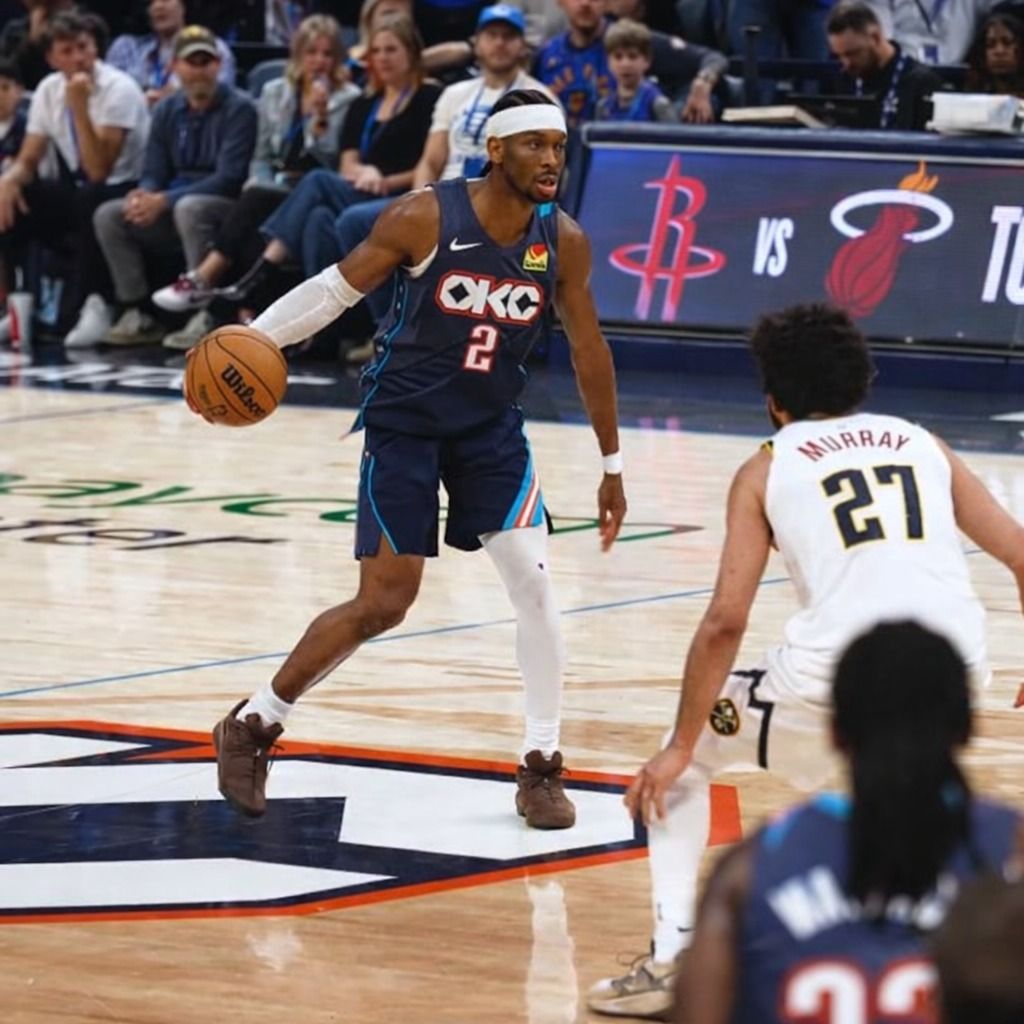
If you want to understand why the Oklahoma City Thunder are 46–15 and sitting atop the Western Conference, don’t start with the box score.
Start with who wasn’t on the floor.
Start with the reigning MVP watching overtime in warmups. Start with Lu Dort walking to the locker room after a Flagrant 2. Start with Nikola Jokić jawing at midcourt and a building at the Paycom Center vibrating with postseason tension in late February.
That’s where you begin to understand what Oklahoma City’s 127–121 overtime win over the Denver Nuggets really was.
It wasn’t just another regular-season victory. It was a stress test. And the Thunder passed it without their closer.
Shai Gilgeous-Alexander’s return alone would have been enough of a storyline. After missing nine games with an abdominal strain, he poured in 36 points and handed out nine assists, carving up Denver’s defense with that familiar blend of hesitation dribbles and foul-line precision. He was surgical in regulation — 12-of-13 from the stripe, timely midrange daggers, defensive activity with two steals and two blocks.
But the most important detail of his night?
He didn’t play in overtime.
Because of a minutes restriction, the Thunder’s best player sat the entire extra period of a tied game against one of the top challengers in the west. And Oklahoma City didn’t just survive.
They controlled it.
That’s not an accident. That’s infrastructure.
All season, we’ve wondered whether this Thunder team — as young, as exuberant, as emotionally volatile as they can be — had the internal wiring to handle championship-defending adversity. Friday night gave us the clearest answer yet.
Denver threw the first punch. Jamal Murray was incandescent, finishing with 39 points and hitting contested jumpers that felt like psychological body blows. Jokić did what Jokić does — 23 points, 17 rebounds, 14 assists — bending the geometry of the game with his patience and vision. The Nuggets built an early double-digit lead and looked, for stretches, like the more settled team.
Oklahoma City didn’t blink.
Instead, the Thunder started doing what elite teams do when the shot variance swings against them: they created chaos.
They forced 17 Denver turnovers and turned them into 21 points. They swarmed passing lanes. They dug down at the nail. They turned live-ball steals into runway sprints. The Nuggets shot 11-of-20 from three in the first half and still couldn’t separate decisively because the Thunder kept stealing possessions.
That’s discipline disguised as energy.
And then the game turned combustible.
With just over eight minutes left in the fourth quarter, Lu Dort was assessed a Flagrant 2 and ejected after a hard foul on Jokić that sent bodies converging at midcourt. It was chippy before that; it became combustible after. Technical fouls were handed out like party favors — to Jokić, to Gilgeous-Alexander, to Jaylin Williams.
This is the moment young teams typically fracture. Emotion spills over into rushed shots. Defensive rotations lag half a beat. The opponent senses the unraveling.
Instead, Oklahoma City tightened.
From the point of Dort’s ejection to the end of regulation, the Thunder’s defense sharpened. Rotations were crisp. Closeouts were under control. They played the next possession. And the next one. And the next.
Chet Holmgren was the backbone of it all.
His final line — 15 points, 21 rebounds, three blocks — only tells part of the story. Nineteen of those boards were defensive. That matters against Denver. Jokić’s genius often manifests in the second phase of possessions — tip-outs, quick kick-outs, soft-touch putbacks. Holmgren erased that margin.
More importantly, he absorbed contact without losing positioning. He contested without fouling. He altered floaters late in the fourth quarter when the game hung in the balance.
There’s a reason his name is starting to surface in Defensive Player of the Year conversations. Against the most sophisticated offensive center in the world, Holmgren didn’t dominate — that’s unrealistic — but he endured. He made every catch work. He finished possessions. He protected the rim without overcommitting.
That’s playoff basketball in February.
Still, the defining stretch came in overtime, when Mark Daigneault’s minutes restriction for Gilgeous-Alexander forced Oklahoma City to reveal something deeper about itself.
No MVP. No primary half-court savant.
Just system.
Isaiah Joe drilled two massive three-pointers in the extra period — the kind that silence doubt more than crowds. Alex Caruso, who has quietly become one of the Thunder’s most important connective pieces, scored eight of his 12 points across the fourth quarter and overtime. He jumped passing lanes. He pushed in transition. He delivered a back-breaking steal and fast-break finish in the final minute that felt like a closing argument.
Those aren’t star-driven heroics. They’re ecosystem plays.
Too often we reduce championship viability to star power. Do you have the best player? Do you have the closer?
Oklahoma City has one. Gilgeous-Alexander’s brilliance is not in question. But what Friday night underscored is that the Thunder are not star-dependent in the fragile way many contenders are.
They can win ugly. They can win tense. They can win without their alpha in the most pressurized five minutes of the night.
That’s maturity.
And it’s why this 46–15 record feels sturdier than previous Thunder ascents.
Think about the psychology of it all. You lose Dort to an ejection. You’re trading technical fouls with a team that has hoisted a trophy. Your superstar is capped on minutes. You’re facing Murray in flamethrower mode and Jokić in orchestral command.
In that environment, Oklahoma City opened overtime with a 5–0 run.
That’s composure weaponized.
There will be critics who point to Denver’s blown lead. Who frame this as Nuggets slippage rather than Thunder resilience. But perspective matters. The Nuggets are 37–23 for a reason. Murray’s 39 weren’t hollow. Jokić’s triple-double wasn’t cosmetic.
Oklahoma City earned this.
They earned it on the margins — by forcing turnovers, by rebounding, by turning defensive stops into tempo. They earned it by adhering to a minutes plan when the temptation to unleash Gilgeous-Alexander for five more minutes must have been overwhelming.
And that discipline might be the most telling detail of all.
Daigneault trusted his depth. He trusted his structure. He trusted that the habits this group has built over 61 games would hold in an overtime crucible.
He was right.
If you’re searching for the moment this season that crystallized Oklahoma City as something more than a fun, precocious top seed — this is it.
Not because of the 36 points from their MVP.
But because of the 20 points they scored in five overtime minutes without him.
Because of Holmgren’s 21 rebounds.
Because of Caruso’s defensive punctuation.
Because they responded to chaos with clarity.
Championship teams reveal themselves in fragments before they ever hang a banner. A road win in November. A defensive stand in January. An overtime survival in late February.
Friday night was one of those fragments.
The Thunder didn’t just beat Denver 127–121. They demonstrated an internal steadiness that travels. The kind that survives whistles, ejections, and superstar limitations. The kind that can absorb a 39-point explosion from Jamal Murray and still dictate the final five minutes.
There’s still a postseason gauntlet ahead. Still series to win. Still scars to earn.
But if you wanted proof that Oklahoma City isn’t merely leading the Western Conference by circumstance — that they’re leading it by construction — you saw it at the Paycom Center.
They didn’t need their MVP to close.
They needed their identity.
And that’s far more dangerous in June.
Follow us on Instagram & Facebook