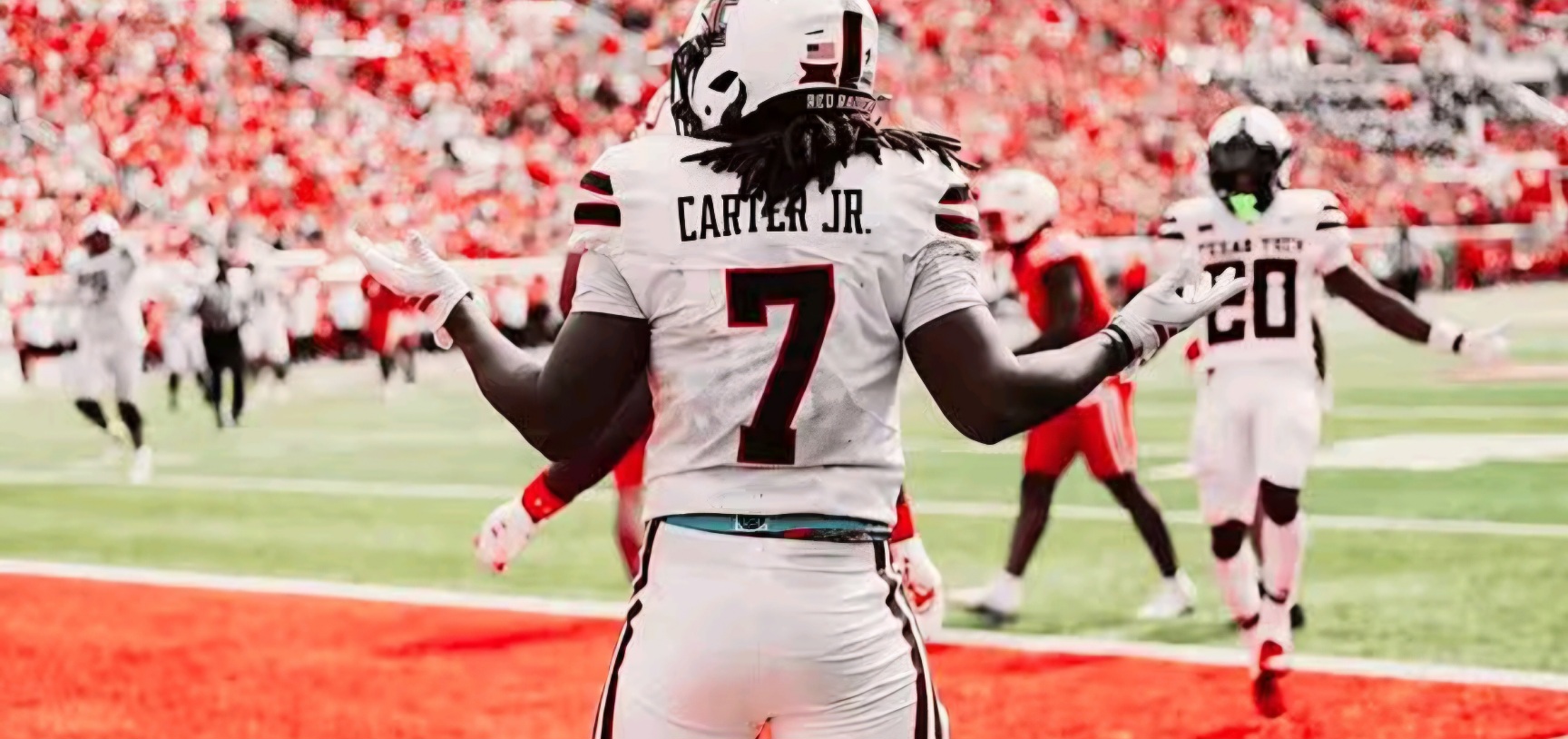
The Big 12 may not receive the same national attention for its tight end play as some other conferences, but the position has become increasingly important throughout the league.
Several programs enter the 2026 season with proven returning starters, emerging stars and versatile players capable of contributing as both blockers and receivers. At the top of the conference, Texas Tech has a legitimate national-level weapon in Terrance Carter Jr., while BYU and Kansas State bring physical, dependable rooms to the table.
To determine our 2026 Big 12 Tight End Position Rankings, Caleb, Matt and Zack each ranked the conference’s 16 tight end rooms from No. 1 through No. 16.
Our scoring system awards 16 points for a first-place vote, 15 for second, 14 for third and so on down to one point for 16th place.
The final results produced a clear winner at the top, but there was plenty of disagreement behind the Red Raiders.
Consensus Big 12 Tight End Rankings
| Rank | Team | Caleb | Matt | Zack | Points |
|---|---|---|---|---|---|
| 1 | Texas Tech Red Raiders | 1 | 1 | 1 | 48 |
| 2 | BYU Cougars | 2 | 5 | 4 | 40 |
| 3 | Kansas State Wildcats | 3 | 6 | 3 | 39 |
| 4 | UCF Knights | 11 | 2 | 2 | 36 |
| 5 | Arizona Wildcats | 12 | 3 | 7 | 29 |
| 6 | Houston Cougars | 13 | 4 | 6 | 28 |
| 7 | TCU Horned Frogs | 4 | 10 | 10 | 27 |
| 8 | Arizona State Sun Devils | 6 | 11 | 8 | 26 |
| 9 | Baylor Bears | 8 | 7 | 13 | 23 |
| 10 | Utah Utes | 5 | 12 | 12 | 22 |
| 11 | Iowa State Cyclones | 7 | 15 | 9 | 20 |
| 12 | Cincinnati Bearcats | 10 | 8 | 15 | 18 |
| 13 | Colorado Buffaloes | 14 | 9 | 11 | 17 |
| 14 | Oklahoma State Cowboys | 16 | 14 | 5 | 16 |
| 15 | Kansas Jayhawks | 9 | 13 | 16 | 13 |
| 16 | West Virginia Mountaineers | 15 | 16 | 14 | 6 |
Texas Tech was the unanimous No. 1 selection, receiving 16 points from all three voters for a perfect 48-point score.
Behind the Red Raiders, however, things get considerably more complicated.
Caleb
1. Texas Tech | The Red Raiders have the best tight-end room in the Big 12 because of its combination of proven production, versatility, and depth. Terrance Carter Jr. is the headliner and gives the Red Raiders a legitimate difference-maker at the position. He can contribute as both a receiver and blocker, which allows Texas Tech to use him in multiple formations and create matchup problems for defenses. What separates the Red Raiders from the rest of the conference is that they aren’t completely dependent on one player. They have enough talent behind Carter to keep the position productive throughout the season. With a strong combination of athleticism, physicality, and experience, Texas Tech has the most complete tight-end room in the Big 12.
2. BYU | The Cougars get the second spot because they have one of the most reliable tight-end groups in the conference. Their tight ends fit the physical style BYU wants to play while still providing value in the passing game. The program has also done a very good job developing players at the position, with Carsen Ryan being selected in the 2026 NFL Draft. BYU’s strength is its ability to use tight ends in multiple ways without sacrificing physicality. They may not have quite the same overall depth as Texas Tech, but the combination of blocking ability, experience, and development makes BYU one of the Big 12’s best rooms.
3. Kansas State | The Wildcats earn the No. 3 spot because its tight ends are a perfect fit for K-State’s physical offensive identity. This group can be heavily involved in the running game while still providing the quarterback with reliable targets when they want to throw. The Wildcats may not have the biggest name at the position in the conference, but they have a balanced room that can contribute in several different ways. Their blocking ability and versatility give them a high floor, while the potential for one of their players to emerge as a bigger receiving threat gives the room plenty of upside.
- TCU
- Utah
- Arizona State
- Iowa State
- Baylor
- Kansas
- Cincinnati
- UCF
- Arizona
- Houston
- Colorado
- West Virginia | The Mountaineers enter 2026 with more questions than answers at tight end. West Virginia has some players with potential, but they don’t have the same level of proven production or depth as most of the teams ahead of them. Their tight ends should still be able to contribute as blockers, but finding a consistent receiving threat will be important. Until someone establishes himself as a dependable starter and playmaker, West Virginia remains one of the weaker tight-end rooms in the Big 12.
- Oklahoma State | The Cowboys have the most uncertainty at tight end in the Big 12 entering 2026. OSU is still rebuilding their roster and don’t have much established production at the position. There is young talent that could develop into contributors, but compared with the rest of the conference, Oklahoma State lacks the combination of experience, depth, and proven receiving ability needed to rank higher. Because of those questions, I have the Cowboys at No. 16 entering the season.
Matt
1. Texas Tech | The Red Raiders Form the absolute meanest group in the league, combining returning Preseason All-Big 12 first-teamer Terrance Carter Jr. with physical veteran transfer Jett Carpenter.
2. UCF | The Knights boast a high-floor passing game anchor in Dylan Wade, who recently shattered program tight end records for catches, yardage, and touchdowns.
3. Arizona | The Wildcats feature premium athleticism on the edge with Cole Rusk, giving quarterback Noah Fifita a highly dependable safety valve down the seam.
4. Houston
5. BYU
6. Kansas State
7. Baylor
8. Cincinnati
9. Colorado
10. TCU
11. Arizona State
12. Utah
13. Kansas
14. Oklahoma State
15. Iowa State | The Cyclones are near the bottom following a complete programmatic shift that wiped out virtually all proven tight end experience and production.
16. West Virginia | The Mountaineers occupy the basement due to a scheme that heavily emphasizes wide receiver spacing, leaving their tight end room with sparse targets and blocking duties.
Zack
1. Texas Tech | Terrance Carter Jr. was a Second-Team All-Big 12 selection last season, and now he’s not just a Preseason All-Big 12 team, he’s considered one of the best returning tight ends in the entire country. He’s going to be a key feature in the Red Raider offense.
2. UCF | Dylan Wade wasn’t quite as good as Terrance Carter Jr. last season, but he’s also considered one of the country’s top returning talents at the TE position. The Golden Knights are expected to finish near the bottom of the conference, but Wade should be a bright spot regardless.
3. Kansas State | Garrett Oakley has19 starts in 34 games played over the last 3 seasons in Manhattan, and he is another one of the top returning tight ends in the entire nation. The Wildcats could be a dark horse in the Big 12, and a guy like Oakley is someone they can lean on for consistent production.
4. BYU
5. Oklahoma State
6. Houston
7. Arizona
8. Arizona State
9. Iowa State
10. TCU
11. Colorado
12. Utah
13. Baylor
14. West Virginia
15. Cincinnati | Gavin Grover played in all 13 games last season, but he didn’t see the ball much, and the Bearcats aren’t expected to be very good.
16. Kansas | Carson Bruhn started in 5 of his 8 games played as a sophomore last season before getting injured, but he recorded just 5 catches for 55 yards. Pair that with an inexperienced quarterback and low expectations in Lawrence, and he can only go up from here
Where Did We Agree?
The biggest agreement in the entire exercise was obvious:
Texas Tech Is In A Class Of Its Own
All three voters selected the Red Raiders No. 1.
That’s significant because Texas Tech wasn’t simply the highest-scoring team in the aggregate—it was the only unanimous No. 1.
Terrance Carter Jr. is the common denominator.
The Preseason All-Big 12 selection gives Texas Tech an established weapon who can impact the game as a receiver while still bringing the physicality necessary to function as a traditional tight end.
More importantly, all three of us believe the Red Raiders have enough depth around Carter to keep the position productive.
The result was a perfect 48 out of a possible 48 points.
Kansas State Was Another Major Consensus
Kansas State finished:
- Caleb: 3rd
- Matt: 6th
- Zack: 3rd
The Wildcats’ 39 points put them third overall.
While Matt was less enthusiastic than Caleb and Zack, there was no ballot that placed Kansas State outside the top six.
Garrett Oakley was a major reason for the enthusiasm, with his experience giving the Wildcats a reliable option in the passing game while fitting naturally into their physical offensive identity.
BYU Was Consistently Highly Regarded
BYU finished:
- Caleb: 2nd
- Matt: 5th
- Zack: 4th
That’s another excellent consensus result.
The Cougars’ physical approach, tight end development and returning talent made them one of the few teams that all three voters placed comfortably inside the top five.
Where Did We Disagree?
The biggest disagreements came in the middle of the rankings.
UCF: From 2nd to 11th
No team generated a wider spread than UCF.
- Matt: 2nd
- Zack: 2nd
- Caleb: 11th
This is perhaps the most fascinating disagreement in the rankings.
Matt and Zack see Dylan Wade as one of the conference’s premier returning tight ends and believe his individual production can elevate the entire position group.
Caleb, however, appears to place considerably more emphasis on the overall room rather than the presence of one elite player.
The result is a fourth-place consensus finish for UCF with 36 points.
That’s a remarkable outcome considering the 11th-place vote.
Arizona: 3rd to 12th
Arizona produced another major split:
- Matt: 3rd
- Zack: 7th
- Caleb: 12th
Matt’s belief in Cole Rusk’s ability to become a major weapon drove his ranking of the Wildcats into the top three.
Zack also sees enough talent to put Arizona in the top half.
Caleb, meanwhile, is much less convinced about the overall room.
Arizona ultimately lands fifth in the consensus with 29 points.
Oklahoma State: 5th to 16th
Oklahoma State might be the most surprising disagreement.
- Zack: 5th
- Matt: 14th
- Caleb: 16th
Zack is clearly much higher on the Cowboys’ potential than the other two voters.
That fifth-place ranking was enough to keep Oklahoma State from falling all the way to the bottom of the consensus rankings, despite receiving a 16th-place vote from Caleb.
The Cowboys finish 14th overall with 16 points.
TCU: 4th to 10th
TCU also generated a significant difference:
- Caleb: 4th
- Matt: 10th
- Zack: 10th
Caleb’s belief in the Horned Frogs’ overall room was much stronger than that of Matt and Zack.
That consistency from the latter two voters ultimately pulled TCU down to seventh in the aggregate rankings.
The Consensus Tiers
The voting reveals a fairly interesting structure across the Big 12.
Tier 1 — The Standard
1. Texas Tech
The Red Raiders are the clear No. 1.
Tier 2 — Proven Contenders
2. BYU
3. Kansas State
4. UCF
These three have different strengths, but all possess enough individual talent and proven production to make a case as the conference’s best challenger to Texas Tech.
Tier 3 — Competitive Upper-Middle Class
5. Arizona
6. Houston
7. TCU
8. Arizona State
9. Baylor
10. Utah
This group is where the rankings become much more subjective.
The difference between Arizona at fifth and Utah at 10th is only seven points. A breakout player or unexpected production could dramatically alter that order during the season.
Tier 4 — Questions to Answer
11. Iowa State
12. Cincinnati
13. Colorado
14. Oklahoma State
15. Kansas
16. West Virginia
These teams enter the season with considerably more uncertainty.
Interestingly, Oklahoma State receives a fifth-place vote from Zack but still lands 14th because Caleb and Matt were much lower.
Kansas also finishes near the bottom, with Zack placing the Jayhawks 16th and Caleb ninth.
Final Thoughts
The most striking thing about these rankings isn’t simply that Texas Tech finished first.
It’s how decisively the Red Raiders have the first-place slot.
Texas Tech received three first-place votes and a perfect 48-point score. Terrance Carter Jr. gives the Red Raiders a proven difference-maker, but the consensus also recognizes that this is more than a one-player operation.
Behind Texas Tech, the picture becomes considerably less certain.
BYU and Kansas State are the most consistently respected challengers, while UCF is perhaps the biggest wild card in the entire ranking. The Golden Knights could have one of the conference’s best tight end rooms if Dylan Wade continues his production, but Caleb’s 11th-place ranking illustrates the concern that the room may be too dependent on one player.
Arizona and Houston also have intriguing cases, while TCU, Arizona State and Baylor form a crowded middle tier.
At the bottom, West Virginia was the only team to receive a double-digit ranking from all three voters, while Kansas and Oklahoma State produced surprisingly wide disagreements.
Ultimately, though, there is one conclusion on which our panel was unanimous:
If you’re looking for the Big 12’s tight end standard entering 2026, start in Lubbock.
Texas Tech’s combination of Terrance Carter Jr., physicality, versatility and depth makes the Red Raiders the clear consensus No. 1 tight end room in the conference. The question now is whether the rest of the Big 12 can close the gap once the season begins.