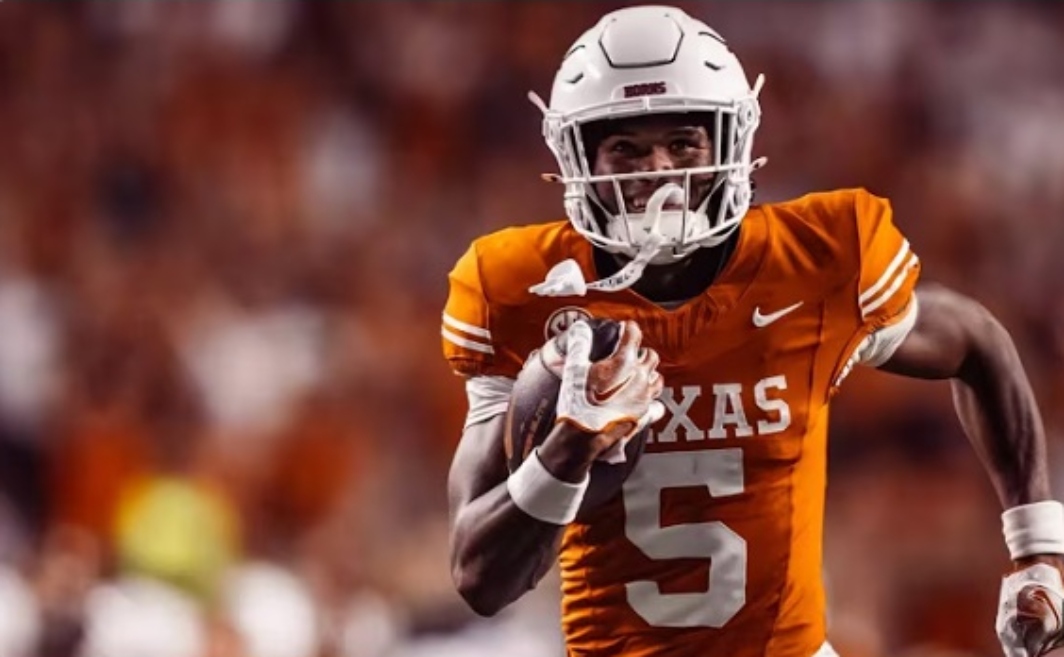
Few position groups in the SEC carry as much star power as wide receiver entering the 2026 season. The conference is loaded with proven producers, elite transfers, former blue-chip recruits and young players poised for breakout seasons.
But while there is broad agreement about which teams belong near the top, our three writers—Caleb, Craig and Matt—saw the conference somewhat differently once the rankings moved beyond the top two.
To settle the debate, we assigned 16 points for a first-place vote, 15 for second, 14 for third, and so on down to one point for 16th. The result is a consensus ranking that rewards both high placement and overall consistency.
And at the top, there wasn’t much disagreement.
Our Consensus SEC Wide Receiver Rankings
| Rank | Team | Caleb | Craig | Matt | Points |
|---|---|---|---|---|---|
| 1 | Texas | 1 | 1 | 1 | 48 |
| 2 | Texas A&M | 2 | 2 | 2 | 45 |
| 3 | Alabama | 3 | 4 | 5 | 39 |
| 4 | Oklahoma | 5 | 7 | 3 | 36 |
| 5 | Georgia | 4 | 6 | 8 | 33 |
| 6 | Ole Miss | 6 | 8 | 6 | 31 |
| 7 | LSU | 7 | 5 | 9 | 30 |
| 8 | Tennessee | 9 | 9 | 4 | 29 |
| 9 | Florida | 12 | 3 | 11 | 25 |
| 10 | South Carolina | 8 | 10 | 10 | 23 |
| 11 | Auburn | 10 | 11 | 12 | 18 |
| 12 | Missouri | 11 | 13 | 13 | 14 |
| 13 | Mississippi State | 16 | 15 | 7 | 13 |
| 14 | Kentucky | 14 | 12 | 14 | 11 |
| 15 | Arkansas | 13 | 14 | 15 | 9 |
| 16 | Vanderbilt | 15 | 16 | 16 | 4 |
The first thing that jumps off the page is the separation at the top.
Texas received all three first-place votes. Texas A&M received all three second-place votes. That created a six-point gap between the Longhorns and Aggies, followed by another six-point gap between A&M and Alabama.
After that, however, things get considerably tighter.
1. Texas — 48 Points
There was no debate at the top. All three rankings placed Texas No. 1.
Caleb’s explanation:
Texas has the best wide receiver room in the SEC because of its combination of elite individual talent and tremendous depth. Cam Coleman, Ryan Wingo, and Emmett Mosley give the Longhorns three highly talented receivers at the top of the rotation, while players such as Daylan McCutcheon and Kaliq Lockett give them quality depth. Texas has also shown that its receivers are earning the trust of Steve Sarkisian, with the program expanding its rotation heading into 2026. The biggest advantage is that Texas doesn’t have to rely on one receiver to carry the passing game. They can attack defenses vertically, underneath, and in the red zone with multiple talented options.
Craig’s explanation:
Texas – The Longhorns are an easy front runner here with the addition of Cam Coleman. They also have Ryan Wingo and Emmett Mosley which give them multiple downfield threats.
Matt’s explanation:
The Texas Longhorns claim the #1 spot in the SEC heading into the 2026 season. The conference features incredible disparity, with high-flying transfer portal winners at the top and rebuilding programs struggling to find proven depth at the bottom.
The consensus is easy to understand. Texas doesn’t simply have a great receiver; the Longhorns have multiple ways to attack a defense. The addition of Coleman gives an already talented room another potential game-breaker, while Wingo and Mosley give the Longhorns considerable vertical capability.
2. Texas A&M — 45 Points
Like Texas, Texas A&M was a unanimous selection. All three evaluators placed the Aggies second.
Caleb’s explanation:
Texas A&M has one of the deepest receiver rooms in the SEC and could have a legitimate argument for No. 1. Terry Bussey and Mario Craver headline the group, with Craver coming off a 917-yard season. The Aggies also added Alabama transfer Isaiah Horton, giving them a bigger target who can be especially valuable in the red zone. Ashton Bethel-Roman provides another explosive option, giving A&M a combination of speed, size, and versatility. With a new offensive coordinator who has a strong background developing receivers, this room has the potential to be extremely productive.
Craig’s explanation:
Texas A&M – Mario Craver and Terry Bussey will be one of the most fun wide receiver duos to watch. They also brought in Isaiah Horton from Alabama.
Matt’s explanation:
2. Texas A&M: The Aggies boast an incredibly fast and deep unit headlined by Mario Craver, who exploded for 917 yards last season after transferring. Backed by experienced targets like Isaiah Horton (500+ yards, 8 TDs) and Ashton Bethel-Roman, Texas A&M has one of the most cohesive and statistically stable rooms in the nation.
The Aggies are the clear No. 2, and the gap between them and No. 3 Alabama is significant. The combination of Craver, Bussey, Horton and Bethel-Roman gives Texas A&M perhaps the best blend of speed, size and proven production outside of Austin.
3. Alabama — 39 Points
Alabama is where the rankings begin to diverge slightly, but all three still had the Crimson Tide inside the top five.
Caleb’s explanation:
Alabama has a combination of proven production, elite talent, and depth. Ryan Coleman-Williams was named a first-team preseason All-SEC receiver, which gives the Crimson Tide a proven No. 1 option. Alabama also continues to recruit at an elite level, giving the room several talented players capable of expanding their roles. The biggest question is whether the younger receivers can consistently produce behind Coleman-Williams, but the overall talent level gives Alabama one of the highest ceilings in the conference.
Craig had Alabama fourth, while Matt placed the Crimson Tide fifth.
That consistency matters. Even without unanimous agreement on exactly where Alabama belongs, nobody pushed the Tide outside the top five.
Where the Rankings Were Closest
One of the most interesting aspects of the exercise is how often the three evaluators were remarkably close despite taking different approaches.
Texas and Texas A&M: Complete Agreement
The top two were essentially settled before the math began.
All three had:
- Texas
- Texas A&M
That is as strong a consensus as possible.
Ole Miss: Another Strong Consensus
The Rebels were ranked sixth by both Caleb and Matt, while Craig had them eighth.
That produced a consensus No. 6 and demonstrates that all three evaluators view Ole Miss as a legitimate upper-half SEC receiving corps.
Auburn: Extremely Tight
Auburn was ranked 10th, 11th and 12th.
That’s only a two-position spread, making the Tigers one of the most consistently evaluated teams in the entire exercise.
Kentucky: Almost Identical
Kentucky received rankings of 14th, 12th and 14th.
Again, there was little disagreement about the Wildcats’ place in the overall landscape.
Arkansas and Vanderbilt
The bottom of the rankings also showed considerable agreement.
Arkansas was 13th, 14th and 15th, while Vanderbilt was 15th, 16th and 16th.
In other words, while the exact order varied slightly, there was strong agreement that both programs face significant challenges at receiver.
Where the Rankings Were Furthest Apart
The biggest disagreements came with Florida and Mississippi State.
Florida: A Nine-Position Difference
Florida represents perhaps the biggest philosophical difference among the three rankings.
- Craig: No. 3
- Caleb: No. 12
- Matt: No. 11
That’s a nine-position range.
Craig’s explanation:
Florida – The Gators will be one of the most complete wide receiver units with a combination of speed, size, and elite route running. Dallas Wilson and Eric Singleton are a few names to keep an eye on.
Craig clearly sees Florida’s talent as enough to propel the Gators into the SEC’s elite tier.
Caleb and Matt, meanwhile, were much more cautious about Florida’s overall proven production and depth. The consensus ultimately places the Gators at No. 9.
That makes Florida one of the most fascinating teams in these rankings. If Craig is right, Florida could dramatically outperform its consensus position. If the concerns from Caleb and Matt prove correct, the Gators may struggle to crack the conference’s upper tier.
Mississippi State: Another Nine-Position Range
Mississippi State generated an equally dramatic disagreement:
- Matt: No. 7
- Caleb: No. 16
- Craig: No. 15
Matt’s ranking is a significant outlier compared with the other two.
Caleb’s explanation:
Mississippi State has the most uncertainty surrounding proven production and depth. The Bulldogs have young talent and players with potential, but they haven’t established the same level of consistent SEC production as the other teams in the conference.
Craig was also skeptical:
Mississippi State – This group has the potential to out perform their ranking. Mississippi State simply doesn’t have enough on field proven talent for me to rank them higher.
The result is a consensus No. 13, but the enormous range tells us that Mississippi State could be one of the conference’s biggest boom-or-bust receiver groups.
Oklahoma, Georgia and LSU Create Another Interesting Cluster
The teams immediately behind Alabama also generated some meaningful debate.
Oklahoma finished fourth in the consensus despite rankings of fifth, seventh and third.
Matt was the highest on the Sooners, putting them third, while Craig was the lowest at seventh.
Georgia finished fifth after being ranked fourth by Caleb, sixth by Craig and eighth by Matt.
LSU finished seventh despite rankings of seventh, fifth and ninth.
Those three teams illustrate just how difficult it is to separate the SEC’s second tier.
There isn’t a massive talent gap separating Oklahoma, Georgia, LSU, Ole Miss and Tennessee. Instead, the differences come down to how much each of us values proven production, individual star power, depth and projected development.
The Consensus Middle Is Extremely Competitive
The rankings also reveal something important about the SEC in 2026: the middle of the conference is loaded with uncertainty.
From No. 4 Oklahoma through No. 10 South Carolina, there are only 13 points separating seven teams in the consensus scoring.
That means one breakout receiver, one injury, one transfer exceeding expectations or one young player failing to develop could dramatically change the order by December.
Tennessee is a particularly interesting example. Caleb and Craig both placed the Vols ninth, while Matt put them fourth. That four-position difference was enough to push Tennessee into the consensus No. 8 position.
South Carolina, meanwhile, was relatively stable at eighth, 10th and 10th, resulting in a consensus ranking of 10th.
Individual Rankings
Caleb
1. Texas | The Longhorns have the best wide receiver room in the SEC because of its combination of elite individual talent and tremendous depth. Cam Coleman, Ryan Wingo, and Emmett Mosley give Texas three highly talented receivers at the top of the rotation, while players such as Daylan McCutcheon and Kaliq Lockett give them quality depth. Texas has also shown that its receivers are earning the trust of Steve Sarkisian, with the program expanding its rotation heading into 2026. The biggest advantage is that Texas doesn’t have to rely on one receiver to carry the passing game. They can attack defenses vertically, underneath, and in the red zone with multiple talented options.
2. Texas A&M | The Aggies have one of the deepest receiver rooms in the SEC and could have a legitimate argument for No. 1. Terry Bussey and Mario Craver headline the group, with Craver coming off a 917-yard season. Texas A&M also added Alabama transfer Isaiah Horton, giving them a bigger target who can be especially valuable in the red zone. Ashton Bethel-Roman provides another explosive option, giving A&M a combination of speed, size, and versatility. With a new offensive coordinator who has a strong background developing receivers, this room has the potential to be extremely productive.
3. Alabama | The Tide have a combination of proven production, elite talent, and depth. Ryan Coleman-Williams was named a first-team preseason All-SEC receiver, which gives the Crimson Tide a proven No. 1 option. Alabama also continues to recruit at an elite level, giving the room several talented players capable of expanding their roles. The biggest question is whether the younger receivers can consistently produce behind Coleman-Williams, but the overall talent level gives Alabama one of the highest ceilings in the conference.
4. Georgia
5. Oklahoma
6. Ole Miss
7. LSU
8. South Carolina
9. Tennessee
10. Auburn
11. Missouri
12. Florida
13. Arkansas
14. Kentucky
15. Vanderbilt | The Commodores have made progress at wide receiver, but Vanderbilt still lacks the combination of elite talent and proven depth found throughout most of the SEC. They have some players capable of making plays, but they don’t have the same number of established SEC-caliber receivers as the teams above them. For Vanderbilt to climb the rankings, it will need multiple players to take significant steps forward and establish themselves as consistent contributors.
16. Mississippi State | The Bulldogs have the most uncertainty surrounding proven production and depth. Mississippi State has young talent and players with potential, but they haven’t established the same level of consistent SEC production as the other teams in the conference.
Craig
1. Texas | The Longhorns are an easy front runner here with the addition of Cam Coleman. They also have Ryan Wingo and Emmett Mosley which give them multiple downfield threats.
2. Texas A&M | Mario Craver and Terry Bussey will be one of the most fun wide receiver duos to watch. They also brought in Isaiah Horton from Alabama.
3. Florida | The Gators will be one of the most complete wide receiver units with a combination of speed, size, and elite route running. Dallas Wilson and Eric Singleton are a few names to keep an eye on.
4. Alabama
5. LSU
6. Georgia
7. Oklahoma
8. Ole Miss
9. Tennessee
10. South Carolina
11. Auburn
12. Kentucky
13. Missouri
14. Arkansas
15. Mississippi State | This group has the potential to out perform their ranking. Mississippi State simply doesn’t have enough on field proven talent for me to rank them higher.
16. Vanderbilt | The Commodores have Junior Sherrill, but that’s about it. We might see Vanderbilt keep the ball on the ground quite a bit this season.
Matt
1. Texas | The Longhorns claim the #1 spot in the SEC heading into the 2026 season. The conference features incredible disparity, with high-flying transfer portal winners at the top and rebuilding programs struggling to find proven depth at the bottom.
2. Texas A&M | The Aggies boast an incredibly fast and deep unit headlined by Mario Craver, who exploded for 917 yards last season after transferring. Backed by experienced targets like Isaiah Horton (500+ yards, 8 TDs) and Ashton Bethel-Roman, Texas A&M has one of the most cohesive and statistically stable rooms in the nation.
3. Oklahoma | The Sooners hold a premium spot here thanks to preseason All-SEC weapon Isaiah Sategna III, who is coming off a monster 965-yard, 8-touchdown campaign. They also effectively poached depth from their rivals by bringing in reliable portal addition Parker Livingstone away from Texas to solidify their depth chart.
4. Tennessee
5. Alabama
6. Ole Miss
7. Mississippi State
8. Georgia
9. LSU
10. South Carolina
11. Florida
12. Auburn
13. Missouri
14. Kentucky
15. Arkansas | The Razorbacks are dealing with major roster turnover and lack clear, high-end SEC talent at the top of their depth chart. While they have functional rotational options, they enter 2026 lacking a true alpha receiver who can consistently demand double-teams or bail out their passing game on third-and-long.
16. Vanderbilt | The Commodores land at the bottom due to a severe absence of proven production and depth. Unlike programs that heavily reloaded through the transfer portal, Vanderbilt’s room lacks the dynamic speed and size required to separate against premium SEC defensive backs on a weekly basis, placing the burden squarely on their scheme to manufacture open looks.
Final Thoughts
The consensus rankings tell a compelling story about the SEC receiver landscape heading into 2026.
Texas is the clear No. 1. There was unanimous agreement that the Longhorns possess the conference’s best overall combination of star power and depth.
Texas A&M is the clear No. 2. The Aggies also received unanimous support and may have the best argument to challenge Texas if their collection of weapons reaches its potential.
After that, the picture becomes much less certain.
Alabama, Oklahoma and Georgia form the next tier, with Ole Miss, LSU and Tennessee close behind. Florida is perhaps the biggest wild card, while Mississippi State represents the largest disagreement among our three evaluators.
At the bottom, there is much more agreement. Arkansas, Kentucky, Vanderbilt and Mississippi State generally lack the proven depth of the conference’s premier programs, although Mississippi State’s seventh-place ranking from Matt demonstrates just how much uncertainty remains.
Ultimately, that’s what makes these preseason rankings so interesting.
We agree on the top. We agree on much of the bottom. It’s everything in between that could make the 2026 SEC receiver race so fascinating.
And if Texas and Texas A&M live up to the expectations reflected in this consensus, opposing defensive backs are going to have a very long season.