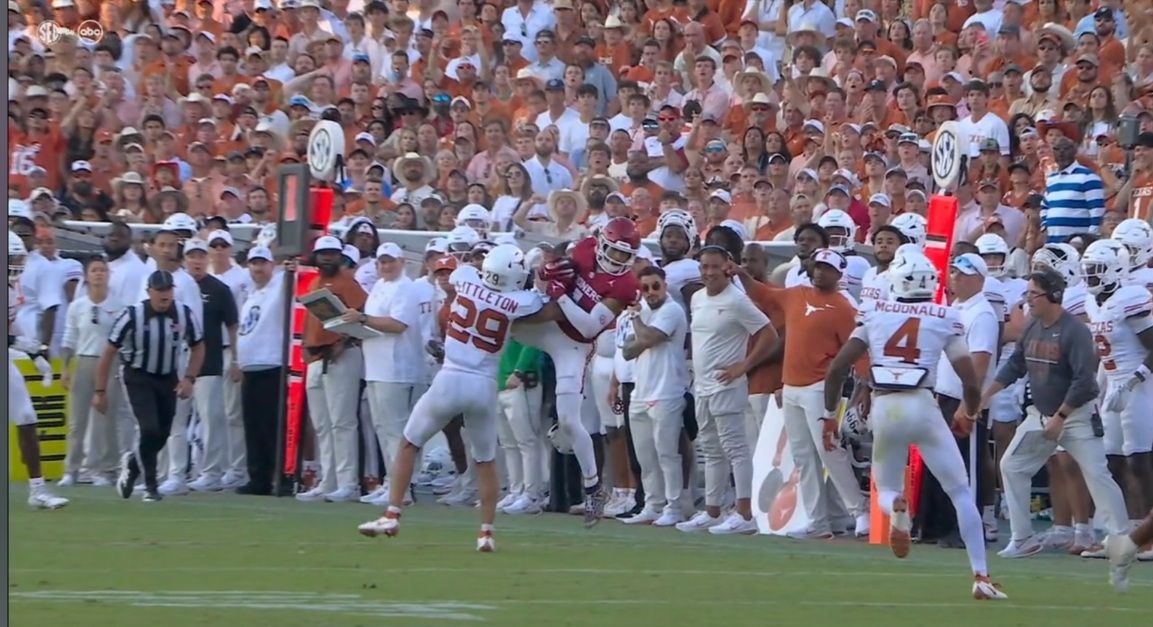
Tate Sandell’s 47-yard field goal as time expired will be remembered for years. Peyton Bowen’s fourth-quarter pick-six changed the game. Danny Okoye and Dakoda Fields delivered a special teams touchdown. Lloyd Avant helped revive the running game, and John Mateer found Isaiah Sategna III twice when Oklahoma needed one final push.
The Sooners did what they had to do to beat the No. 1 team in the country.
But winning and playing well are not always the same thing.
Oklahoma finished with just 238 total yards, struggled to protect Mateer, and managed only one net rushing yard in the first half. The offense needed a significant second-half adjustment, and the defense had to produce game-changing plays to compensate for the offense’s shortcomings.
That’s not a reason to diminish the victory. It’s a reason to examine it honestly.
Here are five crucial takeaways from Oklahoma’s stunning Red River Rivalry win and what they mean moving forward.
1. Oklahoma Found the Perfect Formula for an Upset. It Can’t Expect to Use It Every Week.
Let’s start with the obvious: Oklahoma’s ability to win without playing a complete offensive game was impressive.
The Sooners entered the rivalry at 2-2, facing an unbeaten Texas team ranked No. 1 nationally. They were coming off a difficult loss at Georgia, and the offense had given fans plenty of reasons to worry.
Then Oklahoma went out and won.
How?
The Sooners protected the football, forced critical turnovers, scored in all three phases, and delivered when the game was on the line.
The defense produced two interceptions, including Bowen’s 42-yard pick-six. Special teams delivered a touchdown when Okoye blocked a punt and Fields recovered it in the end zone. The offense eventually found enough rhythm to tie the game and put Sandell in position to win it.
Oklahoma also held Texas to just 3-of-14 on third downs and forced seven three-and-outs, a season high.
That’s complementary football. When one unit struggled, another found a way to make a difference.
But there’s a warning attached.
Oklahoma finished with 238 total yards. The offense didn’t score a passing touchdown, and the Sooners needed a defensive touchdown and a blocked-punt touchdown to help overcome their offensive limitations.
Those are legitimate concerns, even after a monumental victory.
Defensive touchdowns are difficult to produce consistently. Blocked punts are even less predictable. And while Oklahoma’s defense has shown it can make life difficult for opposing offenses, the Sooners shouldn’t need multiple non-offensive touchdowns to remain competitive every week.
The reality check: Oklahoma proved it can beat an elite opponent when the entire team contributes. Now it must find a way to win when the defense doesn’t score and special teams doesn’t produce a touchdown.
The victory showed Oklahoma’s ceiling. The offense still needs to establish a more dependable floor.
2. The Offensive Line’s First-Half Struggles Were Impossible to Ignore
The most encouraging offensive development of the afternoon was Oklahoma’s second-half rushing performance.
The most concerning development was that the Sooners needed halftime to find it.
Oklahoma managed just one net rushing yard on 13 carries in the first half. Texas generated pressure, disrupted the offense’s timing, and made it difficult for Mateer and the running backs to find any rhythm.
The Sooners couldn’t consistently move the line of scrimmage or establish a ground game that forced Texas to respect the run.
That put too much pressure on the passing attack.
When an offense struggles to run the football, it becomes easier for a defense to dictate the terms of engagement. Opponents can focus on pressuring the quarterback, disrupt the timing of passing concepts, and make every third down feel like a must-win situation.
That’s where Oklahoma found itself in the first half.
The second half, however, offered a glimpse of what the offense could become.
Oklahoma rushed for 80 yards on 12 carries in the third quarter, averaging 6.7 yards per attempt. Avant finished with 72 yards on 10 carries, including a 42-yard run that became Oklahoma’s longest rushing play of the season.
He also scored on a two-yard run to tie the game at 17.
The difference was significant. Oklahoma finally had a rushing threat capable of changing field position, creating manageable situations, and keeping the Texas defense from focusing exclusively on Mateer.
Credit belongs to the players and coaches for adjusting at halftime. The improvement demonstrated that the ground game wasn’t entirely beyond repair.
But one productive quarter doesn’t mean the problem has disappeared.
Oklahoma must determine why it struggled so dramatically early, identify which blocking combinations worked best after halftime, and establish greater consistency against the defensive fronts it will encounter in SEC play.
The Sooners cannot afford to spend another half searching for answers against a talented opponent.
The reality check: The second-half improvement was encouraging, but the first-half performance was a reminder that Oklahoma’s offensive line remains one of the team’s most important areas for improvement.
Avant gave the Sooners a spark. Now the offensive line must help make that spark repeatable.
3. John Mateer Earned a Moment of Trust. He Still Needs to Prove He Can Sustain It.
There are two ways to evaluate Mateer’s performance against Texas.
One is to look at the final drive and declare that Oklahoma’s quarterback has officially turned the corner.
The other is to examine the entire game, acknowledge the struggles, and recognize that the finish was still enormously important.
The second approach is more accurate.
Mateer finished with 155 passing yards and no touchdowns. Texas made him uncomfortable for much of the afternoon, and Oklahoma struggled to generate consistent production through the air.
Those numbers aren’t what the Sooners need from their quarterback over the long term.
But the final possession matters because quarterback play isn’t evaluated solely through passing yards and touchdowns. Decision-making, composure, and execution under pressure matter, too.
With 19 seconds remaining, Oklahoma had a choice: play conservatively and prepare for overtime or attempt to move into field-goal range.
The coaching staff trusted Mateer to make the necessary throws.
He responded by connecting with Sategna for gains of 13 and 20 yards. Those completions moved Oklahoma into position for Sandell’s game-winning kick.
That’s the sort of moment that can matter beyond the box score.
Mateer had faced questions about his play. Oklahoma’s offense had struggled, and the quarterback needed to demonstrate that he could execute when the pressure was at its highest.
He did exactly that on the final drive.
Still, it’s important not to confuse a clutch finish with a complete recovery.
Oklahoma needs Mateer to produce more consistently throughout games. The Sooners need better early-down efficiency, fewer stalled possessions, and a passing attack that can create points without relying on defensive and special teams touchdowns.
The final drive gives Mateer something to build on. It doesn’t eliminate the need for improvement.
The reality check: Mateer didn’t erase his early-season struggles, but he gave Oklahoma a reason to believe he can respond to adversity. His next challenge is turning a memorable 19-second sequence into four quarters of dependable quarterback play.
Take A Deeper Dive Into Our Oklahoma Football Coverage On Our Facebook Subscription Hub
Notes & Quotes: What The Sooners Said After Stunning No. 1 Texas
The Red River Overreaction Index: Sorting Fact From Fiction After Oklahoma’s Epic Cotton Bowl Upset
Red River Rivalry Key Notes & Storylines: Oklahoma Faces Its Biggest Test Yet
Help support Heartland Sports by Unlocking Exclusive, data-driven film room breakdowns, recruiting Update, high-leverage personnel matrix updates you won’t find anywhere else, and More by subscribing to our premium Oklahoma Sooners football coverage today.
4. Oklahoma’s Defense Is the Team’s Greatest Strength. Its Biggest Plays Came at Exactly the Right Time.
For all the questions surrounding the offense, Oklahoma’s defense continues to provide a foundation the Sooners can trust.
Texas entered the game unbeaten and ranked No. 1. The Longhorns had the talent to punish mistakes, stretch the field, and make Oklahoma pay for missed assignments.
Instead, the Sooners consistently found ways to disrupt Texas’s rhythm.
The third-down numbers tell part of the story. Texas converted just three of 14 opportunities, and Oklahoma forced seven three-and-outs.
The defense also created two interceptions, including the game’s most consequential defensive play.
Bowen’s 42-yard interception return for a touchdown gave Oklahoma a 24-17 lead in the fourth quarter. It was his first career interception return for a touchdown, and it transformed a defensive stop into seven points.
That distinction mattered.
Oklahoma didn’t merely force Texas to punt. It turned a defensive opportunity into a score that changed the pressure on both teams.
Courtland Guillory then recorded his first career interception with 19 seconds remaining, giving Oklahoma the possession it needed to set up Sandell’s winning kick.
Those plays were decisive, but the defensive contribution extended beyond the interceptions.
Owen Heinecke led the Sooners with nine tackles and recorded a career-high 2.5 tackles for loss. Taylor Wein added a sack and a quarterback hurry, while Trent Wilson recorded his first career sack.
Trystan Haynes also made an impact in his first career start, finishing with seven tackles and a pass breakup.
The defense’s performance was particularly important because the offense wasn’t consistently sustaining drives. Oklahoma needed its defense to get off the field, create short fields, and generate opportunities for the other units.
It did all three.
However, the next step is consistency. Oklahoma cannot assume every close game will feature a pick-six or a decisive interception in the final seconds.
The defense must continue limiting third-down conversions, generating pressure, and preventing opponents from turning isolated breakdowns into explosive plays.
The reality check: Oklahoma’s defense has demonstrated that it can be the backbone of a winning team. If the offense becomes more consistent, the Sooners will be far more dangerous because the defense won’t have to produce game-changing plays simply to keep them alive.
5. This Win Could Change Oklahoma’s Season. What Happens Against Kentucky Will Tell Us More.
Saturday’s victory changes the conversation surrounding Oklahoma.
Entering the game at 2-2, the Sooners were facing legitimate questions about their direction. The loss at Georgia had intensified scrutiny of the offense, and a matchup with the nation’s No. 1 team offered little margin for error.
Now Oklahoma has beaten Texas.
The Sooners have a signature victory, the Golden Hat is returning to Norman, and the locker room has tangible evidence that its work can produce results against elite competition.
That’s important for a team navigating a demanding schedule.
But the danger after a victory this significant is assuming that the hardest part is over.
It isn’t.
The Sooners still have to improve offensively. The offensive line must become more consistent. Mateer needs to sustain his late-game execution. And the defense must continue producing at a high level.
The next game against Kentucky will provide an important test of whether Oklahoma can carry its momentum forward.
Can the Sooners establish the run earlier? Can the offense sustain drives without depending on takeaways and special teams scores? Can Mateer build on his final drive against Texas? Can Oklahoma maintain its defensive intensity after an emotionally exhausting rivalry game?
Those questions will tell us more about the team’s long-term outlook than the celebration alone.
A win over No. 1 Texas is a tremendous achievement. It also creates an opportunity to establish a new standard for the remainder of the season.
Oklahoma has shown what it can do when all three phases contribute.
Now it must show that it can do it again.
The reality check: The Texas victory gives Oklahoma momentum, confidence, and a result that will resonate throughout the season. Beating Kentucky would provide something even more valuable: evidence that the Sooners are learning how to build on success instead of treating it as a one-week accomplishment.
The Final Word: Enjoy the Victory, but Don’t Ignore the Work Ahead
Oklahoma earned every second of its celebration.
The Sooners beat the No. 1 team in the country, won the Red River Rivalry, and delivered a finish that will be remembered long after this season ends.
Sandell made the kick. Bowen changed the game. Okoye and Fields delivered a special teams touchdown. Avant helped revive the running game. Mateer found Sategna when the opportunity arrived. And the defense repeatedly gave Oklahoma a chance to win.
That is a team victory, and it deserves to be recognized as one.
But the best thing Oklahoma can do with this win is learn from it.
The offensive struggles were real. The first-half rushing performance was unacceptable. Mateer still has room to improve. And the Sooners cannot depend on defensive touchdowns to compensate for offensive inconsistency every week.
Those truths don’t diminish the victory. They identify the next steps.
Oklahoma has proved it can beat the best team in the country on a day when almost everything is on the line.
The next challenge is proving that the Sooners can play well enough to avoid needing another miracle.