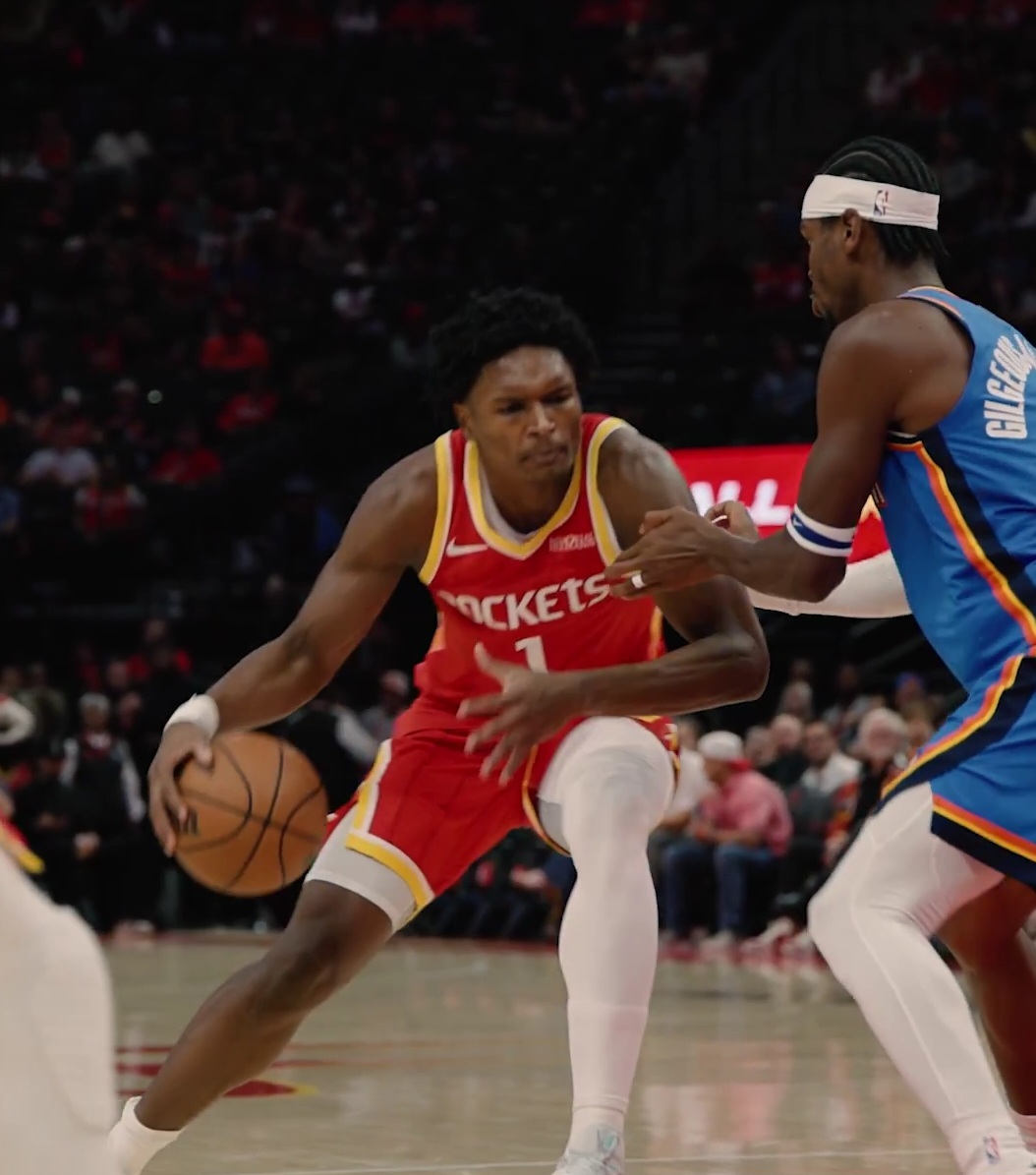
The Oklahoma City Thunder wanted one final opportunity to sharpen their rotation before the games started counting. Instead, they left Houston with a 116-89 loss, a frustrating shooting performance, and a reminder that even an established contender has work to do when key pieces are missing.
The Houston Rockets controlled the preseason finale Thursday night at Toyota Center, jumping out to a 33-15 first-quarter lead and eventually stretching the margin to 27 points. Oklahoma City briefly made things interesting before Houston pulled away again, turning what could have been a useful final dress rehearsal into a lopsided finish.
Jalen Williams led the Thunder with 18 points and seven rebounds, while Shai Gilgeous-Alexander added 17 points and three assists. Rookie center Aday Mara contributed six points, nine rebounds, two assists, and a block in just under 21 minutes.
But the defining number was 5-for-36 from three-point range.
Oklahoma City made just 13.9% of its attempts from beyond the arc. Against a Houston team that shot 17-for-53 from deep, the difference in perimeter production proved impossible to overcome.
A Rough Opening Puts the Thunder in a Hole
The Thunder entered the finale without Chet Holmgren, Cason Wallace, and Jaylin Williams. Holmgren’s absence was particularly notable with Oklahoma City evaluating its frontcourt combinations, while Wallace’s unavailability removed another established perimeter defender from the equation.
Ajay Mitchell moved into the starting lineup, but the early minutes belonged to Houston.
The Rockets attacked with physicality, put pressure on Oklahoma City’s interior defense, and built a double-digit advantage before the Thunder could find much offensive rhythm. Amen Thompson provided downhill pressure, while Alperen Şengün helped Houston establish its presence around the basket.
Oklahoma City struggled to generate consistent offense. The Thunder went into the second quarter trailing 33-15, having scored only 15 points in the opening period.
The deficit was not solely a product of poor three-point shooting. Oklahoma City had trouble creating a dependable flow, and the early offensive struggles put additional pressure on a lineup already missing important pieces.
Houston, meanwhile, played with the urgency of a team determined to finish its preseason on a positive note. The Rockets moved the ball, attacked defensive openings, and forced Oklahoma City to spend much of the opening quarter reacting rather than dictating terms.
For the Thunder, the challenge was finding a way to stabilize the game before the margin became insurmountable.
Jalen Williams and Shai Gilgeous-Alexander Provide a Response
Oklahoma City found a better rhythm in the second quarter.
Williams and Gilgeous-Alexander helped lead the response as the Thunder began attacking more effectively and found opportunities to score in transition. Alex Caruso also contributed to the push, helping Oklahoma City generate offense before Houston could fully establish its half-court defense.
The Thunder scored 32 points in the second quarter, cutting a deficit that had reached 18 points to seven by halftime.
Williams finished with 18 points on 7-of-14 shooting, including two three-pointers. He added seven rebounds and provided one of Oklahoma City’s more encouraging performances on a night when the team struggled to find consistent scoring.
Gilgeous-Alexander scored 17 points, shooting 5-of-12 from the floor and making all five of his free throws. His ability to create points at the line helped keep the Thunder within striking distance during the middle portion of the game.
The second-quarter response mattered because it demonstrated that Oklahoma City could generate offense even after a disastrous start. The Thunder attacked the basket more effectively, found better opportunities in transition, and briefly put pressure on Houston to respond.
However, the comeback remained incomplete. Oklahoma City still needed more perimeter production, and the second-half challenge was to sustain that offensive improvement against a Houston defense that could adjust.
The Three-Point Problem Never Went Away
The Thunder’s 5-for-36 performance from beyond the arc was the clearest statistical explanation for the offensive struggles.
Oklahoma City shot 40.4% overall, but its inability to convert from three-point range allowed Houston to concentrate more attention on the paint and the players operating inside it.
When a team is not making outside shots, driving lanes become more crowded. Defenders can sag toward the basket, help earlier against penetration, and recover with less fear of giving up an open perimeter look.
That creates a difficult environment for an offense built around attacking advantages and making the next pass.
Isaiah Hartenstein finished with six points and eight rebounds. His screening, passing, and interior presence remain useful components of Oklahoma City’s offense, but those strengths are harder to maximize when the defense can shrink the floor.
The issue was not that Hartenstein suddenly became ineffective. It was that the Thunder had fewer ways to make Houston pay for loading up inside.
Jared McCain experienced the same shooting problem. After erupting for 20 points and six three-pointers against Indiana, McCain scored eight points against Houston and missed all eight of his three-point attempts.
One poor shooting night does not erase what McCain showed against the Pacers. It does, however, underline the volatility Oklahoma City must account for as it works to establish its second-unit rotation.
The Thunder do not need to make every three-pointer. They do need to generate enough credible perimeter offense to prevent opposing defenses from treating the paint as their first and last priority.
Bogdanović Helps Houston Pull Away
The game remained more competitive after Oklahoma City’s second-quarter push, but Houston regained control after halftime.
Bogdan Bogdanović delivered one of the Rockets’ most damaging performances, scoring 15 points in approximately 16 minutes off the bench and making five of his eight three-point attempts.
His shooting illustrated the difference between the two teams on this particular night. While Oklahoma City struggled to convert open-floor and perimeter opportunities, Houston found a productive outside shooter who could punish the defense when attention shifted elsewhere.
The Rockets also received 14 points, seven rebounds, five assists, and two blocks from Şengün. Thompson added 12 points, five rebounds, and four assists, while Kevin Durant scored 11 points in limited minutes.
Houston finished with 34 assists, compared with 19 for Oklahoma City. The Rockets also recorded 12 steals and committed only eight turnovers, while the Thunder gave the ball away 16 times.
Those numbers reflect a broader difference in execution. Houston moved the ball more effectively, created more opportunities for teammates, and did a better job turning defensive activity into control of the game.
Oklahoma City scored 22 points in the third quarter but could not close the gap. In the fourth, Houston outscored the Thunder 37-20 as the game moved deeper into reserve minutes and the margin ballooned.
The final quarter made the score look even worse, but the problems had been developing well before the benches took over.
Aday Mara Offers a Bright Spot
There were still useful developmental minutes for Oklahoma City, particularly for Mara.
The rookie center finished with six points, nine rebounds, two assists, and one block while shooting 3-of-4 from the floor. His rebounding helped him remain involved even as the Thunder struggled to establish offensive consistency.
Mara’s size and interior presence give the coaching staff an intriguing option as it evaluates frontcourt depth. The next step is determining how his physical tools translate against NBA opponents who can test his positioning, decision-making, and ability to finish possessions.
His performance was not enough to change the outcome, but it offered another opportunity to evaluate his progress before the regular season begins.
The same principle applies to Oklahoma City’s other reserves. Preseason results matter less than the information they provide, and this game gave the coaching staff a clearer picture of the areas requiring attention.
What the Thunder Must Take Into Opening Night
Oklahoma City finishes its preseason at 1-4, but the record itself is not the primary concern. Exhibition games are about preparation, experimentation, and making decisions before the standings begin to matter.
The more important questions involve execution and rotation.
Can the Thunder find dependable perimeter production when McCain is not making shots? How will the team adjust its frontcourt combinations when Holmgren is unavailable? Which reserves can provide reliable minutes without compromising defensive communication or offensive flow?
The loss to Houston does not answer those questions on its own. It does make them harder to ignore.
Oklahoma City’s second-quarter response showed that the offense can recover after a poor start. The second half showed how quickly that progress can disappear when shots stop falling and the opposition continues to execute.
The Thunder now turn their attention to the regular season, opening against the San Antonio Spurs on Tuesday, October 20.
The preseason is over. The evaluation period is closing, and the margin for error is about to become much smaller.
The final lesson from Houston is straightforward: Oklahoma City can survive a cold stretch, but it cannot allow poor perimeter shooting to dictate the terms of its entire offense.