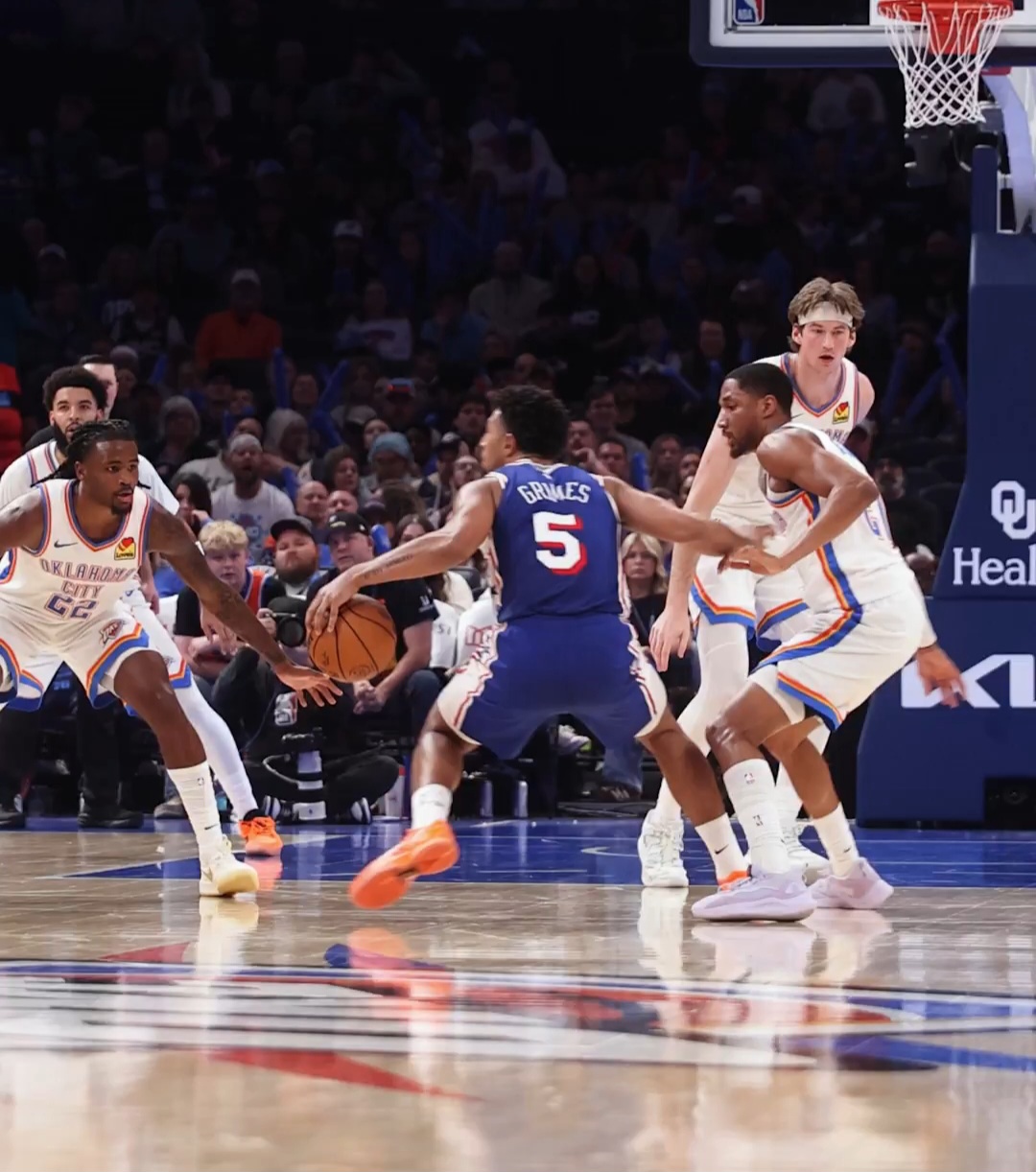
The most important thing the Oklahoma City Thunder did Sunday night against the Philadelphia 76ers didn’t show up in the box score.
It happened at halftime.
After two uneven quarters, with the game tighter than expected and the rhythm not quite right, the defending NBA champions walked into the locker room and made a decision. Not a tactical tweak alone. Not just an emotional reset. A championship decision — to stop allowing variables, stop flirting with inefficiency, and impose their will.
What followed was a 38–24 third quarter, a flood of turnovers forced, a surge of confidence from a rising star, and ultimately a 129–104 dismantling of a proud Eastern Conference opponent. This wasn’t a feel-good bounce-back win. It was something far more meaningful.
It was a reminder of how champions respond when the game asks questions.
The Chet Holmgren Game — And Why It Matters More Than the Stat Line
Yes, Chet Holmgren scored 29 points on 12-of-17 shooting. Yes, he controlled the paint, finished through contact, and looked every bit like a player comfortable carrying responsibility.
But the real significance of Holmgren’s night wasn’t dominance — it was authority.
Against Philadelphia, Holmgren wasn’t just a beneficiary of space created by Shai Gilgeous-Alexander. He was a central figure in dictating defensive coverage. When the Sixers tried to stay home on shooters, he punished them inside. When they collapsed, he moved the ball decisively or stepped out and hit from range. When they hesitated, he attacked the rim.
That’s not growth. That’s arrival.
Championship teams need more than stars — they need pressure points. Holmgren becoming one changes the geometry of the floor in ways that elevate everyone else. It’s no coincidence Oklahoma City’s best basketball came when he was fully engaged and fully trusted.
This wasn’t a flash. It was a statement.
The Third Quarter Was the Season in Microcosm
If you want to understand why Oklahoma City is still the team everyone must measure against, rewatch the third quarter.
Philadelphia entered halftime believing. The Thunder exited halftime deciding.
Oklahoma City turned defense into offense with ruthless efficiency. Passing lanes closed. Ball handlers were harassed without fouling. Help defense arrived early and rotated out cleanly. The Sixers didn’t implode — they were suffocated.
Fourteen Philadelphia turnovers in the second half weren’t accidental. They were induced. And Oklahoma City converted them into easy points, forcing the Sixers to defend in retreat — a losing proposition against a team this fast, this skilled, and this disciplined.
That third quarter wasn’t chaos. It was controlled violence, the kind championship teams unleash when they want to end debate early.
Shai’s Night Was Quiet — And That’s the Point
Shai Gilgeous-Alexander scored 27 points on near-perfect efficiency, extended his historic scoring streak, and committed just one turnover. And somehow, it didn’t feel like a Shai game.
That’s not a knock. It’s a luxury.
The Thunder didn’t need Shai to rescue them. They needed him to steady them, and that’s exactly what he did. When Philadelphia flirted with momentum early, Shai kept Oklahoma City connected. When the run came after halftime, he guided it without hijacking it.
This is what elite leadership looks like at the highest level. Not dominance by necessity — dominance by design.
Shai’s presence continues to give Oklahoma City the most valuable currency in basketball: late-game certainty. But the most encouraging development is how rarely they now need to spend it.
Depth Isn’t About Numbers — It’s About Trust
One of the quieter takeaways from Sunday’s win was how smoothly Oklahoma City navigated rotations.
Aaron Wiggins. Jalen Williams. Role players who didn’t force offense but punished mistakes. Shooters who spaced the floor without hunting shots. Defenders who rotated on time and closed under control.
This wasn’t bench production for the sake of balance. It was functional depth, the kind that keeps pressure constant even when stars rest.
Philadelphia, short-handed without Joel Embiid, felt the difference acutely. Once Oklahoma City built separation, the Sixers simply didn’t have answers. Every substitution extended the gap instead of stabilizing it.
That’s what separates contenders from champions — the ability to maintain identity regardless of lineup.
Context Matters — But Execution Matters More
Yes, Philadelphia was without Embiid. That matters. But it doesn’t explain a 25-point loss defined by execution gaps, not individual absences.
The Thunder didn’t win because the Sixers were limited. They won because they recognized limitations and exploited them mercilessly.
That’s not opportunism. That’s professionalism.
Great teams don’t wait for opponents to be whole. They don’t apologize for circumstances. They play the game in front of them, at the level required to win decisively.
Oklahoma City did exactly that.
This Was the Correct Response
After back-to-back losses to San Antonio, there was curiosity around this game. Not concern — curiosity.
Would the Thunder play tight? Would they overcorrect? Would they chase style points?
Instead, they did what champions do. They simplified. They defended. They trusted structure. And when the opening appeared, they took control without drama.
This win didn’t erase the Spurs losses — and it shouldn’t. Those games offered valuable lessons. But this performance showed those lessons were absorbed, not internalized as doubt.
That distinction matters.
The Bigger Picture
This wasn’t Oklahoma City announcing itself. They already did that last season.
This was Oklahoma City reaffirming its identity:
- Defense that travels
- Stars who scale
- Depth that sustains pressure
- Adjustments that arrive on time
The Thunder didn’t need a perfect night. They needed a correct one. And against Philadelphia, they delivered it.
If the Spurs games were about friction, this one was about resolution.
And as the calendar turns and the league settles into its long winter grind, Oklahoma City once again looks like what it has been all along — the standard everyone else must reach, even on nights when the rhythm isn’t perfect.
That’s what champions do.
Follow us on Instagram & Facebook