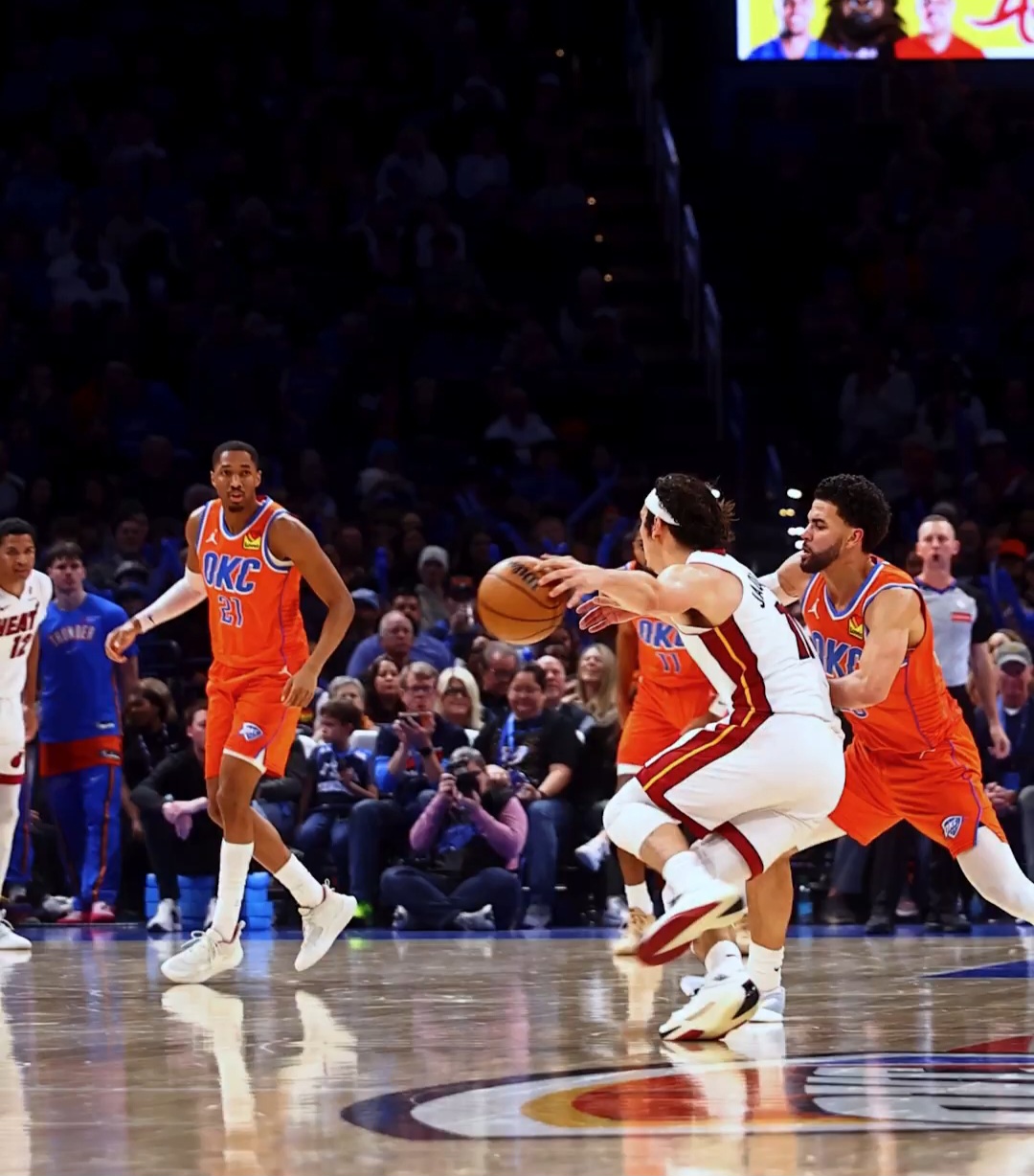
There’s a moment in every NBA game when the truth comes out.
Not the scoreboard truth. Not the box-score truth. The competitive truth. The kind that reveals which team is reacting and which team is imposing. On Sunday night at the Paycom Center, that moment arrived somewhere in the middle of the third quarter, when the Oklahoma City Thunder stopped playing with the Miami Heat and started playing through them.
From there, the game was over—long before the final horn sealed a 124–112 win.
The Thunder’s 39–26 third quarter wasn’t just a run. It was a declaration. A reminder that this team doesn’t need to dominate wire to wire to control a game, and that their greatest strength might be their ability to flip the switch from patience to punishment faster than almost anyone in the league.
Miami came in doing what Miami does. They executed. They shot the ball extremely well. They stayed connected early. They played with purpose. For a while, that was enough to keep the Thunder from fully breathing.
Then Oklahoma City decided it was time to take the game personally.
The 15–0 run that turned a manageable contest into a Thunder runway wasn’t fueled by shot-making luck or a hot hand. It was fueled by pressure. Relentless, intelligent, suffocating pressure. The kind that doesn’t just force turnovers—it forces hesitation, second-guessing, and rushed decisions that compound possession after possession.
By the end of the night, Miami had committed 23 turnovers. Oklahoma City turned those mistakes into 39 points.
That’s not a coincidence. That’s an identity.
What makes this Thunder team so dangerous isn’t that they can score 124 points. Plenty of teams can do that on a good night. What makes them dangerous is that they can do it even when the opponent shoots 53.7 percent from the field. When your opponent is making shots at that clip and still loses by double digits, the game wasn’t decided by offense. It was decided by control.
And Oklahoma City controlled everything that mattered.
Shai Gilgeous-Alexander, once again, was the calm center of the storm. His 29 points, eight assists, and five rebounds were delivered without urgency, without wasted movement, without panic. He didn’t hijack the third quarter—he orchestrated it. Every Miami mistake was punished in rhythm. Every scramble was answered with balance. SGA’s brilliance lies not in volume, but in timing. He always seems to know exactly when to accelerate and when to let the defense destroy itself.
But the most important part of that third quarter wasn’t who scored.
It was who swarmed.
Jalen Williams didn’t force anything. He cut with purpose, defended with intensity, and stayed connected to the game even when he wasn’t the focal point. Chet Holmgren didn’t chase blocks—he took space away. His 16 points and 10 rebounds were the byproduct of being exactly where he needed to be, not trying to be everywhere at once.
And then there was the collective effort—the hands in passing lanes, the quick rotations, the way Oklahoma City turned Miami’s structure into a liability. The Heat pride themselves on execution. On reading the floor. On playing one step ahead.
For one quarter, the Thunder made that impossible.
This is where Oklahoma City separates itself from being merely talented and becoming something more threatening.
Most young teams rely on energy swings. When things go well, they snowball. When they don’t, the cracks show. The Thunder are past that stage. They don’t rely on emotion. They rely on systems. Pressure isn’t something they turn on—it’s something they return to.
That’s why the third quarter wasn’t surprising. It was predictable.
The Thunder entered halftime trailing early but not rattled. They didn’t come out firing threes to erase the deficit. They came out squeezing the game. Passing angles narrowed. Ball-handlers were bumped early. Help defense arrived on the catch instead of the drive. Miami didn’t suddenly play worse basketball. They were simply denied the comfort of playing their basketball.
That’s the mark of a team that understands leverage.
And it’s why Oklahoma City’s record—33–7—feels earned rather than inflated.
This wasn’t a game where one player saved the night. It was a game where the Thunder trusted who they are. Even Jaylin Williams’ return, modest on the stat sheet with nine points, mattered because it reinforced continuity. Roles didn’t change. Responsibilities didn’t shift. Everyone slid back into place.
Meanwhile, Miami did what good teams often do when faced with overwhelming pressure—they kept shooting. And to their credit, the shots fell. Andrew Wiggins and Tyler Herro played well. The Heat didn’t crumble offensively. They were simply overwhelmed by the volume of mistakes they were forced into.
You can survive a bad shooting night. You can survive a rebounding deficit. You cannot survive 23 turnovers against a team built to run decision-makers into quicksand.
That’s the lesson of this game.
Oklahoma City doesn’t need perfection. They don’t need the opponent to cooperate. They don’t even need the lead early. What they need is time. Because the longer the game goes, the more possessions they control, the more pressure they apply, the more likely it is that the dam breaks.
And when it does, it breaks fast.
The third quarter against Miami wasn’t loud because of the scoreboard. It was loud because of inevitability. Every turnover felt heavier than the last. Every Thunder bucket felt like confirmation rather than surprise. By the time the fourth quarter arrived, the game had already been decided—it just hadn’t officially ended yet.
This is what contender basketball looks like in January.
Not dominance without resistance. Not highlights without substance. But the ability to identify the moment where the game is still undecided—and seize it completely.
The Thunder did that Sunday night in one devastating quarter.
Follow us on Instagram & Facebook