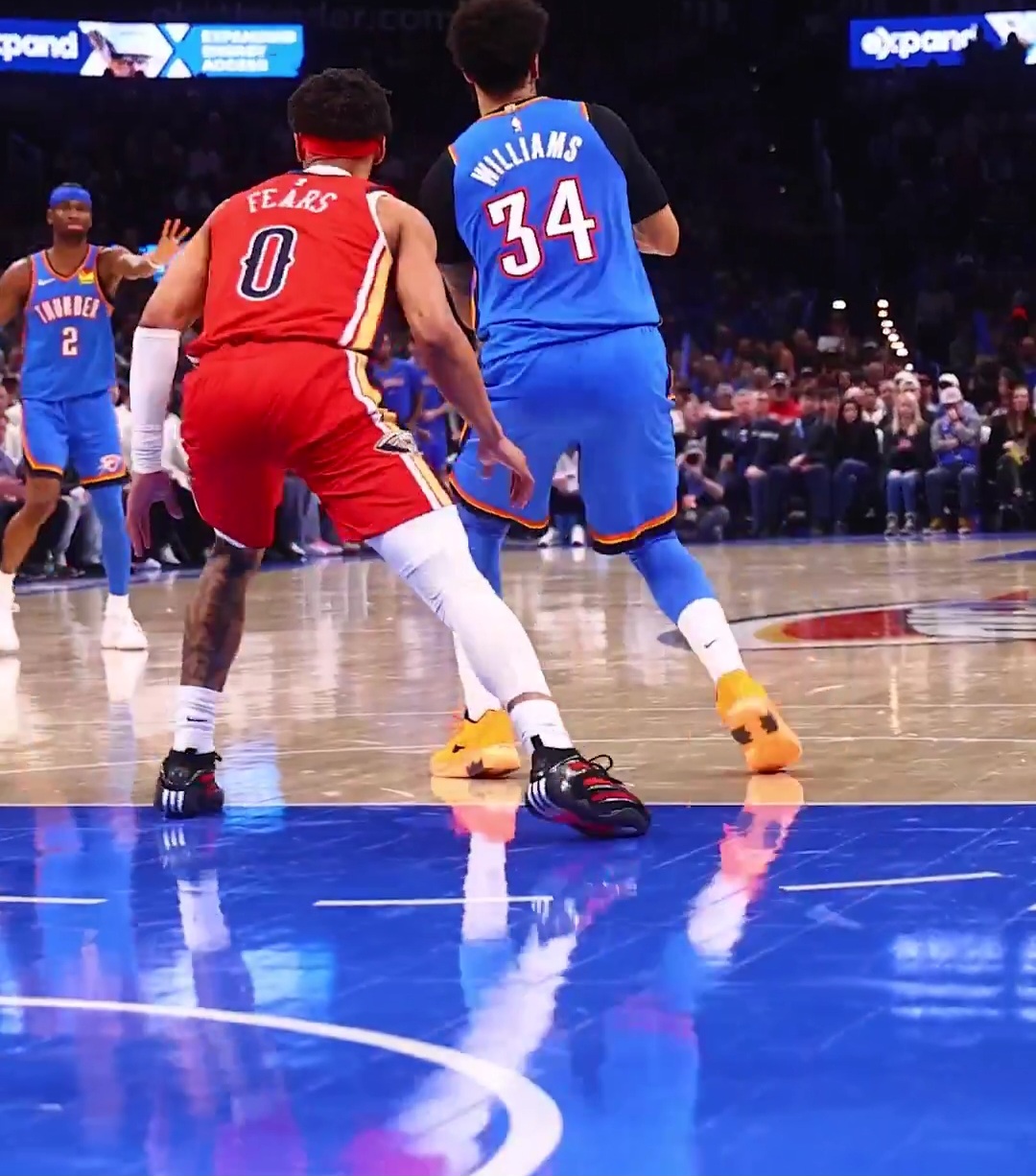
By the time the final horn sounded inside Paycom Center on Tuesday night, the Oklahoma City Thunder had done something that contenders must learn how to do in January: win a game they didn’t particularly like.
The Thunder’s 104–95 victory over the New Orleans Pelicans wasn’t pretty. It wasn’t efficient in the traditional sense. It didn’t feature highlight-reel shot-making for long stretches, nor did it resemble the offensive flow Oklahoma City usually prides itself on.
But it did resemble a team with championship habits.
Short-handed, fatigued, and staring down the possibility of their first three-game losing streak in more than two years, the Thunder leaned on advanced margins — free throws, turnovers, defensive shot quality, and late-game execution — to secure a win that said more about who they are than how they played.
At 38–10, Oklahoma City didn’t just avoid a skid. It reinforced why its floor remains so high even when the offense sputters.
A Game Decided in the Margins
At first glance, the team stats tell a familiar story: neither side shot well. Oklahoma City finished at 40 percent from the field, New Orleans at 34 percent. The Pelicans actually attempted 12 more shots and won the rebounding battle 54–53, including a significant edge on the offensive glass.
And yet, the Thunder never truly lost control of the game.
Why? Because every other efficiency lever tilted decisively in Oklahoma City’s favor.
The Thunder committed just nine turnovers, compared to 16 by New Orleans, a disparity that quietly shaped the entire night. Oklahoma City converted those mistakes into early offense — including 13 points off turnovers in the first quarter alone — allowing them to build rhythm without needing half-court shot-making.
Add in a massive free-throw advantage — 21-of-23 (91 percent) for OKC versus 17-of-22 (77 percent) for New Orleans — and the math becomes unavoidable. In a game where neither team could consistently score from the field, Oklahoma City dominated the easiest points available.
Advanced efficiency metrics back that up. The Thunder finished with a true shooting percentage of 60.4 percent, significantly higher than the Pelicans’ 56.4 percent, despite similar raw shooting struggles. That gap was almost entirely created at the foul line and through shot selection late in possessions.
This was a game where Oklahoma City didn’t outplay New Orleans — it out-managed them.
Shai Gilgeous-Alexander: Control Without Chaos
Shai Gilgeous-Alexander’s 29-point performance won’t go down as one of his flashiest, but it might be one of his most representative.
With the offense bogged down and multiple rotation players unavailable, Gilgeous-Alexander turned the game into something he could dictate. He attacked selectively, lived at the free-throw line (13-of-14), and never forced tempo when it wasn’t there.
His +14 plus/minus in 36 minutes told the real story. When Shai was on the floor, the Thunder created separation — not with scoring bursts, but with composure.
Equally important: he didn’t need to dominate usage to dominate impact. His scoring came within the offense, his defensive pressure disrupted passing lanes, and his late-game possessions drained the clock and the Pelicans’ belief simultaneously.
This marked the 118th consecutive game in which Gilgeous-Alexander scored 20 or more points — the second-longest streak in NBA history — but the number mattered less than the manner. This was control, not volume.
Holmgren Anchors Everything
If Gilgeous-Alexander controlled the game, Chet Holmgren defined it.
Holmgren finished with 20 points, 14 rebounds, and five blocks, numbers that barely capture how thoroughly he warped New Orleans’ offense. The Pelicans shot just 34 percent overall and 25 percent from three, and much of that inefficiency stemmed from Holmgren’s ability to erase mistakes at the rim.
Zion Williamson had his moments — 21 points on 8-of-11 shooting — but even those touches came with consequence. Holmgren’s length discouraged secondary actions, wiped out dump-offs, and forced New Orleans into late-clock jumpers that never stabilized.
Advanced defensive impact doesn’t always show up in box scores, but Holmgren’s presence was unmistakable. When he was on the floor, the Pelicans’ offensive rating cratered, and their spacing collapsed inward.
In a game where Oklahoma City lacked several perimeter defenders, Holmgren’s rim protection became the structural backbone of the win.
Unsung Scorers Step Forward
With Jalen Williams, Isaiah Hartenstein, Cason Wallace, and Alex Caruso unavailable, Oklahoma City needed supplemental scoring — not necessarily in volume, but in timing.
They got it.
Lu Dort chipped in timely buckets while providing physical defense late, Isaiah Joe knocked down threes to punish defensive lapses, and Jaylin Williams helped stabilize the interior minutes when Holmgren rested. No Thunder player besides Shai and Chet cracked 20 points, but several cracked momentum.
That’s where advanced context matters. Oklahoma City didn’t need a third scorer to carry the offense — they needed players who could finish possessions without compromising defensive integrity. They got exactly that.
New Orleans’ Efficiency Problem
For the Pelicans, the advanced metrics painted a brutal picture.
Trey Murphy III endured one of the worst shooting nights of his career, finishing 3-of-20 from the field and 0-of-5 from three, a performance that single-handedly dragged down New Orleans’ spacing. His inefficiency allowed Oklahoma City to help aggressively without paying the price.
Even more telling was the impact of reserve center Karlo Matković, who posted a team-worst -19 net rating. During his minutes, the Pelicans were consistently outscored, struggled to defend pick-and-roll actions, and failed to finish defensively.
While Zion Williamson (+4 plus/minus) played well individually, New Orleans never found a lineup combination that could sustain positive stretches on both ends.
Turnovers, poor shot quality, and inconsistent rotation play doomed them — and the Thunder exploited all three.
Late-Game Execution and Edge
The final five minutes told the story of the night.
Oklahoma City slowed the game, hunted mismatches, and forced New Orleans to execute in the half court — something the Pelicans never proved they could do consistently. Shai’s free throws, Holmgren’s rim deterrence, and a pair of timely defensive possessions sealed it.
Tempers flared late, technical fouls were exchanged, and the physicality ramped up — a sign that New Orleans knew the game had slipped away long before the scoreboard confirmed it.
What This Win Actually Means
This wasn’t a statement win. It was something better.
The Thunder won a game where:
- They shot just 40 percent.
- They were outrebounded.
- They were missing key rotation players.
- The pace never favored them.
And they still controlled the outcome.
Advanced metrics love this kind of win because it’s sustainable. Free-throw efficiency. Turnover control. Defensive rim protection. Late-game execution. These are the traits that travel — and the traits that matter in May.
For Oklahoma City, Tuesday night wasn’t about dominance. It was about discipline.
And for a team with championship aspirations, that might be the most encouraging sign of all.
Follow us on Instagram & Facebook