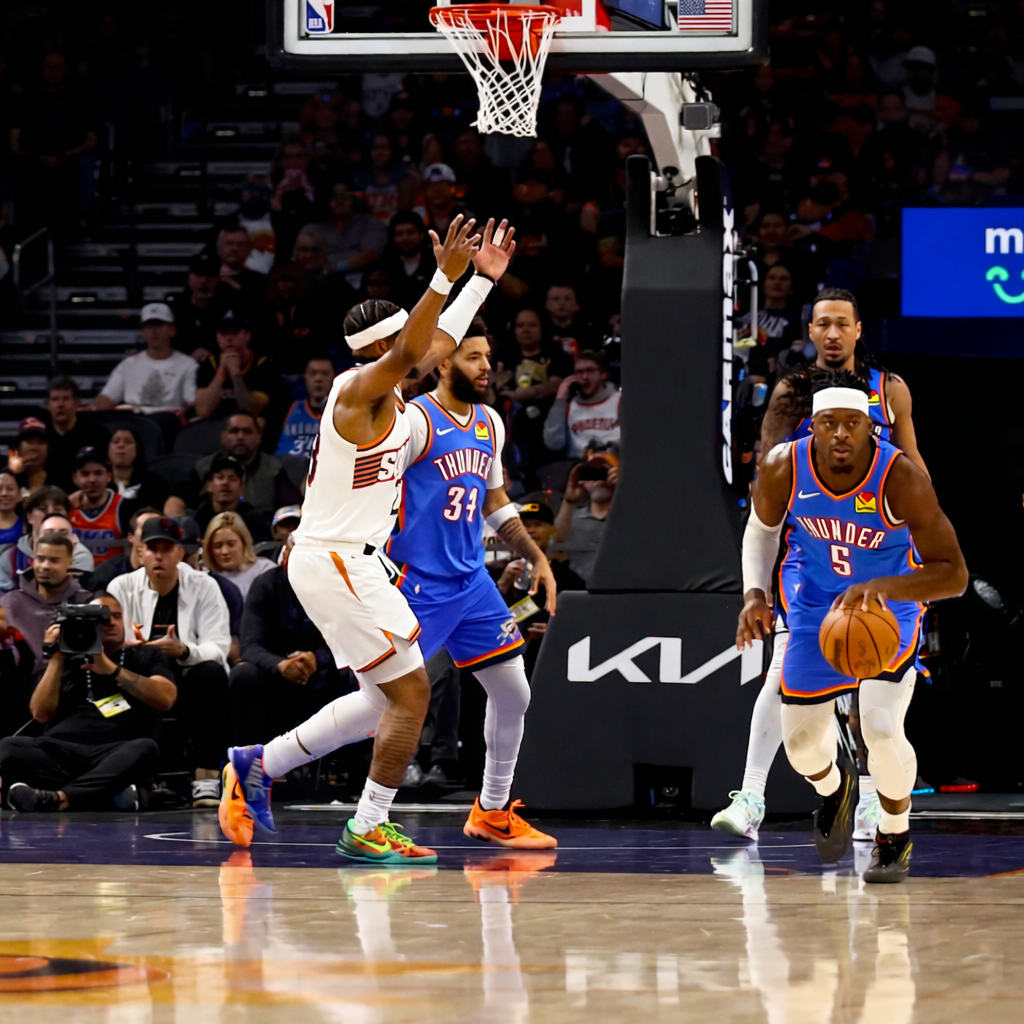
There are nights in the NBA that feel like a negotiation. Two teams probe, adjust, counter, and eventually one side finds just enough leverage to tilt the result. And then there are nights like Wednesday in Phoenix, where the conversation ends before it ever really begins.
Oklahoma City’s 136–109 dismantling of the Suns wasn’t dramatic, suspenseful, or particularly cinematic. It was something far more unsettling for the rest of the league: instructional. Clean lines. Clear roles. Relentless pace. The Thunder didn’t win this game by surviving chaos. They won it by erasing uncertainty altogether.
By halftime, the outcome was already decided. By the middle of the third quarter, the Suns were reduced to spectators. And by the final buzzer, Oklahoma City had done something contenders rarely manage on the road — they made a professional NBA opponent look like it had arrived without a plan.
That matters, because blowouts are easy to dismiss. Missing stars. Schedule loss. Bad shooting night. Pick your qualifier. But not all blowouts are equal. Some happen because one team gets hot. Others happen because one team knows exactly who it is — and the other doesn’t.
This one fell squarely in the second category.
The Thunder entered the night without Shai Gilgeous-Alexander, the reigning MVP and the gravitational center of their offense. Phoenix countered by sitting Devin Booker, Jalen Green, and Grayson Allen, effectively signaling that this game was less about the standings and more about survival. On paper, that should have narrowed the gap. In practice, it widened it.
Because Oklahoma City doesn’t treat absence as disruption. It treats it as redistribution.
From the opening possession, the Thunder played with the unmistakable confidence of a group that knows where its shots are coming from and why. The ball didn’t stick. The floor didn’t shrink. The Suns’ defensive rotations — already stressed — were immediately put under siege by pace and spacing that never wavered.
The numbers tell the story bluntly. Oklahoma City shot over 61 percent from three in the first half. They scored 75 points before the break. They led by 23 at halftime and by as many as 37 shortly thereafter. But those figures don’t fully explain what happened. They only confirm it.
This wasn’t a heater. It was a system firing at full capacity.
At the center of it all was Jalen Williams, returning home and performing like someone deeply aware of the moment — and completely uninterested in overplaying it. Twenty-eight points on 11-of-12 shooting in just 19 minutes is the kind of efficiency that borders on absurd. Nineteen of those points came in a third quarter that turned the game from lopsided to unrecognizable.
What made Williams’ performance so striking wasn’t the shot-making itself, though that was pristine. It was the economy. No wasted dribbles. No forced attempts. Every look arrived on time and in rhythm, the product of a defense already compromised by Oklahoma City’s spacing and ball movement.
He didn’t hunt the spotlight. The spotlight found him.
And just as quickly, it was gone. Williams exited midway through the third quarter after appearing to aggravate his hamstring — a moment that cast a sobering shadow over an otherwise dominant night. The reaction on the Thunder bench said everything. Concern, yes. Panic, no.
Because by that point, the structure had already done its work.
If there was a defining element of this game, it was the Thunder’s bench — not merely productive, but overwhelming. Seventy-four points from the second unit isn’t just an advantage. It’s a philosophical statement. Isaiah Joe drilled six threes and finished with 21 points, stretching the floor until Phoenix had no answers left. Kenrich Williams provided connective tissue. Jaren McCain, still settling into his role after the deadline, played with a calm that suggested this environment suits him just fine.
These weren’t minutes being survived. They were minutes being leveraged.
That’s the difference between depth and redundancy. Oklahoma City doesn’t stack players who replicate the same function. It layers complementary skills so that the machine never stalls. When one piece comes off the board, another slides into place without altering the shape of the offense or the intent of the defense.
Phoenix, by contrast, looked like a team improvising. Dillon Brooks scored 23 points, but most of it felt like noise rather than influence. The Suns tried to shorten the game, slow the tempo, and limit damage. None of it worked. Oklahoma City simply played through them.
The Thunder’s defense deserves just as much credit as the offense, even if the final score suggests otherwise. Phoenix never found a sustained rhythm. Passing lanes closed early. Drives were crowded. Rotations were sharp enough to discourage kick-outs before they even materialized. The Suns didn’t just miss shots — they hesitated, and against this team, hesitation is fatal.
What made the performance so revealing is that Oklahoma City didn’t need to escalate emotionally to achieve separation. There was no chest-beating run, no demonstrative moment meant to break the opponent’s spirit. The break happened quietly, possession by possession, as the Suns realized there was no pressure point to push.
That’s a dangerous realization for the rest of the Western Conference.
Because this wasn’t a game the Thunder needed to win. At 41–13 entering the night, their position was secure. This was a game that revealed how they choose to win — with precision rather than urgency, with patience rather than force.
It also reframed an increasingly important question about their ceiling. Oklahoma City is no longer proving it can survive without its star. That discussion is outdated. The more pressing reality is that the Thunder can impose their style without negotiating terms.
When Gilgeous-Alexander sits, the offense doesn’t scramble to replace his shot creation. It redistributes responsibility. When Williams exits, the pace doesn’t dip. The ball keeps moving. When the opponent concedes the perimeter, the Thunder punish it. When the opponent tries to protect the arc, they slice the interior.
Every response is preloaded.
This is how elite teams separate themselves in February. Not with statement wins, but with games that never require statements at all. Oklahoma City didn’t send a message to Phoenix so much as it reinforced one the league has been receiving for months: this team doesn’t rely on conditions. It creates them.
The only lingering discomfort from the night surrounds Williams’ hamstring, and rightly so. His health matters — not just because of his production, but because of what he represents in this ecosystem. He is the clearest indicator of Oklahoma City’s next evolutionary step: a team that doesn’t just overwhelm with depth, but can surgically dismantle opponents through multiple primary options.
Even without him finishing the night, the lesson remained intact.
The Thunder head into the All-Star break with the league’s best record and a growing sense that their dominance is no longer theoretical. They don’t just beat teams. They clarify the gap.
Wednesday night wasn’t about Phoenix’s absences or Oklahoma City’s shooting variance. It was about the comfort level of a group that knows its identity so thoroughly that the game bends around it.
That’s not a phase. That’s a foundation.
And if the rest of the West was hoping Oklahoma City might eventually reveal a soft spot — a game where the structure frays or the depth blinks — this wasn’t it.
This was the Thunder at full volume, even without all the instruments.
And that should register.
Follow us on Instagram & Facebook