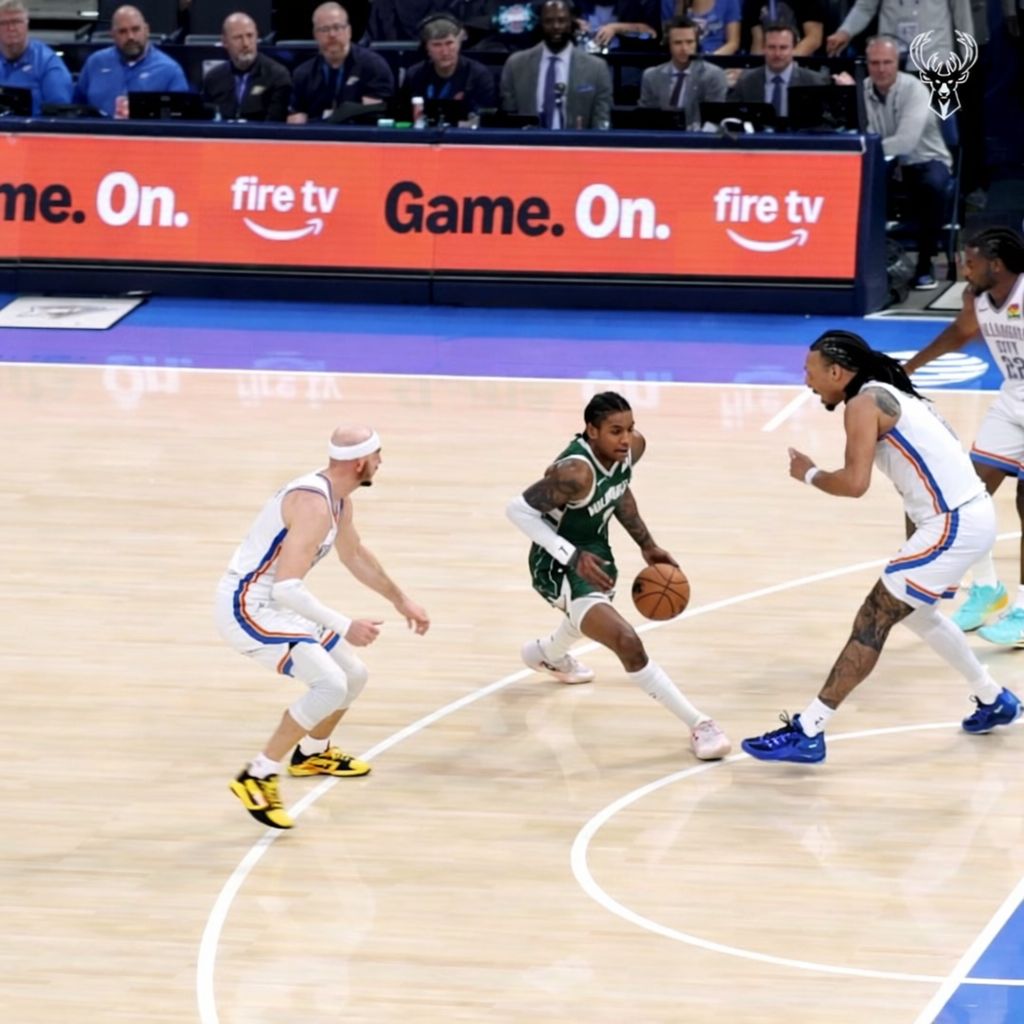
There is a particular kind of loss that doesn’t bruise the standings but still leaves a mark. It doesn’t announce panic, doesn’t unravel belief, and doesn’t even linger very long. But it reveals something quietly important about where a team’s limits live.
Thursday night’s 110–93 loss to the Oklahoma City Thunder against the Milwaukee Bucks was exactly that kind of loss.
It wasn’t dramatic. It wasn’t controversial. It wasn’t even particularly surprising once the injury report settled. But it was clarifying.
Oklahoma City entered the game short-handed in the most literal sense of the phrase. No Shai Gilgeous-Alexander. No Jalen Williams. Two pillars removed from a structure that has otherwise been remarkably stable all season. Milwaukee countered with its own absence — no Giannis Antetokounmpo — but the symmetry ended there. Because the Thunder’s identity is built on pressure, sequencing, and shot creation that flows downhill from its stars. Take away both primary engines, and what remains is still organized, still competitive, but far more fragile.
The first half teased resistance. Oklahoma City matched Milwaukee’s physicality early, traded punches, and even pulled level at 40 midway through the second quarter. For a moment, it looked like this might be another one of those Thunder nights — a game where the system swallows the circumstances and spits out a win anyway.
Then came the run.
Milwaukee’s 20–4 surge didn’t arrive with fireworks or bravado. It came through structure: extra passes, offensive rebounds, second efforts. It came because Oklahoma City couldn’t generate clean offense quickly enough to keep its defense set. It came because, without a stabilizer, every empty possession carried weight.
That stretch decided the game, even if the clock didn’t admit it yet.
The third quarter made the reality unavoidable. Sixteen points in twelve minutes isn’t just a cold spell — it’s an indictment of shot access. The Thunder weren’t careless. They weren’t selfish. They simply ran out of ideas that could reliably bend the defense. Possessions stalled into late-clock attempts. Advantage situations dissolved before they could mature. Milwaukee didn’t need to blitz or gamble. They waited.
This is where the conversation gets uncomfortable, and also honest.
Oklahoma City has built its rise on the idea that it doesn’t need heroics. And most nights, that’s true. But there is a difference between not needing a savior and not having one. When both Gilgeous-Alexander and Williams are unavailable, the Thunder lose more than scoring. They lose inevitability. They lose the ability to calm a game without forcing it.
Isaiah Joe did what he could. Chet Holmgren battled on the glass and filled the stat sheet. Lu Dort worked himself into shots. None of it was hollow effort. It just wasn’t enough to counteract the absence of creation gravity.
Milwaukee, meanwhile, played with a looseness that Oklahoma City couldn’t afford. Ousmane Dieng’s night — 19 points, 11 rebounds, six assists, four blocks — will dominate the postgame discourse, and understandably so. Revenge narratives write themselves. But focusing only on Dieng misses the broader point: the Bucks didn’t need one player to tilt the floor. They needed contributions to stack. Seven players in double figures isn’t coincidence. It’s opportunity multiplied.
For Oklahoma City, Dieng’s performance stings less because of what he did and more because of when he did it. This wasn’t a fully armed Thunder team measuring itself against a former project. This was a depleted roster running into a player who finally had space to stretch. There’s a difference.
And still, the question will linger: did Oklahoma City move on too soon?
The honest answer is that this game can’t answer that definitively. Development isn’t linear, and context matters. But it does underline a truth the Thunder must acknowledge heading into the break — their margin is thinner when multiple creators are unavailable, and that margin will be tested again in April and May.
This loss also exposed something rarer: a brief erosion of defensive imprint.
The Thunder don’t lose because they get outshot. They lose when they stop disrupting. Only three steals. Fewer deflections. Less chaos. That’s not effort — it’s chemistry under strain. With different lineups, different communication, and different offensive responsibilities, the defensive timing slipped. Milwaukee took advantage without ever needing to accelerate.
That matters, because Oklahoma City’s defense is normally its safety net. When that net frays, the offense has to be sharper to compensate. Without its stars, it wasn’t.
And yet, zoom out.
This is still a 42–14 team heading into the All-Star break. Still the top seed. Still the league’s most consistent group over the first two-thirds of the season. One loss in February does not undo months of coherence.
If anything, it arrived at the right time.
This roster has been absorbing physical minutes, emotional wins, and the burden of expectations all season. Injuries didn’t derail the Thunder — they reminded them they’re human. The break isn’t a pause; it’s a reset. A chance to restore legs, recalibrate roles, and re-center the offense around its natural hierarchy.
The most poignant moment of the night didn’t come during the decisive run or the final horn. It came when Nikola Topić checked into his first NBA game and received a standing ovation. A rookie returning from an ACL injury and a cancer diagnosis doesn’t fix a third-quarter drought. But it does provide perspective.
This organization is not clinging to the present. It’s layering the future.
Losses like this one aren’t warnings of collapse. They’re reminders of construction. Of how much is already built — and what still depends on health, timing, and trust.
The Thunder didn’t lose because they lack toughness. They lost because their safety valves were unavailable, and the system finally felt the strain. That’s not alarming. It’s instructive.
By the time Oklahoma City returns from the break, the league will resume pretending the regular season is just a prelude. The Thunder will resume proving otherwise. This game won’t define them. But it will inform them.
And in a season about sustainability, that may be the most valuable outcome of all.
Follow us on Instagram & Facebook