There is a particular kind of victory that reveals more about a team than any highlight reel ever could.
It’s not the kind fueled by a superstar’s 40-point eruption. It’s not the kind that trends for a buzzer-beater or a viral celebration. It’s the kind that quietly exposes the bones of a contender — what holds it together when the most visible pieces are missing.
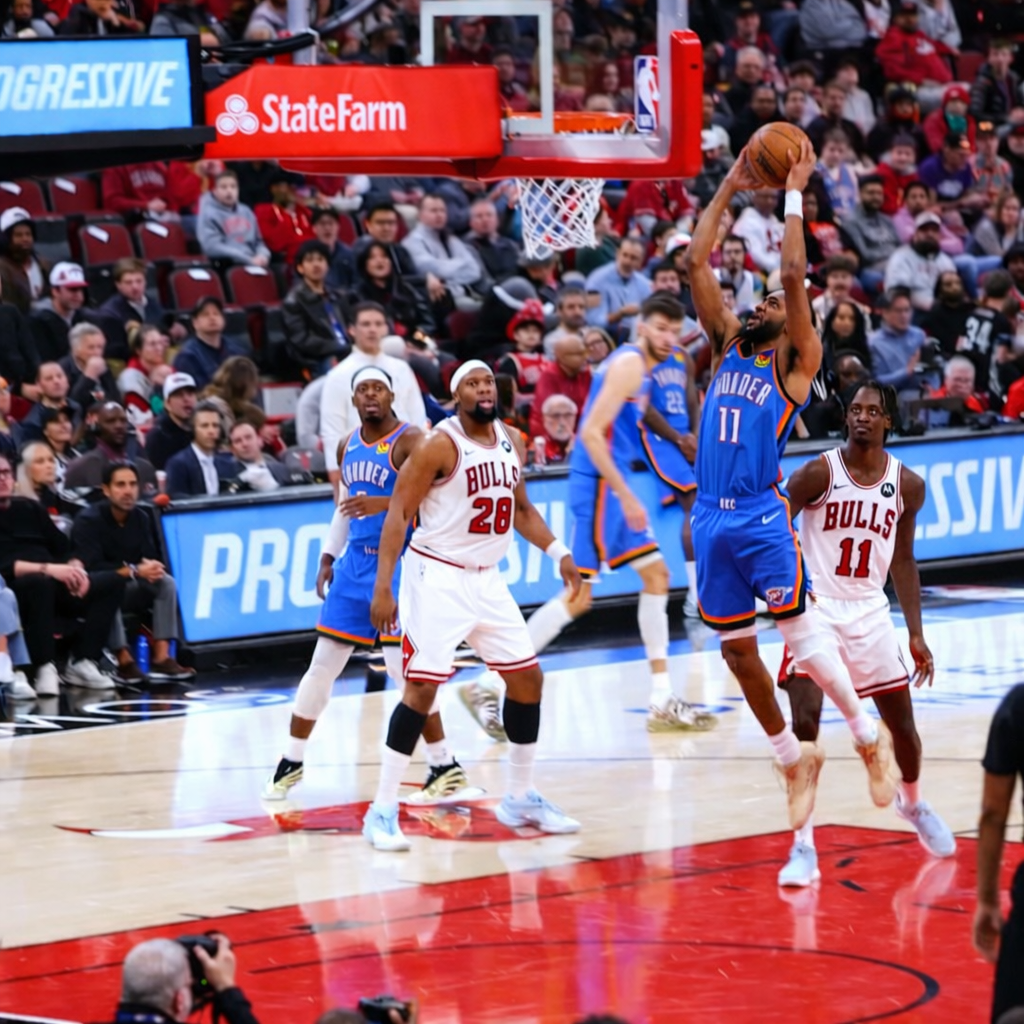
Tuesday night at the United Center, the Oklahoma City Thunder, once again, showed the rest of the league exactly what their foundation looks like.
No Shai Gilgeous-Alexander.
No Jalen Williams.
Still a 116–108 win over the Chicago Bulls.
Still the NBA’s best record at 48–15.
This was not a survival act. It was confirmation.
The System, Not the Star
For two years now, the question hovering around Oklahoma City has been simple: Is this machine dependent on its engine?
When Gilgeous-Alexander sits, does the structure wobble? When his late-game shot creation disappears, does the offense shrink?
The answer on Tuesday was emphatic.
The Thunder didn’t morph into something unfamiliar without their leading scorer. They didn’t slow the game to a crawl or play hero ball by committee. Instead, they leaned further into spacing, cutting, and rapid decision-making. The ball zipped from side to side. Bigs facilitated from the elbows. Guards attacked closeouts rather than dribbling into traffic.
The geometry changed. The identity didn’t.
Mark Daigneault’s offense resembled a five-out clinic for stretches, pulling Chicago’s defense into uncomfortable territory. When the Bulls tried to switch, Oklahoma City slipped screens and back-cut. When they showed help, shooters relocated. It wasn’t beautiful in the traditional sense — the Thunder shot just 24 percent from deep — but the quality of looks suggested process over panic.
The game turned not because of one dazzling play, but because the Thunder kept trusting their blueprint.
The Third-Quarter Shift
The first half was a coin flip. Oklahoma City led 55–54 at the break. Chicago even nudged ahead early in the third.
And then the hinge swung.
A 14–3 burst — sparked by Chet Holmgren attacking the rim — fractured the game. The Thunder didn’t explode offensively; they constricted defensively. Passing lanes vanished. Hands were active. Closeouts arrived with discipline.
By the time the quarter closed, the Bulls were playing uphill.
Holmgren’s influence during that stretch wasn’t just about scoring. It was about angles. He stretched Chicago’s interior defense outward, forcing rotations that opened driving corridors for Aaron Wiggins and kick-outs for Jared McCain. When the Bulls attempted to respond with smaller lineups, Holmgren punished them on the glass.
That’s growth.
Early in his career, Holmgren’s presence felt promising but fragile. Now it feels authoritative. He doesn’t need 30 to dominate the floor. He just needs leverage.
The Night Belonged to the Unheralded
If this were a script written by Hollywood, the returning former Thunder guard would have stolen the spotlight. Josh Giddey flirted with a triple-double for Chicago — 14 points, nine rebounds, nine assists — and the narrative threads were obvious.
But Oklahoma City’s depth swallowed the storyline.
Jared McCain delivered 20 points and four threes, operating as the second unit’s compass. Isaiah Joe poured in 19 with his customary fearlessness. Aaron Wiggins posted 18 points and a +17 rating that mirrored his steady imprint on both ends. And then there was Jaylin Williams — 17 points, 16 rebounds, six assists — orchestrating from the high post like a center who understands he’s also a guard in disguise.
Five players scoring at least 17.
That’s not accidental balance. That’s roster construction working as intended.
There is a financial component here that shouldn’t be ignored. Oklahoma City’s leading scorers Tuesday night represent a fraction of a single max contract. While other contenders rely on top-heavy payrolls, the Thunder’s ecosystem is layered. Affordable contributors who understand spacing, switch defensively, and accept roles.
It’s not glamorous. It’s sustainable.
Pressure as a Weapon
Chicago handed Oklahoma City opportunities — 19 turnovers — but the Thunder earned them. Active hands at the point of attack. Timely traps. Dig-down help in the post without surrendering open threes.
Those takeaways became 25 points. That margin proved decisive.
And perhaps more telling: Oklahoma City committed just nine turnovers of its own.
In a road environment, without its primary ball-handler, against a team with dynamic bench scoring in Collin Sexton, that ball security speaks volumes.
This group values possessions like a veteran squad that understands playoff margins. They do not rush into low-percentage chaos. They probe. They retreat. They attack again.
That composure feels less like youth and more like rehearsal.
The Clutch Without the Clutch King
Late in the fourth, Chicago trimmed the lead to six. The crowd stirred. Sexton hit a three. The Bulls sniffed possibility.
In previous seasons, this is where Oklahoma City would simply hand the ball to Gilgeous-Alexander and clear a side.
Instead, Jaylin Williams caught and fired a three that effectively shut the door. Calm. Square shoulders. No hesitation.
It wasn’t a bailout shot. It was the byproduct of ball movement creating rhythm.
The Thunder closed the game 20-of-24 from the free-throw line. That’s discipline. That’s muscle memory.
Clutch moments don’t always require a single savior. Sometimes they require collective steadiness.
What It Means
At 48–15, Oklahoma City sits atop the Western Conference with a cushion. The standings confirm what the eye test already suggests: this is not merely a talented team. It is an adaptable one.
Resting Gilgeous-Alexander and Jalen Williams in March is not a sign of fragility. It’s strategic patience. Championship windows are protected by foresight, not bravado.
The Thunder are playing the long game.
And here’s the uncomfortable truth for the rest of the conference: Oklahoma City is learning how to win in different ways.
Two nights ago, it was defensive suffocation in Dallas.
Tuesday, it was collective scoring and third-quarter force in Chicago.
Tomorrow, it may be something else entirely.
The versatility is the threat.
When a team can withstand poor shooting from three in consecutive games and still produce road victories, that team is not dependent on variance. It is anchored in structure.
The Thunder’s road trip continues at Madison Square Garden. The spotlight will intensify. The stage will swell.
But what Tuesday proved is this:
Oklahoma City is no longer reliant on one voice to steady it. The chorus carries the tune.
And that is far more dangerous than a single superstar performance.
Because if you can remove the headline name and the machine still hums, what exactly are opponents supposed to dismantle?
The Thunder didn’t just beat Chicago.
They demonstrated that their ceiling isn’t defined by who sits — it’s defined by how deeply the roots run.
In March, that might be the most important revelation of all.
Follow us on Instagram & Facebook