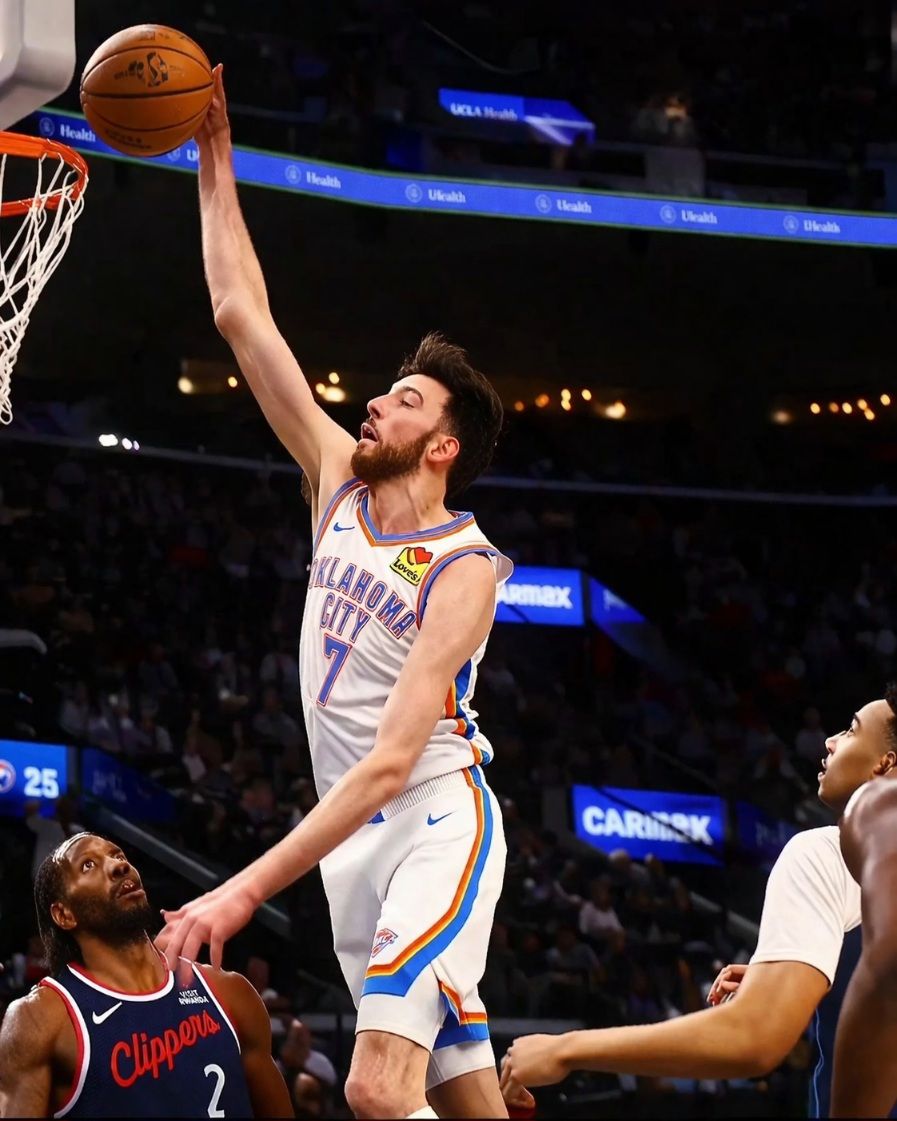
There are games in April that feel like noise.
Box scores inflate. Rotations shift. Contenders toggle between urgency and preservation, trying to balance momentum with health. It’s easy to dismiss big performances this time of year as circumstantial—products of tired legs, uneven focus, or mismatched priorities.
Chet Holmgren’s 30-point dismantling of the Clippers wasn’t one of those games.
It wasn’t noise.
It was instruction.
Because what unfolded in Oklahoma City’s 128–110 win wasn’t just a dominant individual showing—it was a clear, unmistakable blueprint for how the Thunder intend to defend their title.
And more importantly, why they might actually pull it off.
The First Half That Ended the Game
The Thunder trailed early. That part matters, if only because it gave context to what came next.
Great teams don’t panic when they fall behind in April. They diagnose. They adjust. And when they have a player capable of flipping the game instantly, they simplify.
Oklahoma City simplified.
They gave the game to Chet Holmgren.
Twenty-four points in the first half. One missed shot. Total control.
There was no buildup, no gradual rhythm. Holmgren didn’t feel his way into the game—he imposed himself on it. A pick-and-pop three here. A quick seal inside. A weak-side cut that turned into an uncontested finish. Possession after possession where the Clippers had the right idea defensively and still had no answer.
By halftime, the game had already tilted beyond recovery.
By the end of the third quarter, it was over.
That’s the first piece of the blueprint: front-load dominance. Don’t wait for closing time. Don’t rely on late-game execution. Break the game early, and let the rest of the roster manage what’s left.
Holmgren didn’t just score 30.
He eliminated the need for drama.
Efficiency That Breaks Defensive Logic
Ten-for-thirteen from the field. Three-for-four from deep.
Seventy-six point nine percent shooting.
Those numbers don’t just reflect a hot night—they expose a structural problem for opposing defenses.
Because Holmgren isn’t scoring in one predictable way. He’s not a post specialist you can double or a perimeter shooter you can run off the line. He exists in the gaps between traditional defensive rules.
Put a big on him, and he stretches the floor.
Put a wing on him, and he punishes the mismatch inside.
Help off him, and he makes you pay immediately.
Stay home, and Oklahoma City’s spacing opens everything else.
This is what makes him a playoff problem.
In the regular season, teams can survive bad matchups. Over seven games, those matchups become defining.
Holmgren forces opponents into decisions they don’t want to make—and then punishes them for making the least bad one.
That’s not just scoring.
That’s leverage.
The Defensive Backbone of Everything
If Holmgren’s offensive explosion was the headline, his defensive presence was the foundation.
Four blocks. Two steals. Fourteen rebounds.
But the numbers only scratch the surface.
The Thunder don’t have the league’s top defense because they gamble on the perimeter or overwhelm teams with physicality. They have it because Holmgren exists behind every possession, reshaping decisions before they happen.
Drivers hesitate.
Bigs rush finishes.
Perimeter players second-guess angles.
That’s deterrence. And it’s more valuable than any single stat.
Opponents shoot just 48 percent at the rim when Holmgren is there. In a league built on efficiency at the basket, that’s a disruption of the highest order.
But what makes him essential to Oklahoma City’s title defense isn’t just his rim protection—it’s his flexibility.
He can guard the post without fouling. He can step out and contest shooters. He can recover, rotate, and still challenge the shot at the rim.
That allows the Thunder to play aggressively everywhere else.
Lu Dort can pressure.
Jalen Williams can jump passing lanes.
The entire defensive system stretches further because Holmgren holds it together.
That’s the second piece of the blueprint: defensive freedom through a single anchor.
From Complement to Catalyst
For much of Oklahoma City’s rise, Holmgren has been discussed as the perfect complement to Shai Gilgeous-Alexander.
That framing is no longer sufficient.
This performance—this type of performance—forces a shift in perspective.
Holmgren isn’t just a secondary star.
He’s a co-driver of outcomes.
Five assists in this game underline that evolution. He’s not just finishing plays—he’s reading them, manipulating them, and creating advantages for others. The “tactical instincts” that Mark Daigneault has referenced are no longer theoretical. They’re visible.
And in the playoffs, that matters more than raw scoring totals.
Because when defenses load up on Shai—and they will—Holmgren becomes the release valve that turns pressure into opportunity.
That’s the third piece of the blueprint: a second star who doesn’t just score, but solves.
The “Knockout Gear” That Wins Series
Every contender has a version of this.
A stretch of basketball where the game flips irreversibly.
For some teams, it’s a late fourth-quarter run. For others, it’s a defensive surge that strangles momentum.
For Oklahoma City, it might be this:
Chet Holmgren in attack mode from the opening minutes.
Fourteen points in the first quarter. Twenty-four by halftime. A 25-point lead that never dipped back into single digits.
That’s not just dominance—it’s timing.
Because in the playoffs, energy matters. Minutes matter. Preservation matters.
If Holmgren can tilt games early like this, the Thunder gain something invaluable:
Rest.
Shai plays fewer late minutes. The rotation tightens without overextending. The wear and tear of a long postseason gets redistributed.
That’s how championships are sustained—not just won once, but defended.
Proof of Concept for a Repeat
It’s one thing to project what a team might look like in the playoffs.
It’s another to see it materialize in real time.
Holmgren’s performance against the Clippers wasn’t hypothetical. It was executable.
- A dominant early scoring stretch
- Hyper-efficient shot selection
- Defensive control at the rim
- Playmaking that punishes overreactions
- A game that’s effectively decided before the fourth quarter
That’s a repeatable formula.
Not every night. Not every series. But often enough to matter.
And when you layer that on top of what Oklahoma City already has—a league MVP candidate in Shai, elite perimeter defenders, and one of the deepest rotations in basketball—you start to see something more than a contender.
You see sustainability.
The Ceiling Just Got Higher
The most dangerous realization for the rest of the league isn’t that Holmgren can do this.
It’s that he might choose when to do it.
Because if this becomes a consistent gear—if Holmgren toggles into this level of aggression in key playoff moments—the Thunder’s ceiling shifts.
They’re no longer just balanced.
They’re overwhelming.
Too versatile offensively to scheme. Too disciplined defensively to exploit. Too deep to wear down.
And anchored by a player who can control both ends of the floor without sacrificing efficiency on either.
The Blueprint Is Clear
Thirty points. Fourteen rebounds. Four blocks. Seventy-six percent shooting.
Those are the numbers.
But the meaning goes deeper.
This wasn’t just a performance.
It was a statement of capability.
A demonstration of what Oklahoma City looks like when one of its most unique players fully asserts himself—not just as a contributor, but as a force that dictates the structure of the game.
And if that version of Chet Holmgren shows up consistently over the next two months, the conversation around the Thunder won’t be about whether they can defend their title.
It will be about who, exactly, is equipped to stop them.
Because the blueprint is no longer theoretical.
It’s already been drawn.
Follow us on Instagram & Facebook