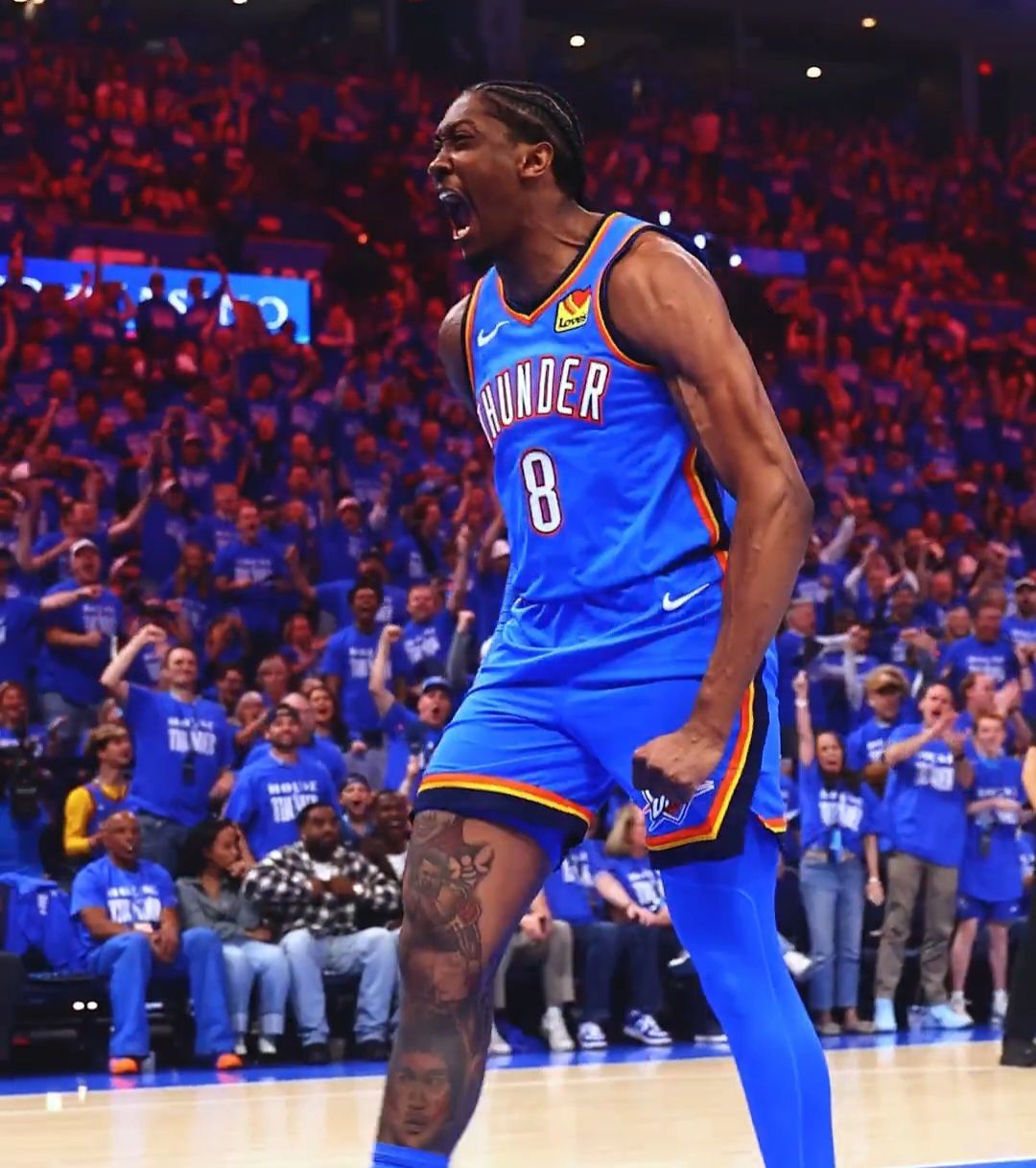
The defending champs didn’t just open their title defense—they sent a message. And if Game 1 is any indication, the Oklahoma City Thunder look less like a team easing into the postseason and more like one tightening its grip on the Western Conference.
Inside Paycom Center on Sunday night, Oklahoma City dismantled the Phoenix Suns 119-84 in a Game 1 performance that was as clinical as it was overwhelming. This wasn’t a game that swung late or hinged on a handful of possessions. It was controlled, dictated, and ultimately decided by the middle of the second quarter.
By the time the fourth quarter began, the only real drama left was how large the final margin would be.
Oklahoma City led by as many as 39 points, never trailed after the midpoint of the first quarter, and rested its starters for the entire fourth. In a playoff environment that typically tightens into half-court battles and late-game execution, the Thunder instead turned Game 1 into a showcase of their defining identity: pressure, pace, and punishment.
The Identity: Defense That Breaks You
Start here, because everything else flowed from it.
The Thunder forced 19 Phoenix turnovers and turned them into 34 points. That’s not just a statistical edge—it’s a philosophical one. Oklahoma City doesn’t just defend to get stops; it defends to create offense.
The gap tells the story: 34 points off turnovers for OKC, just 2 for Phoenix.
That disparity alone would tilt most games. Combined with everything else, it buried this one.
Shai Gilgeous-Alexander set the tone at the point of attack, using his length and instincts to disrupt passing lanes. Behind him, the Thunder’s rotating wall—anchored by Chet Holmgren and supplemented by Isaiah Hartenstein—closed driving angles and erased second efforts.
Phoenix shot just 35% from the field.
Even more telling: the Suns managed only two fastbreak points. Against a defense that thrives on chaos, Phoenix never found rhythm, never found space, and never found a counter.
The Possession Game: Death by Volume
If turnovers cracked the foundation, offensive rebounding collapsed the structure.
Oklahoma City, a middle-of-the-pack offensive rebounding team during the regular season, grabbed 19 offensive boards in Game 1. That translated into an 18-2 advantage in second-chance points.
It’s a staggering swing—and an intentional one.
Time and again, the Thunder sent multiple bodies to the glass, particularly from the weak side. Wings crashed. Guards pinched down. Holmgren extended possessions. The result was a Suns defense forced to defend not once, but two or three times per trip.
For a Phoenix team already struggling to generate clean offense, that imbalance became unsustainable.
As Devin Booker put it afterward, pairing 19 turnovers with 19 offensive rebounds allowed is “a recipe for disaster.”
Game 1 proved him right.
The Catalyst Moment: From Flagrant to Flood
Early playoff games often hinge on emotional swings—moments where intensity spikes and teams either fracture or surge.
This game had one.
Midway through the first quarter, Dillon Brooks was assessed a flagrant-one foul after striking Holmgren in the face. It could have been a moment for Phoenix to impose physicality.
Instead, it ignited Oklahoma City.
The Thunder responded with a 12-2 run immediately following the foul. The sequence wasn’t just about points—it was about control. Oklahoma City sped the game up, forced mistakes, and capitalized in transition.
By the end of the first quarter, punctuated by Holmgren’s buzzer-beating three, the tone had been fully established.
From there, the runs kept coming:
- A 17-2 surge to close the first quarter
- A 15-3 run late in the third
- Multiple mini-bursts that prevented any Suns push from gaining traction
Every time Phoenix hinted at stabilizing, Oklahoma City responded with force.
The Stars: Efficient, Unselfish, Relentless
What makes this Thunder team particularly dangerous is that dominance doesn’t require perfection from its stars—it simply requires presence.
Gilgeous-Alexander finished with 25 points, 7 assists, and 2 blocks—but did so on just 5-of-18 shooting. Normally, that inefficiency might be a concern.
Instead, it became a lesson in control.
SGA lived at the free-throw line, going 15-of-17, manipulating defenders and dictating pace even without a consistent jumper. He didn’t need to score efficiently from the field because he controlled every other aspect of the game.
Alongside him, Jalen Williams delivered one of the most complete performances of the night: 22 points, 7 rebounds, and 6 assists on 9-of-15 shooting. Williams thrived in the gaps created by Phoenix’s defensive breakdowns, attacking mismatches and pushing tempo.
Holmgren added 16 points, 7 rebounds, and 2 blocks, anchoring both ends of the floor while providing a signature moment with his first-quarter buzzer-beater.
Three players. Three different styles. One unified impact.
The Suns’ Problem: No Answers, Then Fewer Options
For Phoenix, the issues started early and compounded quickly.
Turnovers disrupted their offense. Rebounding deficiencies extended Thunder possessions. Defensive matchups broke down under pressure.
Then came the personnel blow.
Guard Jordan Goodwin—tasked with defending Gilgeous-Alexander—picked up early fouls and later exited in the second quarter with a left calf injury. His absence forced the Suns into less favorable defensive alignments, including extended stretches with Brooks on SGA.
That shift opened driving lanes and exposed weaker perimeter defenders, particularly against Williams, who capitalized repeatedly.
Booker led Phoenix with 23 points, but even his production came without rhythm. Brooks added 18 points on 6-of-22 shooting—a reflection of the contested, uncomfortable looks Oklahoma City forced all night.
Nothing came easy. And nothing sustained.
Paint Control: The Hidden Backbone
While turnovers and rebounding grabbed headlines, Oklahoma City’s dominance in the paint quietly sealed the game.
The Thunder outscored Phoenix 52-24 inside.
That margin reflects more than just scoring—it reflects control of space. Holmgren and Hartenstein deterred drives, while OKC’s guards collapsed and recovered with precision. On the other end, the Thunder attacked downhill, turning defensive stops into interior opportunities.
It’s the kind of inside-out dominance that travels—and translates.
The Bigger Picture: A Championship Signal
Game 1 doesn’t decide a series. But it can define its tone.
And this one was emphatic.
Oklahoma City didn’t just win—they imposed their identity in every phase of the game. Defense, rebounding, pace, execution—it all tilted decisively in their favor.
More importantly, they did it without needing a peak scoring performance from their best player. That’s the mark of a complete team.
For Phoenix, the path forward is clear but difficult: protect the ball, control the glass, and find a defensive answer for OKC’s layered attack. Adjustments will come. Rotations will shift. Game 2 will look different.
But the margin for error is already thin.
What’s Next
Game 2 remains in Oklahoma City on Wednesday night, where the Thunder will look to extend their series lead and tighten their grip.
If Game 1 was any indication, the Suns aren’t just playing a team—they’re facing a system.
And right now, that system looks every bit like a champion determined to stay one.
Follow us on Instagram & Facebook