The coronation came before tip-off. The statement followed immediately after.
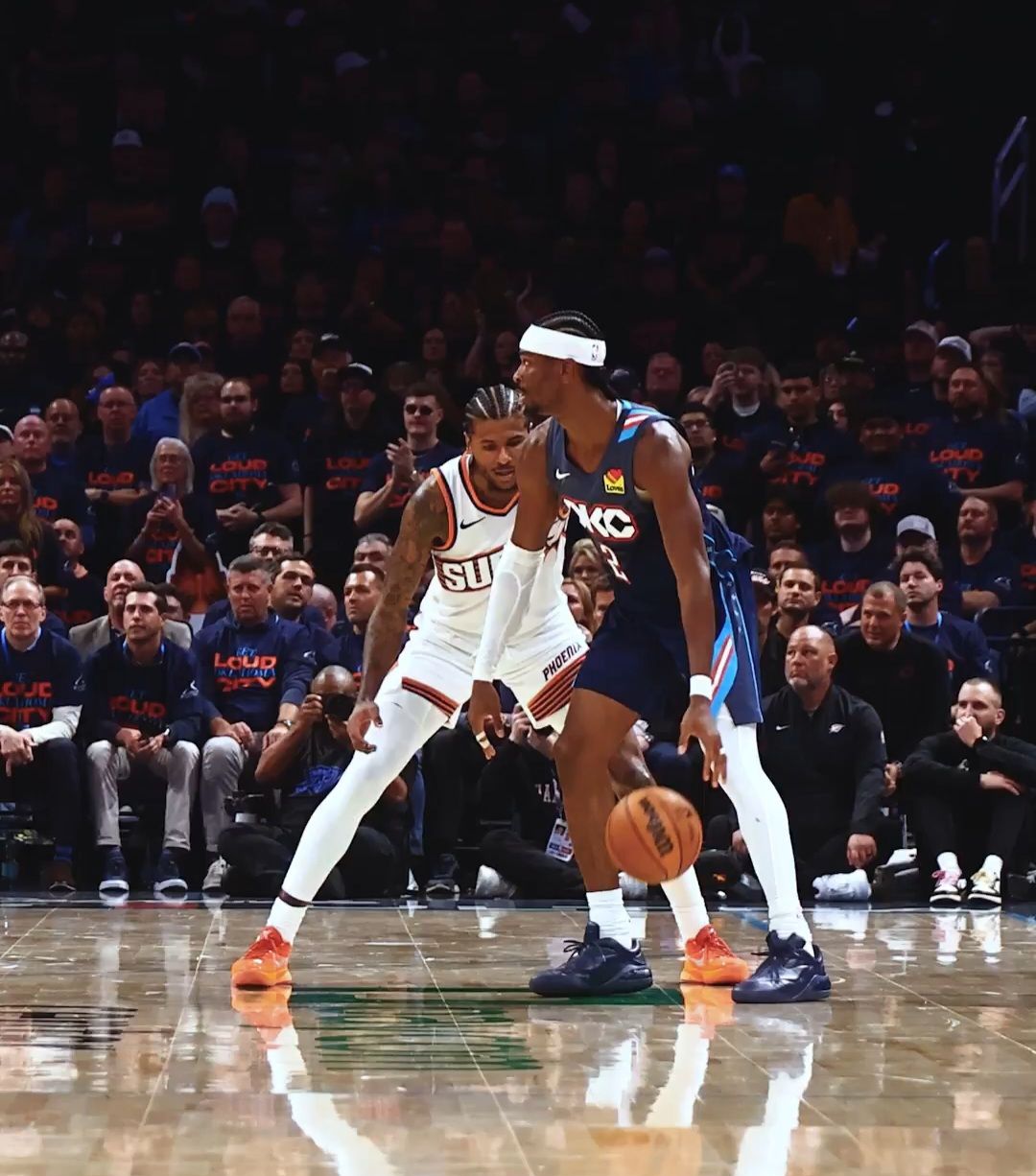
On a night when Shai Gilgeous-Alexander was presented with the NBA’s Clutch Player of the Year award, the face of the Oklahoma City Thunder delivered exactly what the moment demanded—control, composure, and complete command.
Behind Gilgeous-Alexander’s 37 points and 9 assists, Oklahoma City defeated the Phoenix Suns 120–107 in Game 2 on Wednesday night, seizing a 2–0 lead in their first-round series. It wasn’t quite the wire-to-wire demolition of Game 1, but in many ways, it was more revealing.
Because this time, Phoenix pushed back.
And Oklahoma City still had all the answers.
The Response of a Star
Game 1 was efficient. Game 2 was emphatic.
After shooting just 5-of-18 in the series opener, Gilgeous-Alexander recalibrated—not by forcing shots, but by dictating the game on his terms. He finished 13-of-25 from the field and a perfect 9-of-9 from the free-throw line, blending rhythm scoring with surgical playmaking.
More telling than the numbers was the timing.
He scored 27 of his 37 points through the first three quarters, ensuring Oklahoma City never relinquished control even as Phoenix attempted to stabilize. When the Suns cut a 26-point deficit to 10 midway through the fourth, it was Gilgeous-Alexander who steadied the game—slowing the pace, finding the right matchups, and creating clean looks.
That’s what the award represents. And that’s what he embodied.
The Third Quarter Avalanche
If Game 2 had a defining stretch, it came immediately after halftime.
Oklahoma City entered the break with a manageable 65–57 lead. Within minutes, the game was effectively over.
The Thunder outscored Phoenix 35–20 in the third quarter, turning a competitive contest into another double-digit cushion. The surge was sparked—and anchored—by Chet Holmgren, who delivered one of the most impactful stretches of his young playoff career.
Holmgren scored 8 points in just over four minutes early in the quarter, but his true imprint came on the defensive end. He recorded back-to-back blocks during the run, erasing Phoenix drives and igniting transition opportunities that electrified Paycom Center.
By the end of the third, Oklahoma City led 100–77.
For the second straight game, the Thunder had created separation before the fourth quarter even began.
Defense That Travels—and Scales
The numbers tell a familiar story.
- 22 forced turnovers
- 22 points off those turnovers
- 10 total turnovers committed
But what makes Oklahoma City’s defense so difficult to solve isn’t just the volume—it’s the consistency.
Phoenix improved its shooting from Game 1, finishing at 46% from the field. It didn’t matter.
Because the Thunder controlled everything else.
They disrupted passing lanes. They collapsed driving gaps. They rotated with precision. And when Phoenix did break through, Holmgren and the interior defense were waiting.
The result was a game that never truly flipped, even as the Suns found more offensive rhythm than they did in the opener.
This is what elite defense looks like in the playoffs—not just dominant once, but repeatable under different conditions.
The Supporting Cast: Balance Amid Uncertainty
While Gilgeous-Alexander set the tone, Oklahoma City’s balance remained intact.
Holmgren finished with 19 points, 8 rebounds, and 4 blocks, impacting both ends of the floor in ways that extended beyond the box score.
Jalen Williams added 19 points of his own on an efficient 7-of-11 shooting—but his night ended with concern. Williams exited in the third quarter after grabbing his left hamstring following a contested layup and did not return.
The timing is notable. Williams had already missed significant time this season with a hamstring injury—on the opposite leg. His status moving forward now becomes one of the central storylines of the series.
Yet even with that disruption, Oklahoma City didn’t fracture.
Ajay Mitchell stepped in with 14 points off the bench, providing scoring stability. And Luguentz Dort delivered the game’s defining dagger—a late three-pointer that halted Phoenix’s final push and effectively sealed the win.
It’s the hallmark of this roster: production doesn’t come from one place.
It comes in waves.
Phoenix’s Push—and Its Limits
To their credit, the Suns didn’t fold.
Dillon Brooks led all Phoenix scorers with 30 points, knocking down five three-pointers and playing with the kind of edge the Suns needed. Devin Booker added 22, while Jalen Green chipped in 21.
For stretches, particularly late in the fourth quarter, Phoenix showed signs of life. A 16-point deficit shrank to 10 with just over five minutes remaining, briefly raising the possibility of a late-game test.
But every push came with a cost.
Turnovers continued to plague the Suns—they finished with 22—and each mistake fed directly into Oklahoma City’s transition game. Even as their shooting improved, their margin for error remained too thin to sustain a comeback.
And when Brooks fouled out in the fourth quarter, Phoenix lost its most aggressive offensive presence at the exact moment it needed one.
The Numbers Behind Control
Game 2 wasn’t as lopsided as Game 1. But analytically, the Thunder still owned the game.
- Field Goal Percentage: OKC 47%, PHX 46%
- Turnovers: OKC 10, PHX 22
- Points Off Turnovers: OKC 22, PHX 9
- Largest Lead: OKC by 26
Even in a “closer” game, Oklahoma City dictated the most important metrics.
They protected the ball. They created extra possessions. They converted mistakes into points.
That formula has now produced back-to-back double-digit wins.
The Bigger Picture: Control of the Series
Playoff series are about adjustments. About counters. About finding leverage.
Through two games, Oklahoma City has held all of it.
They’ve won with defense. They’ve won with offense. They’ve won with depth. And now, they’ve shown they can win even when the opponent plays better than it did in the opener.
That’s what makes a 2–0 lead feel heavier than the numbers suggest.
Because it’s not just the margin—it’s the manner.
Looking Ahead to Game 3
The series now shifts to Phoenix for Game 3, where the Suns will look to reset on their home floor and find answers that have so far been elusive.
Health will be a major factor. The status of Jalen Williams looms large for Oklahoma City, just as Phoenix continues to navigate its own injury concerns.
But schematically, the challenge remains the same.
How do you slow a team that doesn’t rely on one thing?
How do you counter a defense that turns your mistakes into momentum?
Through two games, those questions have gone unanswered.
Final Thought
Game 2 wasn’t a repeat of Game 1.
It was something more dangerous.
It showed that even when the Suns adjust, compete, and push, the Thunder still have another gear.
And right now, that gear looks a lot like control.
Follow us on Instagram & Facebook