There are playoff wins that swing a series.
And then there are performances that end one.
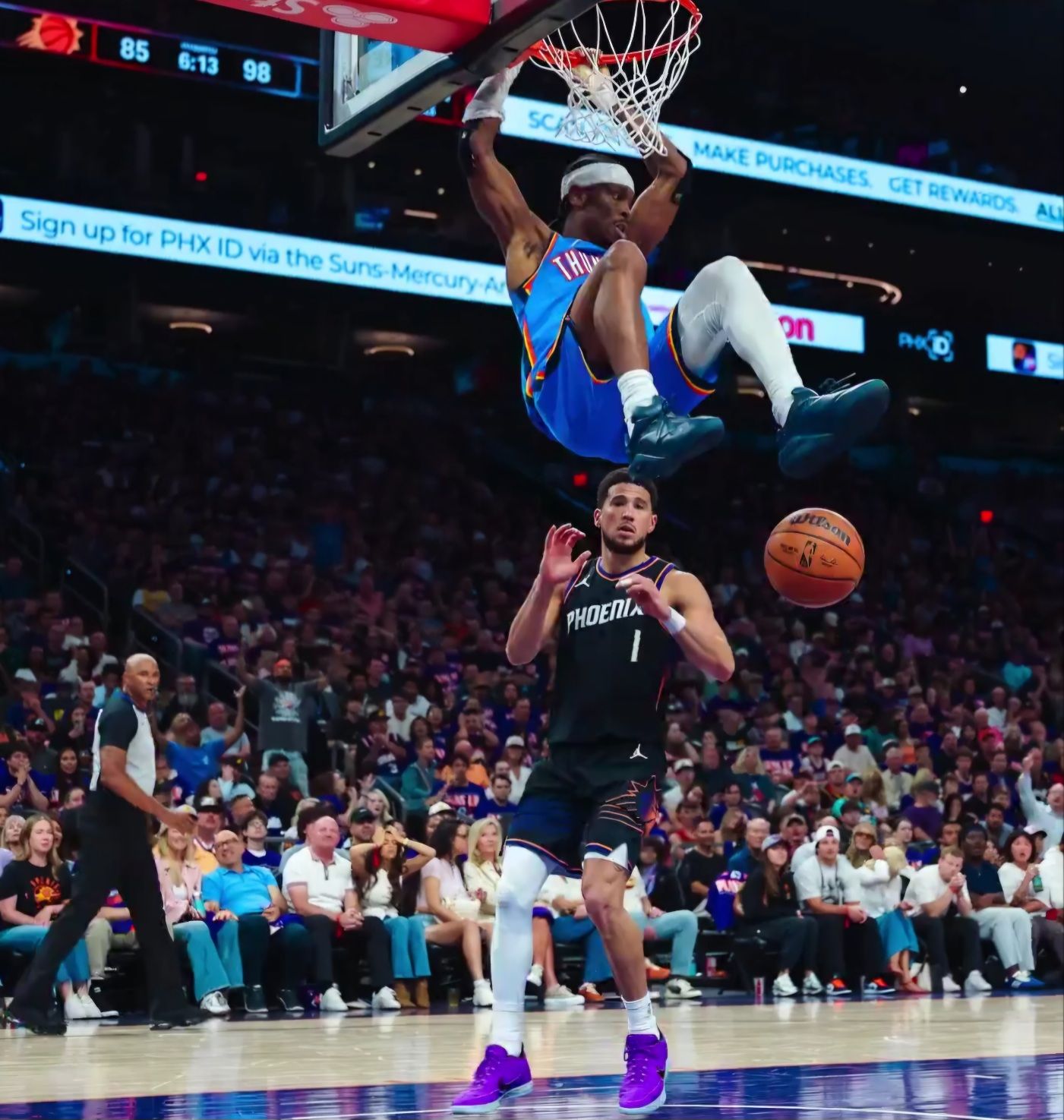
On Saturday afternoon in Phoenix, Shai Gilgeous-Alexander delivered the kind of performance that doesn’t just tilt momentum—it erases doubt entirely. Behind his historic 42-point masterpiece, the Oklahoma City Thunder defeated the Phoenix Suns 121–109 in Game 3, seizing a commanding 3–0 series lead and moving within one win of a first-round sweep.
The numbers tell you Oklahoma City is in control.
The film—and the context—tell you why that control feels absolute.
A Performance That Lives in Playoff History
Gilgeous-Alexander has built a reputation on efficiency, poise, and late-game brilliance.
Game 3 was something else entirely.
He finished with 42 points, 8 assists, and 4 rebounds while shooting a staggering 15-of-18 from the field and 11-of-12 from the free-throw line. For long stretches, he didn’t just look unguardable—he looked untouched.
He opened the game by making his first nine shots. Not forced looks. Not contested heaves. Controlled, surgical scoring that dissected every layer of Phoenix’s defense.
By the final buzzer, he had joined one of the rarest statistical groups in NBA playoff history: players to score 40 or more points while shooting above 80% from the field. It’s a list reserved for outliers—nights where efficiency meets volume at an almost impossible level.
What made it more devastating was the timing.
When Phoenix made its final push midway through the fourth quarter, trimming the lead and energizing the home crowd, it was Gilgeous-Alexander who ended it. A 19-foot fadeaway jumper—difficult, contested, definitive—pushed the lead back to 15 and drained whatever hope remained in the building.
That’s not just scoring.
That’s taking complete control of the moment.
The Turning Point: From Deficit to Dominance
For the first time in the series, Phoenix came out with urgency.
The Suns built a nine-point lead late in the first quarter, feeding off their home crowd and playing with the kind of pace and aggression that had been missing in Oklahoma City.
For a moment, it looked like Game 3 might finally present resistance.
Then the Thunder responded.
Oklahoma City closed the first quarter on an 18–4 run—flipping a nine-point deficit into a five-point lead in a matter of minutes. It wasn’t a single run built on hot shooting. It was a sequence driven by defense, transition, and composure.
From that point forward, the game followed a familiar script.
The Thunder outscored Phoenix 70–48 across the second and third quarters combined, methodically stretching the lead while maintaining defensive pressure. By halftime, Oklahoma City led 62–53. By the end of the third, the separation was clear.
Different building. Same result.
Winning Without Key Pieces
What made Game 3 particularly telling wasn’t just how Oklahoma City won—it was who they won without.
Jalen Williams was out with a left hamstring strain. Isaiah Joe was also unavailable. Two key rotation pieces, one a primary offensive initiator, the other a spacing threat.
It didn’t matter.
Ajay Mitchell stepped into the starting lineup and delivered one of the most composed performances of his young career: 15 points and 6 rebounds, providing stability and spacing without forcing the offense.
Meanwhile, Alex Caruso filled the gaps everywhere else. He finished with 13 points, but his impact went far beyond scoring. Timely steals. Rotational defense. A pair of key defensive plays that halted Phoenix runs before they could fully develop.
Oklahoma City’s depth isn’t theoretical. It’s functional.
Even more telling: the Thunder outscored Phoenix during the 10 minutes Gilgeous-Alexander was on the bench. That’s the kind of margin that ends series before they reach a critical point.
Defense That Dictates Terms
Through three games, one theme has remained constant: Oklahoma City doesn’t react defensively. It dictates.
Game 3 was no different.
The Thunder forced 11 Phoenix turnovers, converting them into 11 points. It’s a continuation of a series-long trend that has effectively neutralized any advantage the Suns might have elsewhere.
More importantly, Oklahoma City controlled who beat them—and how.
Devin Booker, Phoenix’s primary offensive engine, was held to 16 points on 6-of-16 shooting. The Thunder consistently sent extra defenders at the point of attack, forcing Booker into contested looks and rushed decisions. Even before briefly leaving the game in the third quarter with an ankle injury, he struggled to find rhythm.
Meanwhile, Dillon Brooks (33 points) and Jalen Green (26 points) found scoring success—but largely in isolation, disconnected from sustained offensive flow.
That’s the trade-off Oklahoma City is willing to make.
Individual scoring. Team disruption.
And so far, it’s working perfectly.
The Numbers Behind the Control
The final stat line reflects balance, efficiency, and control:
- Field Goal Percentage: OKC 49%, PHX 44%
- Rebounds: OKC 43, PHX 39
- Turnovers: OKC 7, PHX 11
- Free Throw Percentage: OKC 90%, PHX 87%
But the underlying story is more nuanced.
Oklahoma City once again won the possession battle. They took care of the ball, forced mistakes, and maximized efficiency at the line. They didn’t need to dominate every category—just the right ones.
And with Gilgeous-Alexander playing at a historic level, that was more than enough.
The Clutch Factor, Reinforced
It’s worth noting the timing of this performance.
Gilgeous-Alexander entered the game just days removed from being named the NBA’s Clutch Player of the Year. In Game 2, he validated the honor with control and composure.
In Game 3, he elevated it.
He scored 25 of his 42 points in the second half, repeatedly answering every Phoenix push with precision scoring. The defining moments weren’t just late—they were decisive.
This is what separates elite players in the postseason.
Not just production.
But inevitability.
The Historical Reality: 3–0
The Thunder now lead the series 3–0.
In NBA history, teams holding a 3–0 advantage are 159–0 in series play. No team has ever come back to win from that deficit. Only a handful have even forced a Game 7.
The math is unforgiving.
For Phoenix, the challenge isn’t just tactical anymore—it’s historical.
And given the trends through three games—turnover disparity, defensive control, depth advantage—it’s difficult to find a pathway that reverses all of it four times in a row.
Looking Ahead
Game 4 awaits Monday night in Phoenix, where the Thunder will have their first opportunity to close out the series.
Health will remain a storyline. The status of Jalen Williams looms large as Oklahoma City eyes deeper postseason rounds. For the Suns, the condition of Booker’s ankle and the continued absence of key frontcourt pieces only complicate an already steep climb.
But beyond personnel, the series has revealed something more fundamental.
Oklahoma City isn’t just better.
It’s more complete.
Final Thought
Game 3 wasn’t just a win.
It was a declaration.
A declaration that the Oklahoma City Thunder can dominate on the road, absorb early punches, and still impose their identity. A declaration that their depth can withstand injuries. And above all, a declaration that when Shai Gilgeous-Alexander reaches this level, there may not be a defense in the league capable of answering.
One more win remains.
But after Saturday night, it feels less like a question of if—and more like when.
Follow us on Instagram & Facebook