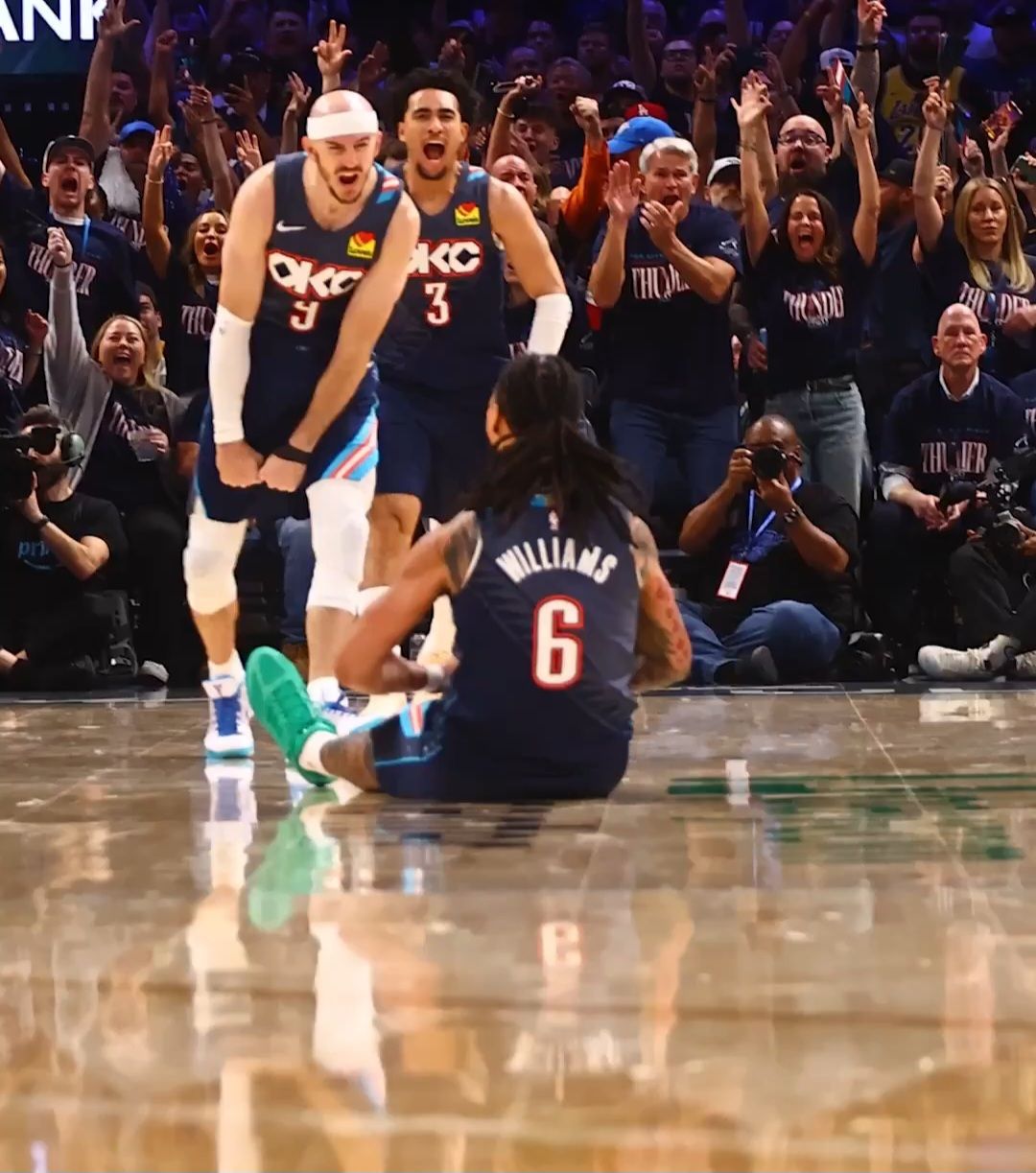
The most dangerous thing about this version of the Oklahoma City Thunder might not be their superstar.
It might be everything surrounding him.
On a night when Shai Gilgeous-Alexander spent much of the pivotal stretch on the bench with foul trouble, Oklahoma City still found another gear. The Thunder overwhelmed the Los Angeles Lakers 125-107 Thursday night at Paycom Center, seizing a commanding 2-0 lead in the Western Conference semifinals behind a devastating third-quarter avalanche that completely changed the shape of the game.
The final margin reflected Oklahoma City’s superiority. The sequence that defined it reflected their identity.
Balanced. Relentless. Deep.
And increasingly, unavoidable.
The Lakers walked into halftime with a 58-57 lead and legitimate momentum. Austin Reaves had shaken off his disastrous Game 1 performance with an aggressive offensive approach. LeBron James, playing in his 300th career playoff game, looked poised and efficient. Gilgeous-Alexander already had four fouls. The crowd had grown tense.
Then Oklahoma City detonated the game in 12 minutes.
The Thunder opened the second half with a ruthless 32-15 third quarter, fueled not by their MVP candidate, but by the exact thing that has made this team feel increasingly inevitable throughout the postseason: wave after wave of contributors who never seem overwhelmed by the moment.
By the time Gilgeous-Alexander returned to the floor, Oklahoma City had already broken the Lakers’ spirit.
The Stretch That Changed Everything
The defining sequence of the night came with SGA cheering from the sideline.
Rather than shrink offensively without their lead initiator, the Thunder accelerated. Ajay Mitchell attacked downhill fearlessly. Jared McCain buried momentum-killing threes. Chet Holmgren erased mistakes at the rim while simultaneously functioning as Oklahoma City’s offensive release valve.
The Lakers simply unraveled under the pressure.
Turnovers became transition opportunities. Defensive breakdowns became corner threes. Missed assignments became dunks.
Oklahoma City transformed a one-point halftime deficit into a 13-point lead entering the fourth quarter, and they did it while Gilgeous-Alexander watched large portions of the run unfold from the bench.
That’s the story of Game 2.
Not merely that the Thunder won. But how they won.
Championship-caliber teams survive adversity. Great teams weaponize it.
Holmgren Continues His Star Turn
There may no longer be a debate about who has been Oklahoma City’s most consistently dominant player through two games of this series.
Holmgren was magnificent again Thursday night, finishing with 22 points, nine rebounds, four steals, and two blocks in another all-court masterpiece.
The stat line alone doesn’t fully explain his impact. Holmgren controlled tempo with his positioning, anticipation, and timing. Every time the Lakers appeared ready to make a push, he responded with a play that restored order.
When Los Angeles trimmed the deficit to five in the fourth quarter, Holmgren personally slammed the door shut with five straight points. On the defensive end, he repeatedly blew up actions before they could fully develop, stripping guards on drives and rotating seamlessly to contest shots at the rim.
Thunder head coach Mark Daigneault called Holmgren “the ultimate winner” after the game, and it’s becoming harder to argue otherwise.
What makes Holmgren so devastating in this matchup is the pressure he places on every layer of the Lakers’ offense. If the guards attack downhill, he’s waiting at the rim. If they hesitate, Oklahoma City’s perimeter defenders close passing windows. If they try to space him out, he punishes them offensively on the other end.
The Lakers have yet to solve the equation.
SGA’s Quiet Control
Gilgeous-Alexander’s night wasn’t dominant in the traditional sense. He finished with 22 points on just 13 field-goal attempts, but foul trouble prevented him from fully dictating the game early.
And yet, his imprint remained everywhere.
What separates Gilgeous-Alexander from most stars is his understanding of game flow. Even while limited, he managed the moments he needed to manage. Once Oklahoma City built separation in the third quarter, SGA returned in the fourth and calmly stabilized the game whenever the Lakers threatened.
No panic. No forcing. Just control.
That composure matters for a young roster.
The Thunder stopped looking like a talented team trying to figure out playoff basketball a long time ago. They look like a team that understands exactly who they are.
McCain and Mitchell Change the Texture of the Series
If Game 1 showcased Oklahoma City’s defense and frontcourt dominance, Game 2 highlighted the terrifying flexibility of their supporting cast.
Mitchell, starting in place of the injured Jalen Williams, delivered 20 points with a confidence level that never wavered. He consistently attacked the gaps in Los Angeles’ defense, particularly during the Thunder’s third-quarter surge.
McCain was equally critical.
The second-year guard finished with 18 points and knocked down four of his five attempts from beyond the arc. More importantly, nearly every shot felt emotionally damaging to the Lakers. Whenever Los Angeles appeared ready to string together momentum, McCain answered with another timely jumper.
The Thunder bench outscored the Lakers reserves 48-20.
That number tells the entire story.
Oklahoma City’s depth isn’t merely functional—it’s transformational. While the Lakers are searching desperately for reliable secondary production behind James and Reaves, the Thunder continue uncovering impact performances from seemingly every corner of the roster.
Lakers’ Turnover Problem Becomes Fatal
The Lakers actually played stretches of solid offensive basketball Thursday night. Reaves erupted for a game-high 31 points in a much-needed bounce-back effort, while James added 23 points in another remarkably efficient postseason outing.
It didn’t matter.
The Lakers committed 21 turnovers, and Oklahoma City punished virtually every one of them.
The Thunder converted those mistakes into 26 points and repeatedly used live-ball turnovers to ignite transition opportunities before Los Angeles could get organized defensively.
That’s where Oklahoma City becomes overwhelming.
They defend aggressively without losing structure. They run without becoming reckless. They swarm without fouling excessively—though that became a major point of contention afterward.
Officiating Frustration Boils Over
As the game slipped away, frustration mounted rapidly on the Lakers’ side.
Head coach JJ Redick openly criticized the officiating after the game, arguing that Oklahoma City’s physicality crossed the line repeatedly throughout the night. Several Lakers players echoed similar frustrations, particularly regarding the Thunder’s perimeter pressure and the whistle disparity during key stretches.
The comments are significant not because they change Game 2, but because they shape the emotional tone heading into Game 3.
This series is becoming increasingly physical. Oklahoma City wants it that way.
The Thunder thrive in chaos. Their athleticism, depth, and defensive activity become even more devastating when games descend into turnover-heavy slugfests.
So far, the Lakers have been unable to consistently handle that pressure.
A Series Tilting Quickly
The numbers surrounding this matchup are becoming difficult to ignore.
Oklahoma City is now 6-0 in the postseason. The Thunder have won 16 of their last 17 games overall. Including the regular season, they’ve now beaten the Lakers six consecutive times.
And perhaps most alarming for Los Angeles: Oklahoma City still hasn’t looked fully stretched.
Williams remains sidelined with a hamstring injury. Gilgeous-Alexander has yet to deliver a truly signature scoring explosion in this series. Despite that, the Thunder are up 2-0 with an average margin of victory of 18 points.
The series now shifts to Los Angeles, where the Lakers enter what effectively feels like a must-win Game 3 on Saturday night.
History is not on their side. Teams that take a 2-0 lead in a best-of-seven series advance the overwhelming majority of the time.
But beyond the math, there’s something more concerning for the Lakers.
Right now, Oklahoma City simply looks faster, deeper, younger, and more connected.
And after two games, the Thunder are no longer just winning this series.
They’re controlling it completely.
Follow us on Instagram & Facebook