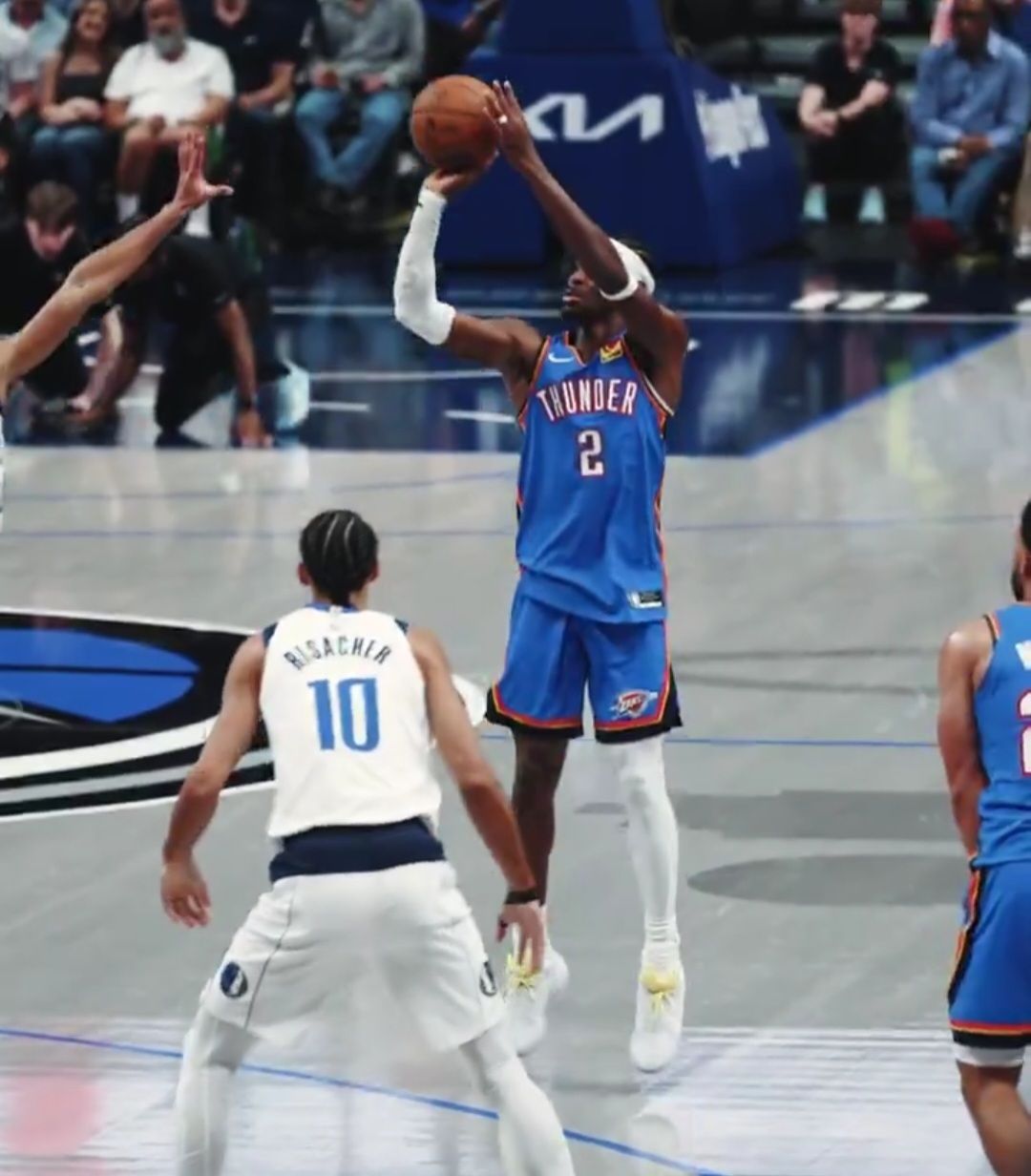
The Oklahoma City Thunder finally hit the wall.
After opening the season with four consecutive victories, including an impressive win over the Phoenix Suns on Monday, Oklahoma City ran out of answers Wednesday night in Dallas. The Mavericks handed the defending champions their first loss of the season, pulling away for a 120-96 victory as the Thunder’s mounting injury problems and depleted rotation finally caught up with them.
There was no shortage of effort from Oklahoma City. But effort can only carry a team so far when the rotation is stretched thin, the minutes keep piling up, and the opponent has enough firepower to punish every mistake.
Dallas did exactly that.
The Thunder were missing four key rotation pieces, leaving head coach Mark Daigneault to rely on an increasingly makeshift lineup. Shai Gilgeous-Alexander fought through an aggressive defensive game plan to finish with 21 points on 7-of-19 shooting, but Oklahoma City lacked its usual collection of secondary playmakers to take advantage of the attention Dallas paid to its superstar.
Yet even on a night when the scoreboard offered little encouragement, Ajay Mitchell provided another reason for optimism.
Ajay Mitchell Is the Real Deal
When Mitchell erupted for 30 points against Phoenix on Monday, it was fair to wonder whether the performance represented a breakthrough or simply a remarkable night from a young player getting an unexpected opportunity.
Wednesday provided a compelling answer.
Mitchell led Oklahoma City with 29 points on 12-of-20 shooting, delivering another efficient scoring performance while the rest of the short-handed offense struggled to find consistency. His ability to create offense gave the Thunder a dependable option even as Dallas took control of the game.
Mitchell has shown that he can do more than capitalize on open opportunities. He can attack the basket, change speeds to keep defenders off balance, create space for his own shot, and remain aggressive when an opposing defense begins treating him like a primary threat.
That last development matters.
Dallas had every reason to make life difficult for Oklahoma City’s emerging scorer. With so many established Thunder playmakers unavailable, Mitchell became one of the few players capable of generating offense without needing someone else to create the initial advantage. Even as the game slipped away, he continued to find ways to score.
Two consecutive performances of this caliber are no longer easy to dismiss as a fluke.
Mitchell is making a case to remain part of the regular rotation even after Oklahoma City gets healthier. The Thunder have invested in developing young talent, and Mitchell is demonstrating that he can handle a larger responsibility when the opportunity arrives.
The eventual return of injured players will create difficult decisions for Daigneault. But those are good problems to have. Mitchell is giving the coaching staff another player it can trust, and his recent performances have made his case much harder to ignore.
The Injury Toll Finally Catches Up
Oklahoma City’s early-season resilience has been impressive, but Wednesday was a reminder of how difficult it is to sustain that success when so many rotation players are unavailable.
The Thunder have already been forced to navigate significant absences, including Jalen Williams, Cason Wallace, Alex Caruso, and Chet Holmgren. Those players provide much more than points. They bring defensive versatility, ball-handling, rebounding, perimeter pressure, and the ability to relieve Gilgeous-Alexander of some of his offensive burden.
Remove that much experience from a rotation, and every remaining player has to do a little more.
The extra workload compounds quickly. Starters have fewer opportunities to rest, young players are asked to handle responsibilities they might not otherwise see this early in their careers, and the margin for error becomes considerably smaller.
Against Phoenix, Oklahoma City found a way to overcome those challenges. Against Dallas, the Thunder eventually ran out of answers.
The Mavericks brought enough offensive firepower to make Oklahoma City pay for its mistakes, and the Thunder struggled to maintain the same level of resistance as the game progressed. When shots failed to fall, the offense became more difficult to sustain. When Dallas found opportunities in transition, Oklahoma City’s depleted lineup had to work even harder to recover.
This was not simply a matter of missing a few shots. It was a roster operating without several of its usual solutions.
Shai Gilgeous-Alexander Faces an Uphill Battle
Gilgeous-Alexander finished with 21 points on 7-of-19 shooting, a difficult night by the standards of a player who normally makes difficult scoring opportunities look routine.
Dallas made the challenge even tougher by directing extra defensive attention toward Oklahoma City’s leading scorer. With key secondary creators unavailable, the Mavericks could devote more resources to disrupting Gilgeous-Alexander and forcing the other Thunder players to generate offense.
That is the problem with losing so many complementary pieces.
When Williams, Wallace, and Caruso are available, Oklahoma City has more players who can handle the ball, attack a defensive rotation, or create an advantage when the defense commits two players to Gilgeous-Alexander. Without that support, the burden becomes heavier on the superstar, and the opposing defense has fewer reasons to hesitate before sending help.
Gilgeous-Alexander still managed to produce, but he could not single-handedly compensate for the missing personnel and the team’s broader offensive struggles.
The Thunder will need more than one player to find answers against aggressive defensive game plans. Until reinforcements return, that challenge will remain part of the nightly equation.
Dallas Takes Advantage as Oklahoma City Fades
For a while, Oklahoma City managed to remain within striking distance despite its limitations. The Thunder competed through the early stages of the game, relying on effort and individual shot-making to stay connected.
But the game changed as Dallas began to create separation.
The Mavericks found opportunities to push the pace, and Oklahoma City’s defensive recovery became increasingly difficult. The Thunder had to cover more ground, close out on shooters, and defend possessions against a Dallas offense that was finding its rhythm.
As the margin grew, Daigneault had to turn to combinations of young and inexperienced players simply to manage the available minutes. Rookies such as Bennett Stirtz, Aday Mara, and Josh Dix found themselves in demanding situations against an opponent capable of exploiting small mistakes.
There is value in those minutes. Young players learn by facing NBA-level competition, and the Thunder’s development system is designed to prepare players for precisely these kinds of opportunities.
But development and winning are not always compatible in the short term. Inexperience can show up in defensive positioning, rotations, communication, and the split-second decisions that separate a good possession from a bad one.
Oklahoma City experienced that reality in Dallas.
The Mavericks deserve credit for taking advantage, and the Thunder must use the game as a learning experience. Still, the injury situation provides important context for why a team that looked so composed against Phoenix struggled to keep pace two nights later.
Mark Daigneault’s Message: The Standard Doesn’t Change
Daigneault has consistently emphasized that Oklahoma City’s expectations cannot depend on which players are available. That principle becomes especially important when injuries force young players into expanded roles.
In his postgame remarks, Daigneault acknowledged Dallas’ performance while maintaining that the Thunder must continue to meet their own standards.
“Give Dallas credit, they out-played us and they out-executed us tonight. But I’m not disappointed in our guys’ edge or their competitive spirit. We are navigating a tough stretch physically, but our standard doesn’t change based on who is available. We didn’t solve the math problem on the perimeter tonight, and we let our offensive frustration impact our transition defense in that second half.”
He also pointed to the relationship between offensive frustration and transition defense, an important detail in understanding how the game got away from Oklahoma City.
The challenge is not merely to survive a difficult injury stretch. It is to maintain the habits that make the Thunder successful: communicating defensively, getting back in transition, taking care of the ball, and continuing to execute when shots are not falling.
Daigneault also praised Mitchell’s development, emphasizing the young guard’s willingness to attack rather than wait for the game to come to him.
That distinction is worth watching as Mitchell’s role grows. Oklahoma City needs players who can create offense when the usual options are unavailable, but it also needs those players to make sound decisions and remain connected to the team’s defensive identity.
The Thunder can accept that young players will make mistakes. What they cannot afford is allowing those mistakes to become a reason to abandon their standard.
The Bigger Picture: One Loss Doesn’t Change the Outlook
The Thunder’s first defeat of the season is a reminder that even the league’s best teams are vulnerable when injuries accumulate.
Oklahoma City has enough talent and organizational continuity to weather a difficult stretch, but there is a difference between being short-handed for a game and being forced to operate without multiple key rotation players night after night.
Wednesday’s result exposed that difference.
The Thunder struggled to generate consistent offense beyond Mitchell, had difficulty containing Dallas as the game opened up, and eventually had to rely on inexperienced lineups against a team ready to capitalize.
That is the disappointing part of the loss.
The encouraging part is Mitchell.
His back-to-back performances against Phoenix and Dallas suggest Oklahoma City may have found another legitimate offensive contributor. If he continues to attack with this confidence and efficiency, he could earn a lasting role even when the roster returns to full strength.
The Thunder will need to learn from the defensive breakdowns, manage the demands on their available players, and wait for their injured rotation pieces to return. They also need to remember that a difficult loss does not erase the lessons of the victories that came before it.
Oklahoma City finally ran out of gas in Dallas.
But Ajay Mitchell gave the Thunder something worth carrying into the next game.