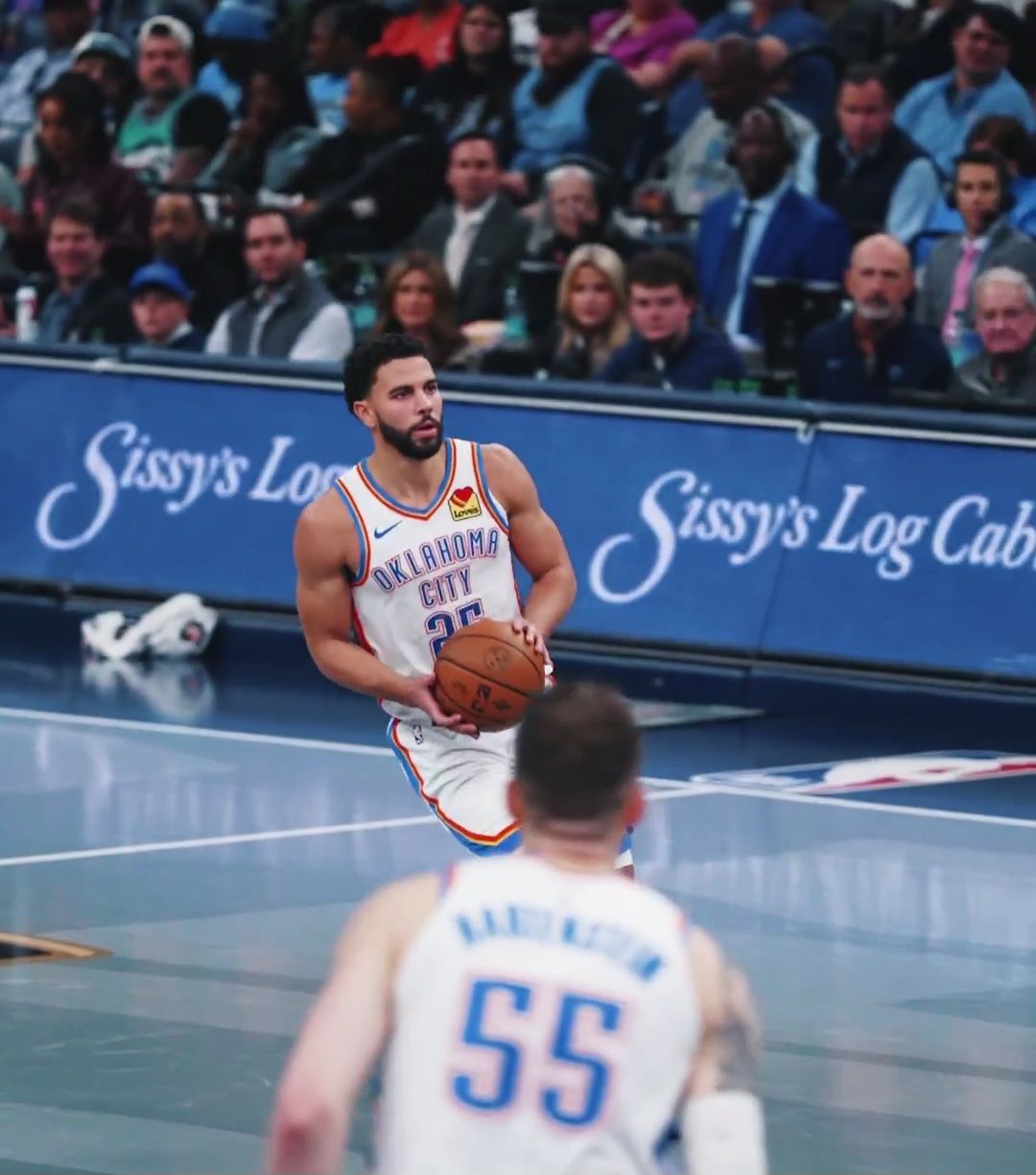
The Oklahoma City Thunder entered Memphis without the frontcourt personnel they would normally rely on to handle a physical opponent. They left FedExForum with a 31-point victory and another reminder that their identity doesn’t depend on having a complete roster.
Oklahoma City dismantled the Grizzlies 128-97 on Friday night, opening Emirates NBA Cup group play with an emphatic road performance. The Thunder shot an extraordinary 69% from three-point range in the first half, forced 18 Memphis turnovers, and converted those mistakes into 30 points. A 12-0 run in the third quarter turned an already commanding advantage into a blowout.
Shai Gilgeous-Alexander needed only 30 minutes to deliver 28 points and four assists. Ajay Mitchell stole the show with 35 points on 14-of-20 shooting, while Jared McCain added 21 points and four steals. Isaiah Hartenstein contributed six rebounds and seven assists, helping Oklahoma City find ways to punish Memphis without relying on traditional interior scoring.
The Thunder improved to 7-2 and opened tournament play with exactly the kind of statement that can matter when the Emirates NBA Cup standings are decided.
This wasn’t simply a good shooting night. It was a complete performance.
The 69% Flamethrower: Oklahoma City Set the Tone Early
The Thunder’s first-half shooting was ridiculous.
Oklahoma City connected on 69% of its three-point attempts before halftime, creating an offensive avalanche that left Memphis scrambling for answers. The Grizzlies were expected to have an advantage inside against an Oklahoma City roster dealing with significant frontcourt injuries. Instead, the Thunder used pace, spacing, and perimeter creation to make that advantage difficult to exploit.
The offensive approach forced Memphis to defend in space. Oklahoma City attacked openings, moved the ball, and created opportunities before the Grizzlies could establish their preferred defensive positioning.
Gilgeous-Alexander provided the familiar foundation, but the supporting cast made the difference in how overwhelming the first half became. Ajay Mitchell repeatedly attacked the defense, and the Thunder’s perimeter threats gave Memphis fewer opportunities to load up on Oklahoma City’s primary creator.
The highlight came in the second quarter, when Gilgeous-Alexander converted an and-one three-pointer. It was the kind of shot that can change the atmosphere in a road arena. Memphis was already trying to find an answer, and Shai made the challenge even more difficult.
Oklahoma City wasn’t just scoring. It was dictating how the game would be played.
Weaponizing the Defensive Scramble
The Thunder’s defensive performance was every bit as important as the shooting.
Oklahoma City forced 18 turnovers and turned those giveaways into 30 points. That combination is especially damaging against a team trying to use its size advantage. Every failed entry pass, loose handle, or disrupted possession gave the Thunder another opportunity to get out in transition.
The Thunder’s perimeter defenders played an important role in making that happen. Micah Peavy and Kenrich Williams were identified in the game plan as key pieces of the pressure, using their activity to disrupt passing lanes and make it difficult for Memphis to establish comfortable post touches.
That is the strategic advantage of an aggressive defensive system. Oklahoma City doesn’t necessarily need to match an opponent’s size possession after possession if it can prevent the opponent from getting into its preferred offense in the first place.
The Thunder made Memphis work to initiate its sets, challenged its passing windows, and turned defensive activity into offense.
The result was a Grizzlies team that struggled to establish consistency while Oklahoma City repeatedly found opportunities to attack before the defense could get set.
The Third-Quarter Dagger: A 12-0 Run Ends the Contest
The Thunder didn’t allow Memphis to believe it had a realistic path back into the game.
Oklahoma City opened the second half with a decisive 12-0 run, pushing the margin to a staggering 32 points and removing any remaining suspense.
The sequence was a continuation of what had worked throughout the first half. The Thunder moved the ball, attacked the defensive rotations, and took advantage of the openings created by Memphis’ attempts to recover.
It was also a demonstration of the team’s discipline. A large halftime lead can sometimes lead to a slower start after the break. Oklahoma City did the opposite, returning with the same urgency and execution that had produced its first-half advantage.
By the time the margin reached 32, the game had effectively been decided. The Thunder had put themselves in position to manage minutes and protect their primary rotation players ahead of Saturday’s matchup with Washington.
That fourth-quarter rest could prove valuable with the schedule demanding a quick turnaround.
Ajay Mitchell’s Breakout: A New Dimension for the Thunder
Gilgeous-Alexander was excellent, but the biggest individual story of the night was Ajay Mitchell.
Mitchell finished with a career-high 35 points on 14-of-20 shooting, delivering the kind of performance that changes the way opponents have to prepare for Oklahoma City.
His scoring wasn’t simply a matter of making open shots. Mitchell’s ability to attack the defense, get into the paint, and make plays against shifting coverage gave the Thunder another reliable offensive option.
The matchup with Memphis’ size is particularly interesting. Oklahoma City used screening actions to bring Zach Edey into space, creating opportunities for Mitchell and Gilgeous-Alexander to attack before the Grizzlies could recover.
That is a difficult assignment for a traditional center. When a big is pulled away from the basket and forced to defend in space, the offense can dictate the matchup rather than allowing the defense to dictate the terms.
Mitchell took advantage.
The 35-point performance also matters beyond one night. Oklahoma City has been built around the idea of having multiple players capable of creating advantages. Mitchell’s emergence gives the Thunder another potential source of offense, particularly when the roster eventually gets healthier and his responsibilities shift.
A young guard capable of producing this kind of scoring while maintaining efficiency is an important addition to an already talented rotation.
Shai’s Effortless Control
Gilgeous-Alexander finished with 28 points and four assists in just 30 minutes.
That stat line might look modest compared with his 42- and 43-point performances earlier in the week, but the context makes it impressive. Oklahoma City didn’t need him to carry the offense for 40 minutes. He established the tone, punished Memphis when the defense gave him opportunities, and allowed the supporting cast to take over as the lead expanded.
His second-quarter and-one three was a defining moment. It showcased the confidence and shot-making that make him so difficult to defend, while reinforcing that Memphis couldn’t afford to give him comfortable looks.
The most encouraging part for Oklahoma City was the balance. Gilgeous-Alexander didn’t have to force the issue because Mitchell and McCain were producing at a high level.
For a team with championship aspirations, that is an important distinction. The Thunder need Shai to be great, but they don’t need him to do everything.
McCain, Hartenstein and the Supporting Cast
Jared McCain added 21 points and four steals, providing another significant contribution on both ends of the floor.
His defensive activity helped fuel the turnover advantage, while his scoring gave Oklahoma City another perimeter threat. The combination was particularly valuable in a game where the Thunder needed contributions from multiple players to compensate for their frontcourt limitations.
Hartenstein’s impact was different.
He finished with two points, six rebounds, and seven assists. The seven assists stand out because they illustrate how Oklahoma City can use him as more than a traditional rebounder and interior finisher.
His passing from the high post helped keep the offense connected, creating opportunities for cutters and perimeter players. Against a defense that wanted to protect the paint, Hartenstein’s ability to facilitate from the middle of the floor gave the Thunder another way to create advantages.
The Thunder bench also contributed 38 points. That production is a major reason Oklahoma City was able to maintain its advantage without depending on its starters to carry the entire night.
The numbers behind the blowout
| Player | Production | Impact |
|---|---|---|
| Shai Gilgeous-Alexander | 28 PTS, 4 AST, +26 | Controlled the game in 30 minutes |
| Ajay Mitchell | 35 PTS, 14-20 FG | Career-high scoring performance |
| Jared McCain | 21 PTS, 4 STL | Scoring and defensive disruption |
| Isaiah Hartenstein | 2 PTS, 6 REB, 7 AST | High-post facilitator |
| Thunder bench | 38 PTS | Sustained the offensive advantage |
The Emirates NBA Cup Factor
The 31-point margin gives Oklahoma City an important opening in tournament play.
Point differential can matter in the Emirates NBA Cup group-stage tiebreaker scenarios, so a dominant win carries value beyond the result itself. The Thunder didn’t merely collect a victory. They established a substantial early advantage in the standings.
That makes the third-quarter push especially meaningful. Oklahoma City continued to build its lead rather than settling for simply protecting a comfortable margin.
The Thunder have made it clear that they intend to compete for the tournament, and this was an emphatic way to begin.
The Takeaway: The System Is the Advantage
Oklahoma City went into Memphis with significant frontcourt questions and came away with a 128-97 victory.
The Thunder shot 69% from three-point range in the first half, forced 18 turnovers, scored 30 points off giveaways, and used a 12-0 third-quarter run to turn a competitive opening into a blowout.
Gilgeous-Alexander was in complete control. Mitchell delivered a career night. McCain supplied scoring and defensive disruption. Hartenstein facilitated. The bench kept the pressure on.
That is the larger story.
The Thunder’s system is designed to create advantages through pace, pressure, spacing, and versatility. Those principles don’t disappear when a few key players are unavailable. In fact, this performance showed how effectively Oklahoma City can lean into them when circumstances demand something different.
The next challenge comes quickly. Oklahoma City returns home Saturday to face the Washington Wizards, with a short turnaround after its trip to Memphis.
The Thunder should have fresher legs than they otherwise might after the starters spent the fourth quarter watching the lead grow from the sideline.
For one night, though, the message was unmistakable: Oklahoma City doesn’t need a perfect roster to look like one of the best teams in basketball.