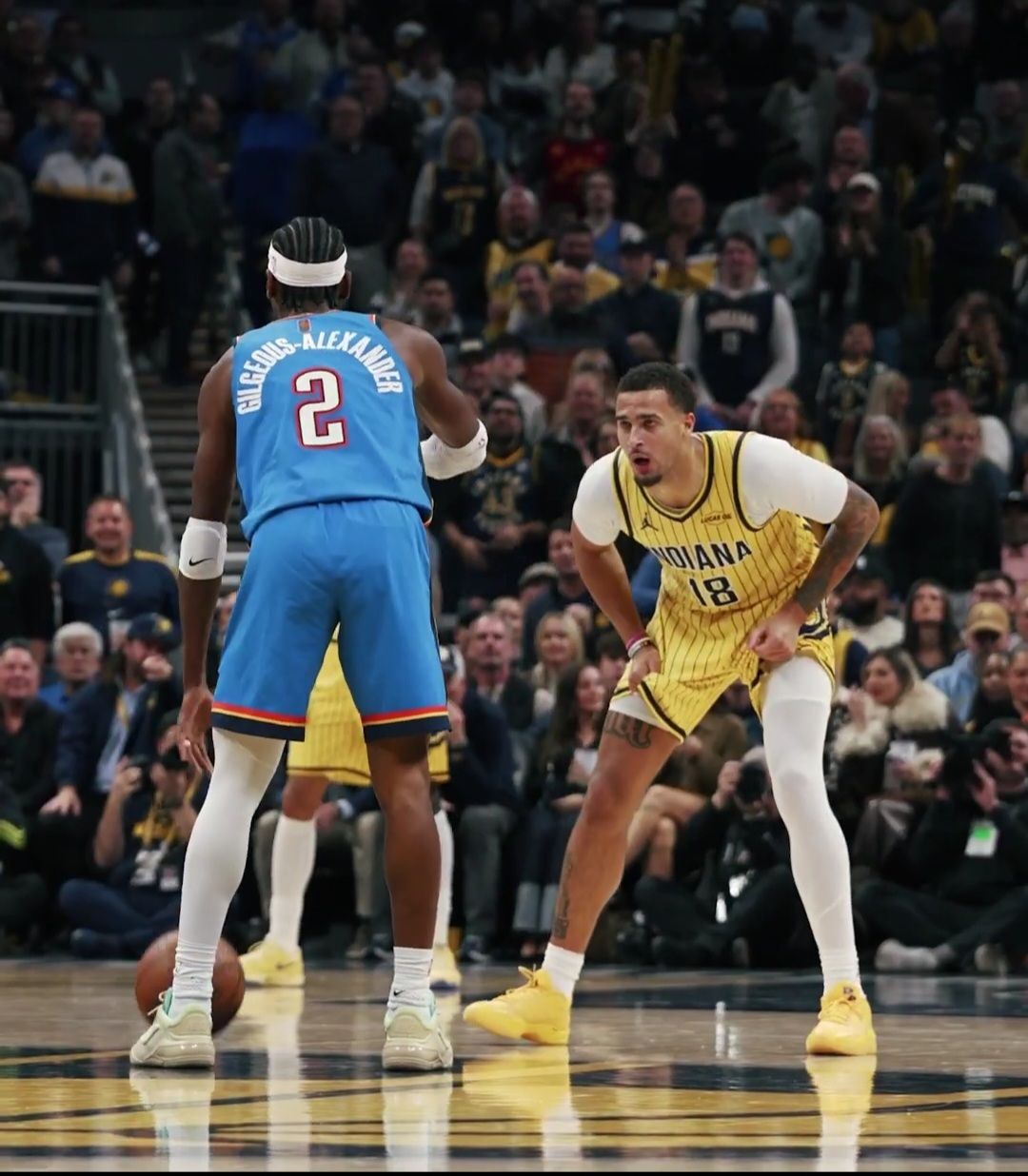
There is a difference between being impressed by a basketball team’s resilience and being comfortable with what that resilience is costing it.
Monday night in Indianapolis, the Oklahoma City Thunder showed plenty of the former. Playing with just 10 available players, they erased a 13-point deficit, battled their way back into contention, and had Indiana on its heels in the final two minutes. Kenrich Williams delivered a vintage performance. Shai Gilgeous-Alexander returned to the lineup and reminded everyone why he remains one of the most difficult players in basketball to defend.
And they still lost.
The Indiana Pacers walked away with a 125–120 victory, handing Oklahoma City its second consecutive defeat and sixth loss in its last eight games. The Thunder are now 10–8, a record that would have seemed almost unthinkable given the expectations surrounding this team entering the season.
Having slept on it, though, the final score isn’t what concerns me most.
It’s what Oklahoma City is having to ask of Shai Gilgeous-Alexander just to remain competitive.
The MVP Can’t Be the Emergency Plan
There is an uncomfortable irony in what happened Monday night.
Gilgeous-Alexander had just missed Oklahoma City’s previous game in Miami while nursing a low back contusion and neck strain, giving his body a brief breather during a demanding early-season stretch. It was a sensible decision, particularly with the bigger picture in mind.
Then he returned against Indiana and played 38 minutes, attempted 30 shots, and finished with a game-high 38 points, seven assists, and five rebounds.
That’s an outstanding individual performance. It’s also a reminder of just how much Oklahoma City is leaning on its franchise player right now.
SGA scored 13 points in the third quarter alone, helping keep the Thunder within striking distance after Indiana opened the second half with a 10–2 run. When the Pacers threatened to turn the game into a rout, he was the one keeping Oklahoma City alive.
But here’s the problem: Even a 38-point performance wasn’t enough.
When your best player has to shoulder that kind of offensive responsibility just to keep a shorthanded team within five points of a 6–12 opponent, something bigger is happening.
Nobody should be questioning Gilgeous-Alexander’s willingness to carry the load. That’s what superstars do. But the Thunder cannot afford to make that their nightly survival strategy.
The goal isn’t simply to get through November. It’s to have enough left in the tank when the games matter most.
You Can’t Outwork a Rebounding Problem
The other takeaway from Indianapolis is that Oklahoma City’s biggest problem right now isn’t necessarily its offense.
In fact, the Thunder did several things well offensively. They committed just six turnovers, went 19-of-21 at the free-throw line, and received a season-high 20 points from Kenrich Williams.
Under normal circumstances, that combination gives you a pretty good chance of winning a road game.
But basketball is a possession game, and Indiana found a way to take more of them.
The Pacers outrebounded Oklahoma City 58–49 and collected 20 offensive rebounds. Ivica Zubac alone grabbed eight offensive boards, finishing with 14 points and 15 rebounds. Jalen Slawson added a 16-point, 10-rebound double-double off the bench.
That’s where this game was lost.
Oklahoma City has built its identity around forcing turnovers, protecting the basketball, and making opponents work for everything. On Monday, the Thunder protected the ball beautifully. Unfortunately, they couldn’t finish defensive possessions.
Giving up 20 offensive rebounds is a possession problem every bit as damaging as turning the basketball over 20 times.
And it’s difficult to separate that problem from the names currently occupying Oklahoma City’s injury report.
Chet Holmgren, Jaylin Williams, and Aday Mara were all unavailable. That’s an enormous amount of size and frontcourt depth missing from a roster that suddenly has very few answers when opponents establish themselves around the basket.
Isaiah Hartenstein battled for 18 points and nine rebounds. Kenrich Williams contributed nine rebounds of his own. The effort was there.
But there is only so much a coaching staff can do with the personnel available.
Mark Daigneault can adjust rotations, experiment with different combinations, and ask his younger players to absorb additional minutes. He cannot manufacture seven-footers out of thin air.
At some point, the problem isn’t coaching or effort. It’s personnel.
There Are Positives. They Just Don’t Change the Math.
That doesn’t mean there weren’t encouraging signs Monday night.
Kenrich Williams deserves considerable credit for what he provided. His season-high 20 points, nine rebounds, and four three-pointers were exactly the kind of contribution Oklahoma City needed. He brought physicality, energy, and a willingness to do the dirty work.
Jared McCain and Ajay Mitchell also continue to gain valuable experience in expanded roles. Isaiah Hartenstein remains an important stabilizing presence, and the Thunder’s young rotation players are being forced to grow up quickly.
Those things matter.
There is something to be said for a team that refuses to fold despite having so many important pieces unavailable. Oklahoma City could have packed it in after falling behind by 13 in the third quarter. Instead, it fought back, briefly tied the game at 98, and made Indiana earn the victory.
But moral victories don’t count in the Western Conference standings.
The Thunder are 2–6 over their last eight games. At some point, the conversation has to move beyond how hard they’re competing and toward what needs to change to start winning again.
The Clock Is Ticking on This Injury Stretch
The good news is that Oklahoma City doesn’t have to abandon its identity or reinvent its approach. This is still a talented basketball team with an established system and a franchise player capable of taking over games.
The concern is how much that system is being asked to compensate for the players who aren’t available.
Wednesday night brings the 13–5 Minnesota Timberwolves to Paycom Center for an important NBA Cup West Group B matchup. There isn’t much recovery time, and there certainly isn’t an opportunity to ease into the next challenge.
The Thunder need contributions from everyone available, but more importantly, they need bodies back.
I’m not suggesting Oklahoma City needs to panic and make a trade. It’s too early to make that kind of declaration, particularly when several of the missing pieces are expected to be part of the long-term rotation.
But the front office and coaching staff have to recognize what these last eight games are showing them.
This roster is capable of competing with just about anyone when it’s healthy. Right now, though, the margin for error has become dangerously thin.
Monday night was a reminder of both sides of that equation. The Thunder have enough fight to make a game out of almost anything. They don’t currently have enough healthy bodies to consistently finish the job.
And that’s a difficult combination to sustain over an 82-game season.
Shai Gilgeous-Alexander can score 38. Kenrich Williams can turn back the clock. Mark Daigneault can keep finding creative ways to piece together a rotation.
But none of those things can replace a healthy frontcourt.
The Thunder don’t need their superstar to become a superhero every night. They need to get healthy enough that he doesn’t have to.
Because the biggest concern coming out of Indianapolis isn’t that Oklahoma City lost another game.
It’s that the team may be asking too much of the player it can least afford to wear down.