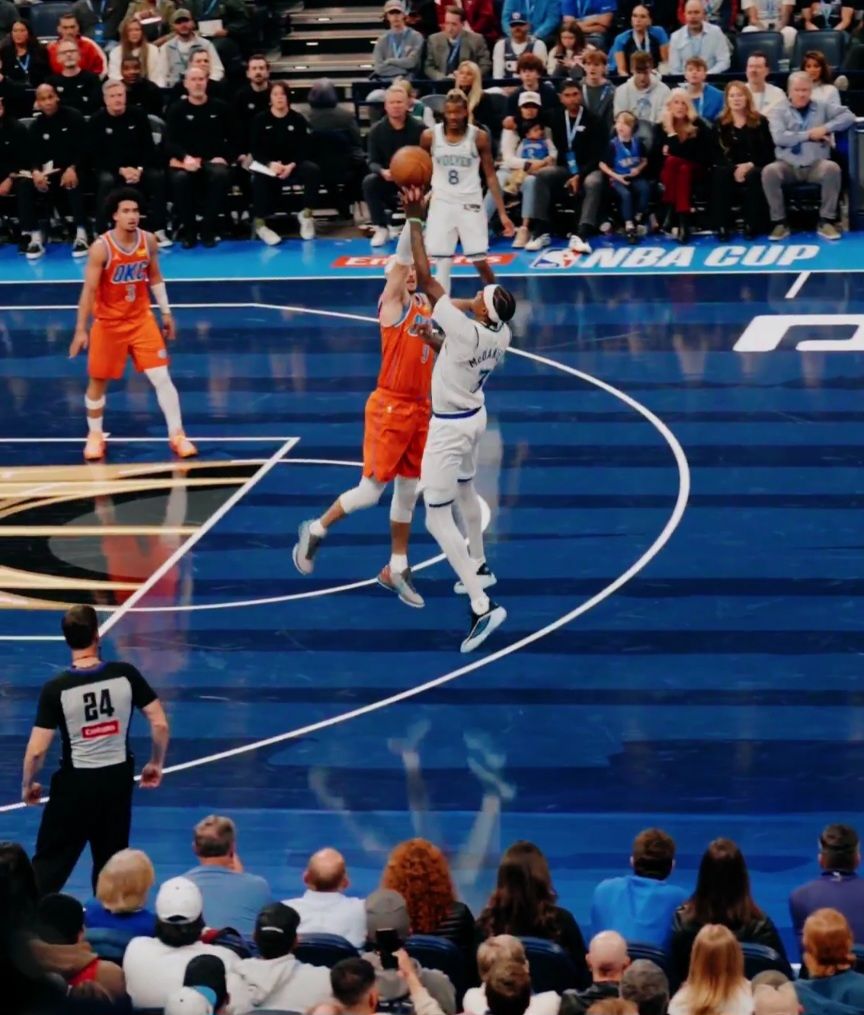
Oklahoma City had the momentum, the lead, and an opportunity to close out its NBA Cup group-stage schedule on a high note. Instead, the Thunder watched a promising night unravel in the third quarter, and despite a late push that nearly pulled them back from the brink, Minnesota walked out of Paycom Center with a 113–106 victory.
The Thunder fell to 10–9 overall and 2–2 in West Group B, losing their third consecutive game after building a 10-point lead midway through the third quarter. Shai Gilgeous-Alexander and Ajay Mitchell did everything they could to keep Oklahoma City in the fight, combining for 57 points, but the Thunder couldn’t withstand Minnesota’s perimeter shooting or Jaden McDaniels’ remarkably efficient performance.
McDaniels finished with 32 points and 10 rebounds, shooting 11-of-15 from the field and 4-of-5 from three-point range without committing a turnover. His production, coupled with Minnesota’s ability to capitalize on Oklahoma City’s third-quarter defensive breakdowns, proved to be the difference.
A Two-Man Offensive Carry Job Wasn’t Enough
For stretches of the night, Oklahoma City had the answer offensively, even without several key pieces of its rotation. Gilgeous-Alexander and Mitchell took turns attacking Minnesota’s defense, creating opportunities, and keeping the Thunder within striking distance when the game threatened to slip away.
Shai Gilgeous-Alexander: 32 points | 13-of-26 FG | 5 assists | 3 rebounds | 2 blocks
Gilgeous-Alexander once again shouldered the responsibility of being Oklahoma City’s primary offensive engine. He scored 32 points on 13-of-26 shooting, added five assists and three rebounds, and provided the offensive spark that helped the Thunder erase an early deficit and take control heading into halftime.
His second quarter was particularly important. After Oklahoma City struggled to find its footing in the opening frame, Gilgeous-Alexander found his rhythm, pouring in 12 points during the quarter, including nine in the final three minutes, helping turn a sluggish start into a six-point halftime advantage.
But this wasn’t a night when the Thunder could rely exclusively on their MVP-caliber guard to carry the offense.
Ajay Mitchell: 25 points | 11-of-19 FG | 2-of-5 3PT | 3 rebounds | 3 assists
Mitchell continued to demonstrate how much his game has evolved. The young guard finished with 25 points, shooting 11-of-19 from the field, and provided the complementary scoring punch Oklahoma City desperately needed.
His confidence was evident throughout the evening, and when the Thunder needed one more push in the fourth quarter, Mitchell delivered. His late three-pointer pulled Oklahoma City within one at 105–104, putting Minnesota on its heels and giving the Thunder a legitimate opportunity to steal the game.
The problem was that Minnesota had its own offensive centerpiece operating at an extraordinarily efficient level.
Jaden McDaniels: 32 points | 11-of-15 FG | 4-of-5 3PT | 6-of-6 FT | 10 rebounds | 5 assists | 0 turnovers
McDaniels wasn’t simply productive. He was devastatingly efficient.
The Minnesota forward converted 73.3% of his field-goal attempts, knocked down four of his five three-point attempts, made every free throw he attempted, and finished with a double-double. He also distributed five assists without a single turnover.
While Oklahoma City leaned heavily on Gilgeous-Alexander and Mitchell to manufacture offense, McDaniels consistently found ways to punish the Thunder’s defense without needing to force the issue.
The difference wasn’t that Oklahoma City lacked offensive production. It was that Minnesota’s offense found a way to generate efficient scoring from multiple areas, particularly when the Thunder’s defensive structure began to break down.
Oklahoma City Turned the Corner in the Second Quarter
The opening quarter offered little indication that the Thunder would eventually have a chance to win this game.
Oklahoma City struggled offensively, scoring just 16 points in the opening 12 minutes while Minnesota established a 26–16 advantage. The Thunder looked sluggish, struggled to find consistent rhythm, and spent the early stages trying to keep the deficit from growing.
The second quarter, however, was a completely different story.
Oklahoma City responded with a 37-point explosion, finding its offensive rhythm while tightening up enough defensively to reverse the momentum. Gilgeous-Alexander led the charge, particularly during the closing minutes of the half, while Alex Caruso provided the kind of defensive energy and connective play that helped the Thunder get back into the game.
By halftime, Oklahoma City had transformed a 10-point deficit into a 53–47 lead.
It was the kind of response that suggested the Thunder were finding their footing despite their depleted rotation. They had weathered the early storm, found ways to generate offense, and entered the second half with control of the scoreboard.
That control, unfortunately, wouldn’t last.
The Third Quarter Changed Everything
Oklahoma City appeared to be in position to take command of the game midway through the third quarter.
The Thunder pushed their advantage to 10 points, leading 73–63 after a Gilgeous-Alexander three-point play. At that moment, Oklahoma City had built a cushion, was playing with confidence, and seemed to have Minnesota searching for answers.
Instead, the Timberwolves found them.
Minnesota mounted a 24–10 run to close the third quarter, systematically erasing Oklahoma City’s advantage and reclaiming control of the game. The Thunder’s defensive execution deteriorated, the Timberwolves began finding open looks from the perimeter, and the momentum shifted dramatically.
The sequence culminated in a 26-foot three-pointer from McDaniels at the buzzer, giving Minnesota an 87–83 lead entering the fourth quarter.
The Thunder went from leading by 10 to trailing by four in the span of a quarter.
That stretch ultimately defined the game. Oklahoma City had spent the first half fighting its way back, only to surrender the momentum in a period where Minnesota’s shooting, execution, and offensive efficiency overwhelmed the Thunder.
The fourth quarter became an uphill battle.
The Numbers Tell the Story
Minnesota’s perimeter shooting was one of the most significant differences between the two teams.
- Minnesota: 17-of-39 from three-point range (43.6%)
- Oklahoma City: 11-of-33 from three-point range (33.3%)
The Timberwolves made six more three-pointers than the Thunder, and that difference was particularly damaging during the third-quarter surge.
Minnesota received contributions from multiple players beyond McDaniels. LaMelo Ball finished with 19 points, seven rebounds, and eight assists while knocking down five three-pointers. Ayo Dosunmu added 16 points and four triples, giving the Timberwolves another perimeter threat capable of stretching Oklahoma City’s defense.
Minnesota also controlled the glass, outrebounding Oklahoma City 50–40.
The Thunder were already operating without Chet Holmgren, Jalen Williams, Cason Wallace, and Aday Mara, who was sidelined with a shin contusion. Those absences left Oklahoma City short on both frontcourt depth and perimeter versatility, making the challenge of containing Minnesota’s offensive attack even more difficult.
Still, there were meaningful contributions from the players available.
Isaiah Hartenstein finished with eight points, 16 rebounds, six assists, and four offensive rebounds. His work on the glass and ability to facilitate from the interior helped Oklahoma City remain competitive.
Alex Caruso delivered 11 points, knocked down three of his five three-point attempts, recorded four blocks, and finished with a team-best plus-16. His defensive impact was evident throughout the game, and his willingness to do the dirty work helped Oklahoma City survive stretches when the offense wasn’t clicking.
Kenrich Williams added 13 points, made three of six attempts from beyond the arc, and recorded three steals. He was also involved in the closing sequence, when Oklahoma City had an opportunity to potentially force overtime.
The supporting cast wasn’t without contributions. The issue was that the Thunder needed nearly everything to go right in the closing minutes after allowing Minnesota to seize control.
A Late Rally Nearly Saved the Night
Oklahoma City refused to go quietly.
After falling behind during Minnesota’s third-quarter surge, the Thunder continued to fight in the fourth quarter, gradually chipping away at the deficit. Mitchell’s late three-pointer brought Oklahoma City within one at 105–104, giving the Thunder a chance to complete the comeback.
Minnesota was also dealt a late blow when Ball exited with a left ankle injury after landing on Hartenstein’s foot with less than 2:30 remaining.
The Thunder had an opening.
But the final possessions didn’t fall their way.
Oklahoma City kept fighting down the stretch, pulling within one at 105–104 on an Ajay Mitchell triple before Kenrich Williams missed an open three-pointer to take the lead. After Jaden McDaniels iced the game at the free-throw line with 14 seconds left, Shai Gilgeous-Alexander’s step-back three with seven seconds remaining came up empty, allowing Minnesota to hold on for a 113–106 victory.
NBA Cup Hopes and What’s Next
The loss leaves Oklahoma City at 10–9 overall and 2–2 in West Group B play, closing its group-stage schedule with a third consecutive defeat.
Minnesota improved to 14–5 overall and 3–0 in group play, strengthening its position in the NBA Cup standings.
For Oklahoma City, the tournament picture now becomes a matter of waiting and watching the remaining results, with any potential wild-card path dependent on how the rest of the Western Conference group standings shake out.
More immediately, the Thunder need to find a way to stop the slide.
Three consecutive losses have exposed some of the challenges facing a shorthanded roster, particularly when defensive execution falters and the margin for error becomes increasingly narrow. Gilgeous-Alexander continues to deliver, Mitchell is emerging as a legitimate scoring contributor, and several role players are providing valuable production.
But tonight demonstrated that offensive heroics alone aren’t enough.
The Thunder built a 10-point lead, surrendered a devastating third-quarter run, and spent the rest of the night chasing a game they had once controlled.
Now they have two full days to regroup before traveling to Milwaukee to face the Bucks on Saturday, November 28, at 7:00 p.m. CST.
The Thunder don’t need to reinvent themselves. They need to rediscover the defensive consistency, composure, and execution that made them so difficult to beat in the first place.
And right now, that matters more than anything happening in the NBA Cup standings.