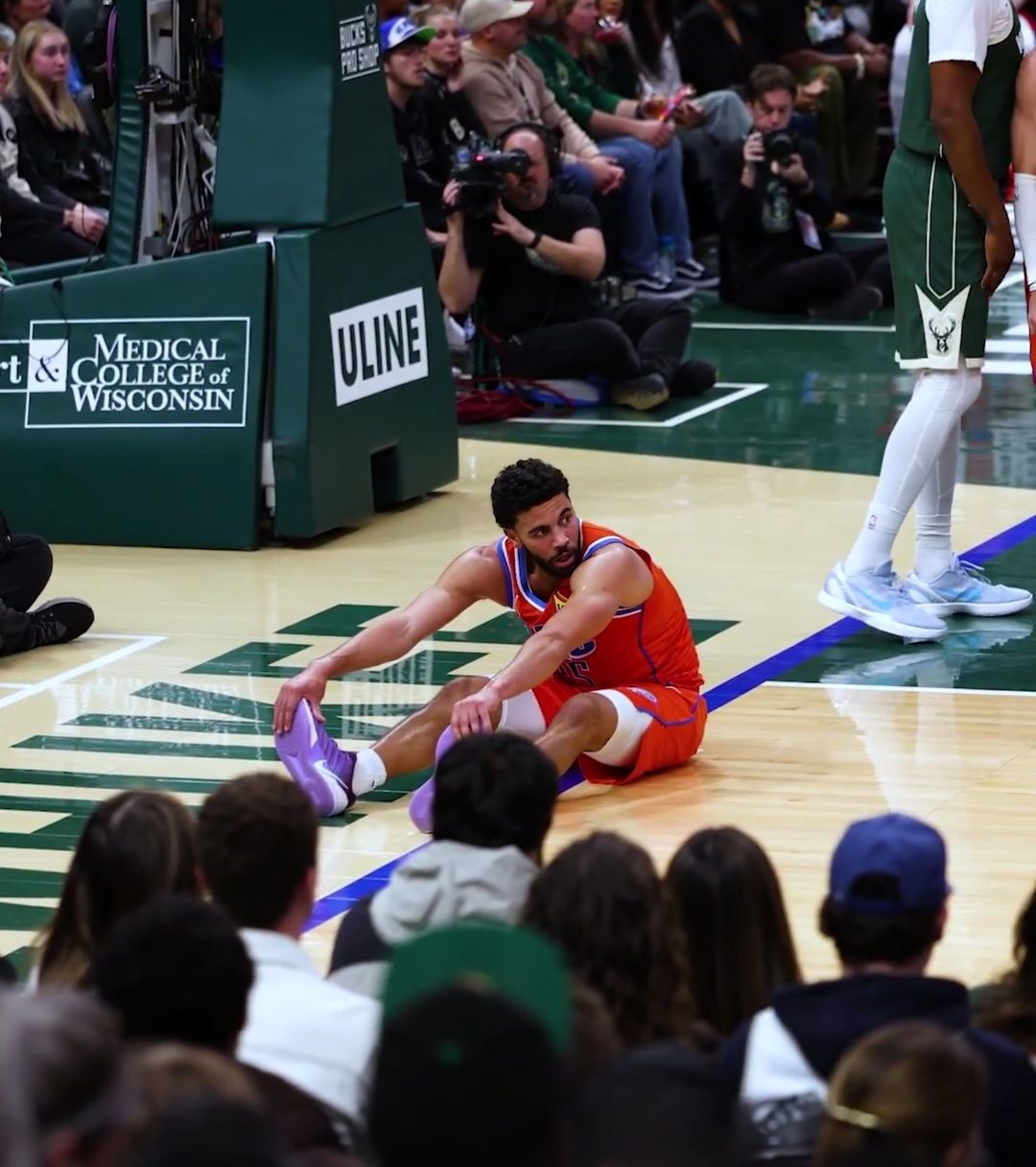
There was a time when a November loss to a struggling team barely registered on the Oklahoma City Thunder’s radar. A bad quarter could be corrected. A sluggish first half could be erased. Even a depleted lineup could usually find enough defensive resistance to keep an opponent from dictating the game.
Those days feel increasingly distant.
The Thunder are 10–10 after Saturday night’s 119–111 loss to the Milwaukee Bucks. They’ve lost four consecutive games, eight of their last 10, and now find themselves sitting at .500 for the first time since the 2023–24 season.
And this time, the most revealing part of the night didn’t happen during the game.
It happened afterward, when Shai Gilgeous-Alexander stopped pretending everything was fine.
“Quite frankly, we’re just not as good as we’ve been as a basketball team in recent years, and calling it what it is. We’re not firing on the same cylinder,” Gilgeous-Alexander said.
He also described this group as “a completely new basketball team” still trying to figure out how to play effectively together.
That’s an uncomfortable admission for a franchise that spent the better part of the last two seasons establishing itself as one of the NBA’s most complete teams. But it might also be the most important thing anyone associated with Oklahoma City has said during this losing streak.
Because the Thunder have a problem that extends beyond the injury report.
THE THIRD QUARTER IS BECOMING A SYMPTOM
For 24 minutes Saturday night, Oklahoma City looked capable of overcoming its personnel limitations.
The Thunder entered halftime with a 64–58 lead, having responded to a competitive opening quarter with a 38-point second period. Gilgeous-Alexander had 19 first-half points, and the offense was generating enough clean looks to keep Milwaukee on its heels.
They even managed to maintain their offensive discipline. Oklahoma City finished with 26 assists against just 10 turnovers and knocked down 18 of 43 attempts from three-point range.
Then the third quarter happened.
Milwaukee outscored Oklahoma City 34–18 in the period, transforming a six-point halftime deficit into a 92–82 advantage heading into the fourth. The Bucks didn’t need some extraordinary offensive performance to do it. They simply took advantage of a Thunder defense that couldn’t consistently keep the ball in front of it, protect the paint, or finish possessions.
And here’s the part that makes the collapse particularly frustrating: Milwaukee lost center Myles Turner early in the third quarter with a right knee sprain.
The Bucks were already short-handed. They were playing on the second night of a back-to-back. They entered the night with just two wins.
And they still found a way to put 34 points on Oklahoma City in a single quarter.
Kel’el Ware had the kind of night that should make the Thunder’s frontcourt situation impossible to ignore. The Milwaukee big man finished with a career-high 30 points and 13 rebounds, shooting 12-of-16 from the floor. Ryan Rollins added a season-high 28 points, knocking down seven three-pointers.
Oklahoma City had no consistent answer.
Some of that is personnel. Playing without Chet Holmgren, Jalen Williams, Cason Wallace, Jaylin Williams, and Aday Mara leaves a considerable hole in the rotation. There is no reasonable way to pretend those absences don’t matter.
But injuries explain why the margin for error is smaller. They don’t automatically explain why a team can play such a strong first half and then surrender control of the game so completely after halftime.
That is where the conversation has to move beyond who’s unavailable and toward what the players who are available are doing.
THE THUNDER HAVE LOST THEIR DEFENSIVE IDENTITY
Oklahoma City’s recent success wasn’t built exclusively on having more talent than the opposition.
It was built on making opponents uncomfortable.
The Thunder defended aggressively, pressured the basketball, disrupted passing lanes, protected the rim, and turned defensive stops into opportunities on the other end. Their identity was recognizable regardless of which player happened to be leading the scoring.
That identity is difficult to recognize right now.
Without Holmgren’s rim protection, the Thunder are asking Isaiah Hartenstein to handle an enormous amount of responsibility in the middle. Without Jalen Williams and Cason Wallace, the perimeter rotation loses two important defensive pieces. The absence of additional frontcourt options only compounds the problem.
Hartenstein finished with 12 rebounds, six offensive boards, and four assists against Milwaukee. He did his part on the glass, but he scored just two points on 1-of-7 shooting. More importantly, Oklahoma City couldn’t consistently prevent Milwaukee from taking advantage of its size and athleticism.
The Bucks outrebounded the Thunder 51–42.
That’s not simply a matter of missing one player. It’s a reflection of how difficult it has become for Oklahoma City to control the physical areas of the game without its regular frontcourt rotation.
And the perimeter defense wasn’t much better.
Rollins went 7-of-12 from beyond the arc. Rookie Brayden Burries added 20 points. Former Thunder forward Ousmane Dieng contributed 13 points, nine rebounds, and nine assists.
Those are significant contributions from a Milwaukee team that entered the night with a 2–18 record.
The Thunder can point to the injuries, and rightfully so. But at some point, the remaining players have to establish a defensive standard that doesn’t disappear when the rotation changes.
Right now, that standard isn’t holding.
THE FREE-THROW NUMBERS ARE MORE THAN A STATISTICAL ANOMALY
There was another number Saturday night that deserves more attention than it might initially receive.
Milwaukee attempted 27 free throws.
Oklahoma City attempted nine.
The Bucks converted 19 of those attempts, while the Thunder made just five. That’s a 14-point advantage at the free-throw line in an eight-point game.
It’s difficult to overcome that kind of disparity, particularly when the team giving away those opportunities is also struggling to protect the paint.
Gilgeous-Alexander finished with 31 points on 13-of-27 shooting, added eight assists, and knocked down four three-pointers. Yet he attempted just two free throws.
That’s an unusual statistical outcome for a player whose ability to pressure the defense and get to the basket is such a significant part of his offensive value.
The larger concern is what the disparity says about the way Oklahoma City is currently playing.
The Thunder shot 41.9% from three-point range. They moved the basketball, protected possession, and generated enough perimeter production to score 111 points on the road.
But Milwaukee consistently found ways to attack the basket, draw contact, and put pressure on Oklahoma City’s interior defense.
The Thunder, meanwhile, had too many stretches where the offense depended on making jump shots.
Ajay Mitchell was an exception. He continued to impress with 24 points on 9-of-14 shooting, six assists, and four rebounds. Alex Caruso added 13 points off the bench, connecting on three of his six attempts from deep.
But when the game became physical, Milwaukee had the advantage.
That’s a difficult way to win consistently in the NBA, especially with the personnel Oklahoma City currently has available.
THERE ARE ENCOURAGING SIGNS, BUT THEY DON’T ERASE THE PROBLEM
It would be unfair to suggest there was nothing positive to take from Saturday night.
Mitchell continues to look increasingly comfortable with a larger offensive responsibility. His 24-point performance was another reminder that Oklahoma City may have found an important piece for its future, particularly when injuries force him into a more prominent role.
Caruso provided veteran stability and finished with 13 points, four assists, and three steals. Nique Clifford also contributed nine points on 4-of-5 shooting in limited minutes.
And Gilgeous-Alexander remains Gilgeous-Alexander.
He scored 31 points, distributed eight assists, and made four three-pointers. He also provided the late push that brought Oklahoma City within two points at 105–103 in the fourth quarter.
The Thunder had opportunities to make the game uncomfortable for Milwaukee down the stretch. They simply couldn’t finish the job.
That’s been the story of this stretch.
There are individual performances worth celebrating. There are young players gaining valuable experience. There are legitimate explanations for why this roster doesn’t resemble the one that dominated opponents over the previous two seasons.
But none of those things changes the standings.
Oklahoma City is 10–10. It’s lost four straight. It’s 2–8 over its last 10 games.
The Thunder have gone from looking like a team capable of controlling the Western Conference to one trying to find its footing before the end of November.
That’s a significant change, and Gilgeous-Alexander understands it.
THE REPUTATION DOESN’T WIN GAMES
Perhaps the most important part of Gilgeous-Alexander’s comments was his willingness to acknowledge that this team isn’t currently operating at the level of its predecessors.
That doesn’t mean the Thunder have suddenly become a bad basketball team. It doesn’t mean their championship aspirations should be abandoned in November. And it certainly doesn’t mean the return of several key players won’t change the complexion of this roster.
But the past two seasons don’t guarantee anything about the next five months.
The habits that made Oklahoma City successful have to be demonstrated again. The defensive intensity has to return. The physicality has to improve. The team has to find a way to generate offense beyond relying on difficult perimeter shots.
Most importantly, the Thunder have to stop allowing one bad stretch to dictate the outcome of an entire game.
Monday night’s trip to Brooklyn provides the next opportunity. The Nets won’t care that Oklahoma City is missing several important players, and another loss would only deepen the concerns surrounding this stretch.
The Thunder don’t need to panic. They don’t need to abandon their identity or start questioning everything that has made this organization successful.
But they do need to be honest about what they’re watching on the floor.
Gilgeous-Alexander was honest Saturday night.
This isn’t the same basketball team we’ve watched over the past two seasons. The chemistry isn’t there. The defensive consistency isn’t there. And the results certainly aren’t there.
The encouraging part is that Oklahoma City still has time, talent, and players who know what winning basketball looks like.
The discouraging part is that knowing what it looks like and actually playing it are two very different things.
The Thunder have spent the last two seasons making opponents figure out how to beat them. Right now, they’re the ones searching for answers.