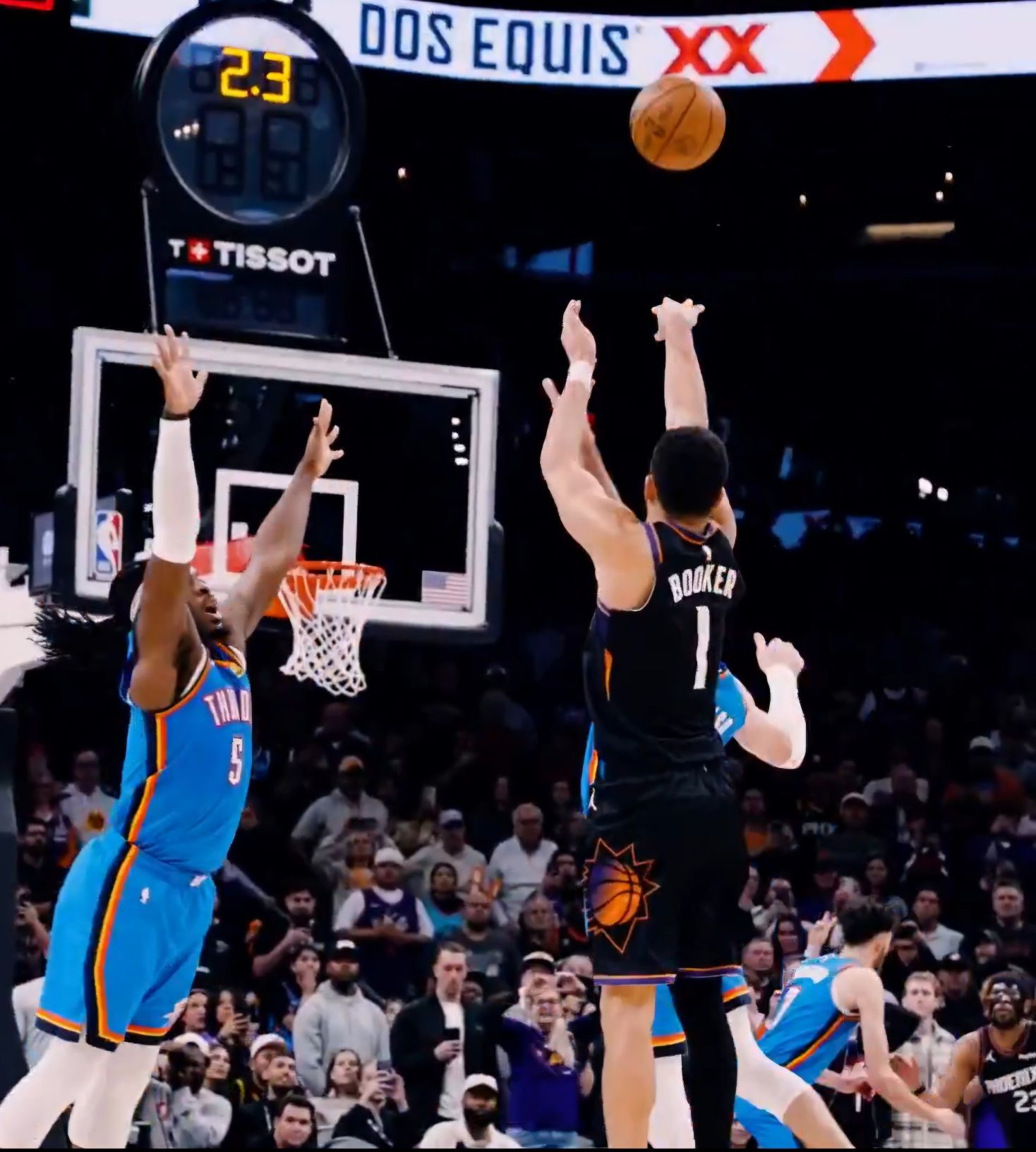
The box score will remember Sunday night in Phoenix for one thing: Devin Booker rising over a contest and burying a game-winning three with 0.7 seconds left. That image will live in highlight reels and late-night recaps, neatly packaged as “one of those nights” for the Oklahoma City Thunder.
But if you strip the emotion out of the moment and dig into the advanced numbers, a different story emerges — one that has very little to do with hero shots and everything to do with possessions, margins, and the hidden math that decides close NBA games.
Oklahoma City didn’t lose because it panicked. It didn’t lose because it turned the ball over. It didn’t lose because its stars were inefficient or overwhelmed. In fact, by several core efficiency measures, the Thunder played well enough to win.
And yet, they didn’t.
That contradiction is precisely why this loss matters — and why it’s instructive rather than alarming.
The Game Within the Game: Possessions Over Points
Advanced analytics start from a simple truth: basketball games are decided by possessions, not raw point totals. Points are the outcome; possessions are the currency.
On Sunday night, both teams played exactly 94 possessions. That matters, because it removes pace as a variable. This was not a game Phoenix stole by speeding things up or slowing them down. It was a straight-up efficiency battle — and Phoenix won it in subtle but decisive ways.
Oklahoma City finished with a 112.1 offensive rating, meaning it scored just over 112 points per 100 possessions. That’s a solid number. On most nights, paired with OKC’s defensive identity, that’s enough to win.
Phoenix, however, posted a 115.3 offensive rating, and that gap — just over three points per 100 possessions — mirrors the final margin almost perfectly.
This wasn’t about one possession. It was about Phoenix squeezing slightly more value out of nearly every trip down the floor.
Turnovers: When Winning the Obvious Battle Isn’t Enough
If you were asked before the game which team would win if one committed turnovers on just 9.6% of possessions, you’d take that team every time. That’s elite ball security — championship-level discipline.
That team was Oklahoma City.
Phoenix, meanwhile, turned the ball over on 16% of its possessions, a number that normally spells trouble against a defense as active and opportunistic as the Thunder’s.
And yet, the Suns won.
This is where analytics challenge intuition. Turnovers matter — but only if you capitalize on the possessions they give you. Oklahoma City took care of the ball beautifully, but it did not convert that advantage into a decisive scoring edge. Phoenix, for its part, compensated for its sloppiness in other ways — and those ways proved more impactful.
The Real Story: Offensive Rebounding as a Weapon
If there is one number from this game that deserves to be framed and hung in the Thunder film room, it’s this:
Phoenix offensive rebound percentage: 24.5%
Oklahoma City offensive rebound percentage: 6.9%
That disparity is enormous.
In practical terms, Phoenix rebounded nearly one out of every four missed shots on its own end. Oklahoma City rebounded fewer than one out of fourteen.
That difference did three critical things:
- Extended Phoenix possessions, allowing the Suns to survive cold stretches and reset their offense.
- Neutralized Oklahoma City’s turnover advantage, effectively replacing lost possessions with second chances.
- Compressed late-game margins, keeping Phoenix within striking distance long enough for Booker’s shot to matter.
This is where the game was truly decided. Not on the final shot — but on the cumulative effect of Phoenix refusing to let possessions die.
Advanced stats don’t care how pretty the shot was. They care that Phoenix simply had more opportunities to score meaningful points.
Shot Quality Over Shot Volume
Another subtle edge shows up in effective field goal percentage (eFG%), which accounts for the added value of three-pointers.
Phoenix: .551
Oklahoma City: .537
That’s not a massive gap, but in a game decided by three points, it’s meaningful. Phoenix didn’t just make shots — it made slightly better shots, particularly from deep. The Suns’ willingness to keep firing, even after misses, paid off because offensive rebounds allowed them to hunt high-value attempts without fear of wasted possessions.
Oklahoma City, by contrast, played cleaner basketball — but cleaner doesn’t always mean more dangerous.
Individual Efficiency: Stars Did Their Jobs
One of the most important takeaways from the advanced efficiency numbers is that this was not a failure of Oklahoma City’s stars.
Shai Gilgeous-Alexander carried a heavy offensive load with a true shooting percentage around .584 — not elite by his standards, but efficient given the volume and defensive attention he faced. His assist-to-turnover ratio remained positive, reinforcing that he controlled the game rather than forcing it.
Jalen Williams was outstanding by the numbers. A true shooting percentage north of .750 is exceptional efficiency, especially for a player combining scoring and playmaking responsibilities. His turnovers mattered, but they did not outweigh the offensive value he provided.
Chet Holmgren, meanwhile, posted one of the quietest efficient games you’ll see in a loss. His ~.759 TS%, rim protection, and finishing efficiency were exactly what Oklahoma City needed — and exactly what makes the rebounding disparity so glaring. When a team gets that level of efficiency from its center and still loses the possession battle, the problem isn’t talent.
It’s leverage.
Where the Margins Slipped
This game exposed something subtle about Oklahoma City’s current construction: it is elite at controlling mistakes, but still learning to control physical margins.
The Thunder defended well. They moved the ball. They avoided self-inflicted wounds. But Phoenix outworked them in the least glamorous area of the sport — the one that rarely makes highlight packages but decides close games with ruthless consistency.
Offensive rebounding is not about size alone. It’s about timing, intent, and collective commitment. Phoenix crashed selectively, decisively, and without hesitation. Oklahoma City, comfortable in its defensive structure, paid the price.
Why This Loss Shouldn’t Worry the Thunder — But Should Educate Them
For a lesser team, this loss might raise alarms. For Oklahoma City, it should sharpen focus.
The advanced numbers show a team that played winning basketball in most controllable areas — ball security, shot efficiency, star production — and still lost because it surrendered the possession battle.
That’s fixable.
And perhaps more importantly, it’s instructive. The Thunder don’t need to reinvent their offense or question their stars. They need to recognize that in the playoffs — where margins shrink and possessions become precious — second chances are oxygen.
Phoenix didn’t steal this game. It earned it by manufacturing extra opportunities.
The difference between dominance and defeat in the NBA is rarely dramatic. More often, it’s mathematical.
And Sunday night, the math caught up to Oklahoma City.
Follow us on Instagram & Facebook