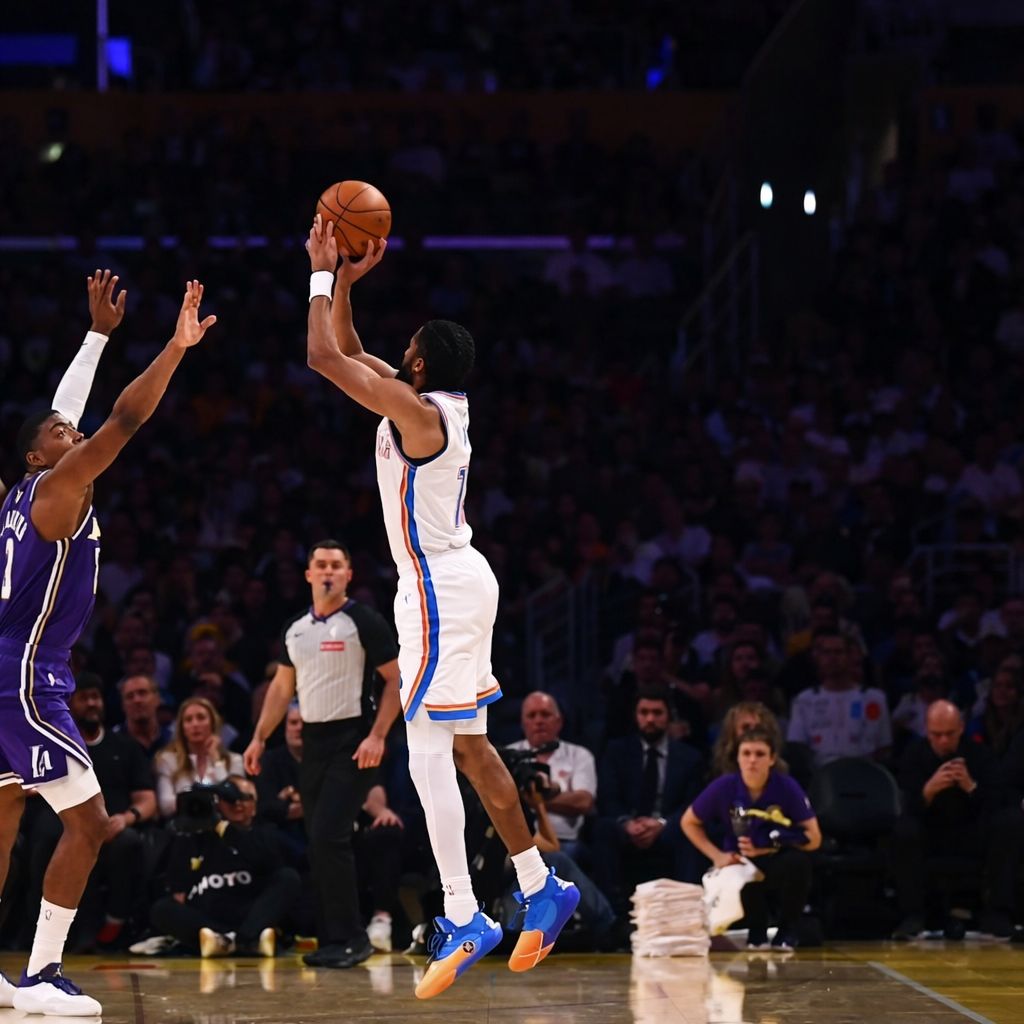
Oklahoma City’s 119–110 victory over the Lakers on Monday night was an unmistakable confirmation. Not because it was clean — it wasn’t. Not because it was dominant from start to finish — it wasn’t that either. But because it answered a question the Thunder have been inviting all season without ever asking out loud.
What happens when the MVP isn’t there?
The answer, delivered over 48 increasingly revealing minutes at Crypto.com Arena, was simple and unsettling for the rest of the league: Oklahoma City keeps coming. And it doesn’t need perfect conditions to do it.
This game arrived with built-in excuses on both sides. No Shai Gilgeous-Alexander for the Thunder. No Luka Dončić for the Lakers. A nationally televised matchup stripped of its headline stars, reduced instead to structure, depth, and execution. Those are the kinds of games contenders win quietly and pretenders lose loudly.
Oklahoma City won it decisively.
The Thunder snapped a two-game skid not by hunting a savior, but by rediscovering their spine. Seven players scored in double figures. The bench outscored Los Angeles by 17 points. The defense strangled the Lakers in the fourth quarter, holding them to 19 points when the game was still undecided. And when it finally came time to close, Jalen Williams — back after missing ten games with a hamstring injury — didn’t hesitate.
That matters more than the box score.
Because the defining opinion from this game isn’t about shooting percentages or plus-minus columns. It’s about sustainability. Oklahoma City didn’t win because someone went nuclear. They won because their identity didn’t flicker under pressure.
The Lakers, for a brief stretch in the third quarter, made this uncomfortable. A 22–3 run erased an 11-point Thunder lead and reminded everyone why LeBron James still bends games with gravity alone. Marcus Smart hit shots. Austin Reaves found seams. The building woke up. For a few minutes, it felt like Oklahoma City might let go of the rope.
That’s when the game pivoted — not on a run, but on a single possession.
Alex Caruso’s buzzer-beating three at the end of the third quarter didn’t just reclaim the lead. It reclaimed control. It stopped the bleeding, re-centered the Thunder, and carried a quiet message: you’re going to have to beat us with precision, not momentum.
The Lakers couldn’t.
The fourth quarter was where Oklahoma City revealed its most championship-ready trait — emotional neutrality. No panic. No overreaction. Just possession-by-possession discipline. They switched with purpose. They rebounded like it mattered. They trusted the pass even when the shot didn’t immediately present itself.
And when the game tightened — when Los Angeles briefly took a 99–98 lead — the Thunder responded with an 11–2 run that felt inevitable once it started. Cason Wallace fought for an offensive rebound that turned into points. Jaylin Williams spaced the floor. Isaiah Joe punished hesitation. Chet Holmgren erased mistakes with length and timing.
This is the part that should unsettle opponents: Oklahoma City’s margin for error doesn’t shrink when stars are missing. It shifts.
Without Gilgeous-Alexander, the Thunder didn’t try to mimic his offense. They didn’t force isolation or hunt mismatches they couldn’t consistently win. Instead, they leaned harder into their ecosystem — spacing, pace, trust, and relentless defensive activity. The result wasn’t spectacular basketball. It was mature basketball.
That distinction matters.
Jalen Williams’ return was the emotional headline, and deservedly so. Ten of his 23 points came in the fourth quarter, including a pull-up jumper over Austin Reaves that functioned as a dagger in everything but name. That shot wasn’t flashy. It was authoritative. It said, “We’re done here,” without raising its voice.
Williams didn’t hijack the game. He closed it.
That’s the difference between talent and readiness.
The Thunder’s bench dominance told an even louder story. Isaiah Joe’s 19 points came within the flow, not outside of it. Alex Caruso’s 17 points — against his former team — came paired with a game-high plus-minus and a defensive edge that never dulled. This wasn’t a revenge game. It was a reminder of why Oklahoma City coveted him in the first place.
Caruso didn’t just make shots. He stabilized moments.
Chet Holmgren’s stat line won’t headline national shows, but his impact sealed the game. His put-back dunk with 1:17 remaining wasn’t about athleticism; it was about presence. He read the moment, attacked the glass, and removed hope from the building. That’s playoff basketball in February.
Meanwhile, the Lakers looked exactly like a team still searching for its ceiling. LeBron James was excellent — 22 points, 10 assists, six rebounds — but excellent wasn’t enough. The Lakers needed someone else to bend the game when Oklahoma City tightened the screws. They didn’t have it. Their fourth-quarter offense devolved into late-clock attempts and contested jumpers, the exact shots the Thunder want opponents to settle for.
And that’s where the comparison becomes unavoidable.
Oklahoma City doesn’t rely on urgency to defend. It doesn’t rely on emotion to execute. It relies on habits. The Thunder defend like they expect resistance. They rebound like they’re offended by second chances. They close games like they’ve been there before.
LeBron said it plainly after the game: “That’s a championship team… they can sustain energy and effort for 48 minutes.”
That wasn’t flattery. It was recognition.
The most important takeaway from this win isn’t that Oklahoma City can survive without its MVP — we already knew that. It’s that the Thunder don’t lose themselves when circumstances shift. Their offense doesn’t collapse into hero ball. Their defense doesn’t soften when the margin tightens. Their bench doesn’t treat minutes like a favor.
Everything is earned. Everything is connected.
At 41–13, Oklahoma City didn’t need this game for validation. But the rest of the league needed to see it. Because wins like this don’t announce themselves loudly. They sit in the film room. They linger in scouting reports. They become the reason teams tighten rotations a little earlier than they want to.
This wasn’t a signature win because of who wasn’t on the floor. It was a signature win because of what stayed intact.
The Thunder didn’t just beat the Lakers. They reminded everyone watching what real sustainability looks like. And as the calendar inches closer to spring, that reminder carries weight.
Oklahoma City didn’t solve anything Monday night. They confirmed it.
Follow us on Instagram & Facebook