If Saturday was the gut punch and Sunday was the steadying breath, then Monday feels like the first real test of whether this model—our stripped-down, sharpened V3.0 “Specialist”—actually has staying power.
Because let’s be honest: a 7–5 bounce-back doesn’t erase a -13.8% return overnight. It doesn’t magically fix a 44–45–1 playoff record. What it does do is give us something we haven’t had in a few days—traction. And in the volatility of the NBA postseason, traction is everything.
Sunday mattered not just because we won, but because how we won finally aligned with what this model is built to do: identify physical mismatches, trust usage consolidation, and stop chasing emotional narratives.
The San Antonio sweep of the board—moneyline, spread, and total—wasn’t luck. It was a blueprint. And now, with a three-game Monday slate featuring wildly different scenarios—a 2-1 series tilt in Orlando, a potential sweep in Phoenix, and a desperate elimination game in Denver—we find out if that blueprint travels.
Game 4: Detroit Pistons at Orlando Magic
Series: Orlando leads 2-1
This is where things get uncomfortable for the model—and that’s exactly why it’s valuable.
The market still leans toward Detroit as the “better team.” The No. 1 seed. The superior regular-season profile. The presumed stabilizer in a chaotic series.
But V3.0 doesn’t care about résumés anymore. It cares about what’s actually happening between the lines.
And right now? Orlando is winning the fight.
The Magic’s Game 3 win wasn’t a fluke. It was a statement of physical control—dominating the glass, clogging the paint, and forcing Detroit into a one-dimensional offense built almost entirely around Cade Cunningham. That’s not sustainable playoff basketball, especially on the road.
This is where the “Usage Surge” component cuts both ways. Yes, Cunningham’s volume is elite. But when that usage creeps toward predictability—and there’s no secondary scoring to relieve pressure—it becomes easier to scheme against in late-game situations.
Orlando, meanwhile, doesn’t need a singular star explosion. They’re winning with balance, length, and interior discipline. They’ve turned this series into a half-court grind, and Detroit hasn’t shown it can consistently win that style away from home.
The Pick:
- Moneyline: Orlando Magic
- Spread: Magic +2.5
- Total: Under 214.5
Why it works:
This is a textbook V3.0 spot—home team controlling the paint, dictating tempo, and forcing the opponent into high-usage inefficiency. Until Detroit proves it can win the physical battle, laying points on the road is a losing proposition.
Game 4: Oklahoma City Thunder at Phoenix Suns
Series: Oklahoma City leads 3-0
This is the most dangerous game on the board—not because of uncertainty, but because of certainty. The kind that tempts you into overthinking.
The Oklahoma City Thunder have been the most dominant team in this series, full stop. Three games, three convincing wins, and a matchup advantage that Phoenix hasn’t come close to solving.
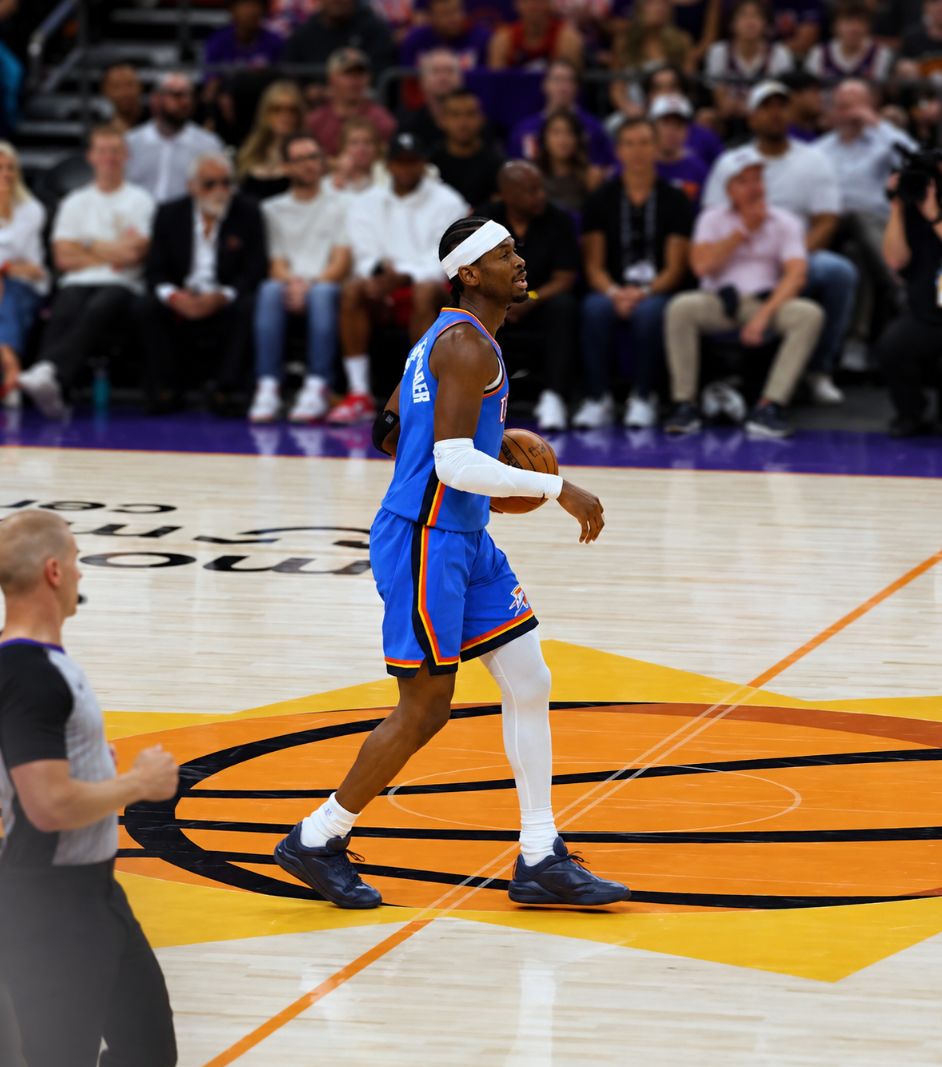
It starts—and ends—with Shai Gilgeous-Alexander.
When a player is operating at this level of control and efficiency, the “Usage Surge” isn’t just a factor—it’s a foundation. Phoenix has thrown multiple looks at him. None have worked. And without interior resistance or consistent secondary scoring, the Phoenix Suns are running out of counters.
Now, traditionally, this is where bettors get nervous. The “3-0 Trap.” The idea that a team might ease off the gas, that the desperate home team finds one last push.
V3.0 acknowledges that risk—but it doesn’t overvalue it.
Because there’s a difference between desperation and capability.
Phoenix may have the former. They haven’t shown the latter.
Even with Oklahoma City missing a key piece in Jalen Williams, their depth, defensive structure, and perimeter pressure have completely suffocated Phoenix’s rhythm. This isn’t a series hanging in the balance—it’s one being methodically closed.
The Pick:
- Moneyline: Thunder
- Spread: Thunder -10.5
- Total: Under 216.5
Why it works:
The model isn’t guessing about motivation—it’s measuring dominance. And right now, OKC’s defensive ceiling and SGA’s offensive floor create a margin that Phoenix simply hasn’t approached.
Game 5: Minnesota Timberwolves at Denver Nuggets
Series: Minnesota leads 3-1
This is where V3.0 earns its paycheck.
Because this game is a contradiction on the surface.
The Minnesota Timberwolves are up 3-1. They’ve controlled large stretches of the series. They’ve found unexpected production, including explosive performances from role players stepping into expanded roles.
But the deeper you dig, the more fragile that advantage looks.
Minnesota is no longer the same team that built this lead. Injuries have stripped away their offensive identity, leaving them reliant on high-variance performances and unsustainable efficiency spikes.
Enter Denver.
The Denver Nuggets aren’t just desperate—they’re structurally positioned to respond. This is where the “Matchup Edge” reasserts itself, anchored by Nikola Jokić, who now faces a depleted frontcourt and a compromised perimeter defense.
Yes, Denver has struggled on the glass in stretches. Yes, the Rebounding Floor penalty is in play. But V3.0 isn’t static—it adjusts for context.
And the context here is simple: Minnesota doesn’t have the firepower to sustain a 3-1 closeout on the road at altitude without its primary offensive engines.
Meanwhile, Denver’s historical resilience in elimination scenarios isn’t just narrative—it’s supported by execution. This is a team that understands how to extend a series, especially at home.
The Pick:
- Moneyline: Nuggets
- Spread: Nuggets -11.5
- Total: Under 222.5
Why it works:
This is the intersection of desperation and matchup reality. Denver’s interior advantage, combined with Minnesota’s injury-driven offensive ceiling, creates a scenario where the favorite doesn’t just win—they separate.
The Bigger Picture: Why This Slate Matters
Monday isn’t just another day in the playoffs—it’s a stress test.
Three games. Three different psychological environments:
- A tight, physical series in Orlando
- A potential sweep in Phoenix
- An elimination fight in Denver
And yet, the same principles apply across all three.
That’s the difference now.
We’re no longer chasing trends or overreacting to one-night anomalies. We’re not patching emotional leaks with arbitrary adjustments. We’ve stripped the model down to what actually translates in playoff basketball:
- Who controls the glass
- Who dictates usage
- Who can sustain their edge under pressure
Sunday showed that this approach can stabilize results. Monday will tell us if it can build momentum.
Because climbing out of a -13.8% hole doesn’t happen in one night.
It happens with disciplined edges, one slate at a time.
Follow us on Instagram & Facebook
One Reply to “Picking the Playoffs: V3.0 Finds Its Footing as Game 5 Pressure Reshapes the Board”